Amazon, “Economic Terrorism” and the Destruction of Competition and Livelihoods
By Colin Todhunter | OffGuardian | August 30, 2021
Global corporations are colonising India’s retail space through e-commerce and destroying small-scale physical retail and millions of livelihoods.
Walmart entered into India in 2016 with a US$3.3 billion take-over of the online retail start-up Jet.com. This was followed in 2018 with a US$16 billion take-over of India’s largest online retail platform, Flipkart. Today, Walmart and Amazon control almost two thirds of India’s digital retail sector.
Amazon and Walmart have a record of using predatory pricing, deep discounts and other unfair business practices to attract customers to their online platforms. A couple of years ago, those two companies generated sales of over US$3 billion in just six days during Diwali. India’s small retailers reacted by calling for a boycott of online shopping.
If you want to know the eventual fate of India’s local markets and small retailers, look no further than what US Treasury Secretary Steven Mnuchin said in 2019. He stated that Amazon had “destroyed the retail industry across the United States.”
AMAZON’S CORPORATE PRACTICES
In the US, an investigation by the House Judiciary Committee concluded that Amazon exerts monopoly power over many small- and medium-size businesses. It called for breaking up the company and regulating its online marketplace to ensure that sellers are treated fairly.
Amazon has spied on sellers and appropriated data about their sales, costs and suppliers. It has then used this information to create its own competing versions of their products, often giving its versions superior placement in the search results on its platform.
The Institute for Local Self-Reliance (ILSR) published a revealing document on Amazon in June 2021 that discussed these issues. It also notes that Amazon has been caught using its venture capital fund to invest in start-ups only to steal their ideas and create rival products and services.
Moreover, Amazon’s dominance allows it to function as a gatekeeper: retailers and brands must sell on its site to reach much of the online market and changes to Amazon’s search algorithms or selling terms can cause their sales to evaporate overnight.
Amazon also makes it hard for sellers to reduce their dependence on its platform by making their brand identity almost invisible to shoppers and preventing them from building relationships with their customers. The company strictly limits contact between sellers and customers.
According to the ILSR, Amazon compels sellers to buy its warehousing and shipping services, even though many would get a better deal from other providers, and it blocks independent businesses from offering lower prices on other sites. The company also routinely suspends sellers’ accounts and seizes inventories and cash balances.
The Joint Action Committee against Foreign Retail and E-commerce (JACAFRE) was formed to resist the entry of foreign corporations like Walmart and Amazon into India’s e-commerce market. Its members represent more than 100 national groups, including major trade, workers’ and farmers’ organisations.
JACAFRE issued a statement in 2018 on Walmart’s acquisition of Flipkart, arguing that it undermines India’s economic and digital sovereignty and the livelihoods of millions in India. The committee said the deal would lead to Walmart and Amazon dominating India’s e-retail sector. It would also allow them to own India’s key consumer and other economic data, making them the country’s digital overlords, joining the ranks of Google and Facebook.
In January 2021, JACAFRE published an open letter saying that the three new farm laws, passed by parliament in September 2020, centre on enabling and facilitating the unregulated corporatisation of agriculture value chains. This will effectively make farmers and small traders of agricultural produce become subservient to the interests of a few agrifood and e-commerce giants or will eradicate them completely.
Although there was strong resistance to Walmart entering India with its physical stores, online and offline worlds are now merged: e-commerce companies not only control data about consumption but also control data on production and logistics. Through this control, e-commerce platforms can shape much of the physical economy.
What we are witnessing is the deliberate eradication of markets in favour of monopolistic platforms.
BEZOS NOT WELCOME
Amazon’s move into India encapsulates the unfair fight for space between local and global markets. There is a relative handful of multi-billionaires who own the corporations and platforms. And there are the interests of hundreds of millions of vendors and various small-scale enterprises who are regarded by these rich individuals as mere collateral damage to be displaced in their quest for ever-greater profit.
Thanks to the helping hand of various COVID-related lockdowns, which devastated small businesses, the wealth of the world’s billionaires increased by $3.9tn (trillion) between 18 March and 31 December 2020.
In September 2020, Jeff Bezos, Amazon’s executive chairman, could have paid all 876,000 Amazon employees a $105,000 bonus and still be as wealthy as he was before COVID. Jeff Bezos – his fortune constructed on unprincipled methods that have been well documented in recent years – increased his net wealth by $78.2bn during this period.
Bezos’s plan is clear: the plunder of India and the eradication of millions of small traders and retailers and neighbourhood mom and pop shops.
This is a man with few scruples. After returning from a brief flight to space in July, in a rocket built by his private space company, Bezos said during a news conference:
I also want to thank every Amazon employee and every Amazon customer because you guys paid for all of this.”
In response, US congresswoman Nydia Velazquez wrote on Twitter:
While Jeff Bezos is all over the news for paying to go to space, let’s not forget the reality he has created here on Earth.”
She added the hashtag #WealthTaxNow in reference to Amazon’s tax dodging, revealed in numerous reports, not least the May 2021 study ‘The Amazon Method: How to take advantage of the international state system to avoid paying tax’ by Richard Phillips, Senior Research Fellow, Jenaline Pyle, PhD Candidate, and Ronen Palan, Professor of International Political Economy, all based at the University of London.
Little wonder that when Bezos visited India in January 2020, he was hardly welcomed with open arms.
Bezos praised India on Twitter by posting:
Dynamism. Energy. Democracy. #IndianCentury.”
The ruling party’s top man in the BJP foreign affairs department hit back with:
Please tell this to your employees in Washington DC. Otherwise, your charm offensive is likely to be waste of time and money.”
A fitting response, albeit perplexing given the current administration’s proposed sanctioning of the foreign takeover of the economy, not least by the unscrupulous interests that will benefit from the recent farm legislation.
Bezos landed in India on the back of the country’s antitrust regulator initiating a formal investigation of Amazon and with small store owners demonstrating in the streets. The Confederation of All India Traders (CAIT) announced that members of its affiliate bodies across the country would stage sit-ins and public rallies in 300 cities in protest.
In a letter to PM Modi, prior to the visit of Bezos, the secretary of the CAIT, General Praveen Khandelwal, claimed that Amazon, like Walmart-owned Flipkart, was an “economic terrorist” due to its predatory pricing that “compelled the closure of thousands of small traders.”
In 2020, Delhi Vyapar Mahasangh (DVM) filed a complaint against Amazon and Flipkart alleging that they favoured certain sellers over others on their platforms by offering them discounted fees and preferential listing. The DVM lobbies to promote the interests of small traders. It also raised concerns about Amazon and Flipkart entering into tie-ups with mobile phone manufacturers to sell phones exclusively on their platforms.
It was argued by DVM that this was anti-competitive behaviour as smaller traders could not purchase and sell these devices. Concerns were also raised over the flash sales and deep discounts offered by e-commerce companies, which could not be matched by small traders.
The CAIT estimates that in 2019 upwards of 50,000 mobile phone retailers were forced out of business by large e-commerce firms.
Amazon’s internal documents, as revealed by Reuters, indicated that Amazon had an indirect ownership stake in a handful of sellers who made up most of the sales on its Indian platform. This is an issue because in India Amazon and Flipkart are legally allowed to function only as neutral platforms that facilitate transactions between third-party sellers and buyers for a fee.
UNDER INVESTIGATION
The upshot is that India’s Supreme Court recently ruled that Amazon must face investigation by the Competition Commission of India (CCI) for alleged anti-competitive business practices. The CCI said it would probe the deep discounts, preferential listings and exclusionary tactics that Amazon and Flipkart are alleged to have used to destroy competition.
However, there are powerful forces that have been sitting on their hands as these companies have been running amok.
In August 2021, the CAIT attacked the NITI Aayog (the influential policy commission think tank of the Government of India) for interfering in e-commerce rules proposed by the Consumer Affairs Ministry.
The CAIT said that the think tank clearly seems to be under the pressure and influence of the foreign e-commerce giants.
The president of CAIT, BC Bhartia, stated that it is deeply shocking to see such a callous and indifferent attitude of the NITI Aayog whch have remained a silent spectator for so many years when:
…the foreign e-commerce giants have circumvented every rule of the FDI policy and blatantly violated and destroyed the retail and e-commerce landscape of the country but have suddenly decided to open their mouth at a time when the proposed e-commerce rules will potentially end the malpractices of the e-commerce companies.”
Of course, money talks and buys influence. In addition to tens of billions of US dollars invested in India by Walmart and Amazon, Facebook invested US$5.5 billion last year in Mukesh Ambani’s Jio Platforms (e-commerce retail). Google has also invested US$4.5 billion.
Since the early 1990s, when India opened up to neoliberal economics, the country has become increasingly dependent on inflows of foreign capital. Policies are being governed by the drive to attract and retain foreign investment and maintain ‘market confidence’ by ceding to the demands of international capital which ride roughshod over democratic principles and the needs of hundreds of millions of ordinary people. ‘Foreign direct investment’ has thus become the holy grail of the Modi-led administration and the NITI Aayog.
The CAIT has urged the Consumer Affairs Ministry to implement the draft consumer protection e-commerce rules at the earliest as they are in the best interest of the consumers as well as the traders of the country.
Meanwhile, the CCI probably will complete its investigation within two months.
Colin Todhunter specialises in development, food and agriculture and is a Research Associate of the Centre for Research on Globalization in Montreal.
U.S. Government Stats on COVID Vaccines: 13,627 Deaths 2,826,646 Injuries 1,429 Fetal Deaths
By Brian Shilhavy | Health Impact News | August 30, 2021
According to the most recent stats released by the CDC this past Friday, August 27, 2021, their Vaccine Adverse Event Reporting System (VAERS) now has recorded more than twice as many deaths following COVID-19 shots during the past 8 and a half months, than deaths recorded following ALL vaccines for the past 30 years.
This has to be the most censored information in the U.S. right now, even though these statistics come directly from official government statistics.
They have now recorded 13,627 deaths, 2,826,646 injuries, and 1,429 fetal deaths from pregnant women who took a COVID shot.
They also report 17,794 permanent disabilities, 74,369 emergency room visits, 55,821 hospitalizations, and 14,104 life threatening events. (Source.)
And all of this has happened in just over 8 months.
From January 1, 1991 to November 30, 2020, the last month before the COVID shots were given emergency use authorization, there were only a total of 6,068 deaths recorded (mostly infant babies) following ALL vaccines. (Source.)
The Science of “Hope” – Biden Regime Promotes New Plan For Multiple Booster Shots Every Six Months in Perpetuity
THE LAST REFUGE | August 25, 2021
The Biden administration is on the precipice of announcing mandatory six month booster shots for people who have already had the vaccine. The reason? Data from Israel is showing that vaccinated populations are, for yet unknown reasons, more susceptible to even worse infections from the Delta variant.
It appears, from the early data, that once you take the vaccine you put your immune system into a state of perpetual dependency requiring booster shots to chase the variants every six months. Without the boosters, the hospitalization rates amid the vaccinated population appear worse than non-vaccinated. Delta hits the vaccinated population harder than Alpha, and Lambda will likely hit the vaccinated population harder than Delta…. and so it goes, and so it appears it will continue.

The Daily Beast outlined a foreboding article yesterday with the overarching message that America had better prepare for this quickly based on the Israeli data. The Israeli scientists call the population who have taken the vaccine+booster the “ultra-vaccinated”, and unfortunately it appears those ultra-vaccinated patients are now on course to require frequent booster updates as their immune system is now mRNA dependent to battle the evolving COVID variants.
FTA – […] Asked what has brought Israel to peak transmission even as the country has already provided third doses of vaccines to 1.5 million citizens, Rahav, who has become one of the best known faces of Israel’s public health messaging, sighed, saying, “I think we’re dealing with a very nasty virus. This is the main problem—and we’re learning it the hard way.” (read more)
Metaphorically, a drug user chasing a “high” trains his/her brain to become dependent or addicted in order to retain that altered mental state, so too does the COVID vaccination regime appear to place the patient into an dependent state for their immune system.
However, on the positive side (for those vaccinated) the Biden administration appears to be gearing up to deliver this booster process on a long-term basis.
The Biden administration is planning to announce updated guidance recommending a third dose of Pfizer or Moderna’s vaccine be given to Americans very six months after their second dose (instead of eight months), according to The Wall Street Journal. Right now, the final plan is still being worked out, and will need to be approved by the CDC’s vaccine advisory team, essentially controlled by vaccine makers, along with the FDA (also controlled by vaccine makers).
As soon as the pharmaceutical industry tells the Biden administration what to do, the CDC will begin pushing the booster shots onto the vaccinated population.
There is no actual science behind this process, but then again, there hasn’t really been any science behind any of it; so don’t worry, just take the next shot and await further instructions. However, if this process is put into place, it would appear that the vaccination passports will have an expiration date.
WASHINGTON DC – […] The Biden administration and vaccine companies have said that there should be enough supply for boosters that they plan to begin distributing more widely on Sept. 20. The U.S. has purchased a combined 1 billion doses from Pfizer and Moderna.
A White House spokesman declined to comment. An FDA spokeswoman declined to comment on interactions with vaccine manufacturers. (read more)
You will notice the institutions of Healthcare have now stopped using the term “follow the science.” One of the reasons they have dropped that terminology is apparently because they change the ‘science‘ on a week to week basis.
CDC Director Rochelle Walensky was recently asked if her agency was giving current guidance to the public based on “the data” or based on arbitrary “hope” that they will be correct and their guidance will help people.
Director Walensky was honest in her reply: “… So there’s actually hope, [because] we don’t have data yet…”
It is very comforting to know that “hope” is guiding the decision-making of those who are injecting substances into the global population without any idea what the long-term ramifications might be….
… Then again, if you really believed that human existence was the cause of harm to this planet; and saving the planet was the #1 priority of your community; then removing the harm would be for the greater good. Personally, while I hate to be argumentative, I would respectfully disagree with people who prefer my death in order to save the world. But, to be fair, that’s just me being selfish.
I am reminded of the words from a carnival operator I heard as a child as we approached the turnstiles of the roller coaster. Apparently the young lady at the front of the line had said something to him as we all waited for the next car to arrive. I did not hear the question, but his reply was:
“… Well Miss, once you get on the ride – you ain’t getting off ’til the ride’s over.“
Those words stuck in my mind as I pulled down the retaining bar. And as my life has rattled, wobbled and squeeked toward unknown destinations, I have often found a reason to reference them.
US Drone Strike in Kabul Kills Nine Members of Single Family, Including 6 Kids
by Asya Geydarova – Sputnik – 30.08.2021
The death toll from a US airstrike that targeted a vehicle in the Afghan capital of Kabul on Sunday has gone up to nine, all members of the same family, a relative of those killed told CNN.
A brother of one of the dead told a journalist working with CNN on Sunday that they were “an ordinary family,” not affiliated with Daesh.
There are six children, including his four-year-old sister Armin, 3-year-old brother Benyamin, and two two-year-old sisters Ayat and Sumaya among those killed, the man said, as he reportedly cried.
Earlier, US central command spokesman Capt. Bill Urban said that a drone strike was carried out on Sunday on a vehicle in Kabul, eliminating a Daesh-K threat to the airport.
“We are still assessing the results of this strike,” Urban said, adding that “it is unclear what may have happened,” and the US military is investigating further.
Afghan media reported on Sunday that at least four children were killed in the airstrike that destroyed two vehicles and part of a residential building. CBS said that the size of the secondary explosion suggests that the US strike destroyed a fully loaded car bomb, and did not just kill a suicide bomber riding in the car.
On Saturday, US Army Maj. Gen. William Taylor said that two Daesh-K leaders were killed and another was injured in a US airstrike in the Nangarhar province of Afghanistan.
On Friday, the White House admitted a breakdown in the security process that allowed the Thursday suicide bombing at the Kabul airport, which reportedly killed at least 182, including 13 US troops. The attack, claimed by Daesh-K, comes amid a chaotic US evacuation from Afghanistan following the Taliban’s* takeover of Kabul on August 15.
While the Biden administration has come under fire from both Democrats and Republicans over the evacuation of American forces and Afghans from Kabul, netizens have slammed US media for hypocritical reporting on the situation in Afghanistan.
This comes amid allegations by the media, citing locals, that Afghans killed in the attack on August 26 were shot dead by American soldiers in the panic following the explosion.
US drone operations targeting terrorists in countries have been deemed highly controversial due to reported civilian deaths, which military chiefs define as “collateral damage”. Casualties among civilians became publicly known due to independent investigations and information disclosed by whistleblowers. Last month, ex-US Air Force analyst Daniel Hale was given a prison sentence after leaking classified intel on US drone strikes from his deployment to Afghanistan that reportedly killed innocent people, including children.
What is Behind Algeria’s Severance of Diplomatic Ties with Morocco?
By Vladimir Odintsov – New Eastern Outlook – 29.08.2021
“Algeria has decided to sever diplomatic relations with the Kingdom of Morocco as of August 24,” Algerian Foreign Minister Ramdan Lamamra told a news conference, accusing the neighboring kingdom of “hostile actions.” Although the termination of diplomatic relations has already taken effect, consulates in each country will nevertheless remain open, Ramtane Lamamra said. Algeria is considering suspending air traffic with Morocco, according to the newspaper Algérie Patriotique.
Algeria accused Rabat (capital of Morocco) of threatening stability and security at the instigation of Israel. Morocco is increasing its military presence on the borders, and some regional observers have assessed that tensions could lead to military clashes.
Morocco’s foreign ministry said it regretted the “unjustified decision” and said it would remain a “reliable and loyal partner” to the Algerian people.
Relations between Algeria and Morocco have been tense for the past few decades, with the border between the countries closed since 1994. One of the reasons for the tensions is disagreement over Western Sahara: Morocco considers this territory its own, and Algeria has supported the Polisario Front for decades, insisting on the establishment of the Sahrawi Arab Democratic Republic (SADR). This dispute is also reflected in the current history of the breakdown of diplomatic relations: Algeria has also accused official Rabat of failing to honor its bilateral commitments on the Western Sahara issue.
Further escalation of tensions between the two states over this issue largely occurred late last year for two reasons. In November, after years of relative quietness, the pro-independence Polisario Front announced that it was re-arming. In December 2020, the United States recognized Moroccan sovereignty over Western Saharain exchange for improved relations between Rabat and Israel. The problem of Western Sahara is now challenging to solve, as both countries have strong positions. Algeria’s capacity to assist Polisario Front remains. This conflict will last for many years, and this should be the starting point.
Moreover, in mid-August, Algeria accused Morocco of “supporting two terrorist movements” operating on Algerian territory: the Movement for the Autonomy of Kabylia (MAK) and the opposition Rashad movement. Algerian authorities believe the activists of these organizations were involved in the forest fires last month in northern Algeria. These fires have already killed about 90 people, and the country’s government has repeatedly claimed that arson was the cause of the disaster. Algeria had previously reported the arrest of 61 people on suspicion of involvement in the fires in the country, stressing that the detainees belong to two specified terrorist groups backed by Israel and Morocco. According to local media reports, some of those arrested admitted their membership in the MAK. Algeria had already recalled its Ambassador from Rabat in July after a Moroccan diplomat in New York expressed support for the right of the Kabylian people to self-determination. For those reasons, Algeria’s Supreme Security Council had already considered reviewing relations with Morocco on August 18.
Overall, the Israeli factor has played a significant role in the current context of deteriorating relations between the two countries in North Africa. Last year, Morocco became one of the Arab countries that concluded peace agreements with Israel under Washington’s influence. As part of an agreement to normalize relations, the US, which mediated the talks, agreed to recognize Morocco’s sovereignty over Western Sahara, which caused resentment in Algeria and increased criticism of Washington. At the end of July this year, Algeria opposed Israel’s accession to the African Union as an observer country for the first time since 2002, carried out with Morocco’s support. Earlier, in 2002, Israel was expelled from the union on the initiative of Libya.
Moreover, the Algerian authorities, who do not officially recognize Israel, reacted negatively to the remarks of the Israeli Foreign Minister Yair Lapid during his recent visit to Morocco. He expressed concern about the role of Algeria in the region, “veiled threats” to Algeria, and pointed out his fears about Algeria’s rapprochement with Iran.
Algerian Foreign Minister Ramdan Lamamra has also accused Morocco of using Pegasus spyware to spy on several Algerian officials. According to him, “Morocco has massively and systematically committed acts of espionage against Algerian citizens and officials.”
But behind all these accusations, there is a clear opposition of the current Algerian authorities to Washington’s attempts through Israel and Morocco to prevent Algeria from strengthening its leading role in the Maghreb and cause political instability in the country. An undoubtedly real impetus for the aggravation of Algeria’s relations with Morocco was the African Lion 2021, a military exercise conducted by the US command in North Africa from June 7 to June 18, 2021. Military Watch, an American magazine specializing in military analysis, reported that these ground and air maneuvers simulated an attack in Algerian territories on two fictitious countries, Rowand and Nehone.
Therefore, the British publication Rai Al Youm noted for a reason that these military exercises were undertaken in preparation for an invasion of Algeria. The US believes that Algeria threatens its influence in Africa because it has gas, oil, water, and areas suitable for agriculture. In addition, Algeria covers an area of 2 million square kilometers, has extensive reserves of mineral resources, and its control of the Sahel region of Africa and its people is hard to beat. A European military expert said this in an interview with Rai Al Youm.
Under these circumstances, the Algerian leadership learned lessons from Colonel Muammar Gaddafi’s fatal mistakes. It became more critical of the policies towards Algeria on the part of the United States, Israel, Morocco, and several other states that had supported Washington’s plans to overthrow the Gaddafi regime it hated in the past. For this reason, Algeria has made it an absolute priority to create a strong army equipped with advanced land, air, and naval weapons and to develop military cooperation with Russia. As Rai Al Youm noted, the Algerian authorities have not trusted the West since the victory of the revolution over French colonialism. They are well aware of the plots being prepared against them. Algeria does not want to be the next target after Syria. Especially, according to Algeria, in the context of the ongoing preparations for the invasion and destruction of the countries in the League of the Arab States and the Persian Gulf countries. The United States, Great Britain, and France, which previously stood behind the conspiracies against Libya, Syria, and Iraq, sent NATO aircraft to bomb these countries, hiding behind loud statements about the “protection of democratic values.”
Twitter bans Alex Berenson over COVID tweets
By Cindy Harper | Reclaim The Net | August 29, 2021
Former New York Times reporter Alex Berenson has been permanently banned from Twitter for violating its COVID-19 “misinformation policies.”
The author has become well-known as a critic of coronavirus quarantines and mandates.
A Twitter spokesperson confirmed that the commentator’s account was blocked on Saturday due to “repeated violations.”
“The account you referenced has been permanently suspended for repeated violations of our COVID-19 misinformation rules,” the Twitter representative stated.
The journalist has repeatedly expressed his views about COVID-19, in particular the efficacy of the vaccines, but a recent tweet apparently triggered Twitter’s decision to ban him.
“It doesn’t stop infection or transmission,” stated the tweet, which casts doubt on vaccine effectiveness. “It doesn’t stop infection or transmission. Don’t think of it as a vaccine.”
“Think of it — at best — as a therapeutic with a limited window of efficacy and terrible side effect profile that must be dosed IN ADVANCE OF ILLNESS.”
Twitter later claimed the message was “misleading,” resulting in Berenson’s account being deactivated.
After being suspended from Twitter, Benson made an entry on Substack, a newsletter service, which featured the tweet that appears to have caused the issue.
In the post headlined “Goodbye Twitter,” Berenson wrote: “I am officially suspended. This was the tweet that did it. Entirely accurate. I can’t wait to hear what a jury will make of this. Meantime, guess you’ll be getting more Substacks.”
“We have reached a dangerous moment. Social media companies that have audiences which dwarf any other are now actively censoring reporters at the behest of governments,” Berenson said in a statement.
“I will continue to fight to get out the truth and am considering all legal options.”
Some are horrified the Taliban seized biometric devices. The real scandal is the extent of US’ data collection.
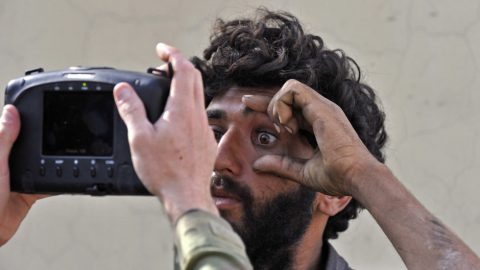
US soldier scans an Afghan resident with an Automated Biometric Identification System (ABIS) during a mission © AFP / TAUSEEF MUSTAFA
By Kit Klarenberg | RT | August 28, 2021
A huge amount of opprobrium was heaped on the Americans for allowing this sensitive data to fall ‘into the wrong hands’. However, surely a better question is why had they gathered all this deeply personal data in the first place?
It’s been reported that the Taliban has seized US military biometric devices in the wake of Washington’s flight from Afghanistan, which could put civilians who assisted coalition forces at significant risk.
The devices, known as HIIDE, for Handheld Interagency Identity Detection Equipment, contain identifying biometric data such as iris scans and fingerprints, as well as biographical information – while their primary stated purpose is to track insurgents, biometric data was also collected and stored on Afghans who assisted the US occupation forces.
The story sparked outcry, widely invoked by both opponents and advocates of the 20-year war as yet another deplorable example of Washington leaving its allies high and dry. While it seems clear there was no consideration given to what could happen if the technology fell into the ‘wrong’ hands, critics have nonetheless overwhelmingly failed to consider the terrifying ramifications of this data being in the right hands, and how the US came into possession of it in the first place.
When precisely the practice of collecting Afghans’ biometric data began isn’t certain, although at a 2010 conference in Kabul, US military officials laid out the terms of Afghan 1,000, a program which sought to collate information on 80% of the country’s population, around 25 million people. It was framed in extremely positive terms, not merely as a means to identify terrorists and criminals, but “enable progress in society” due to its “countless applications for the provision of services” to citizens.
It’s uncertain if that target was reached before Washington’s withdrawal, but the strategy remained in operation for over a decade. The next year, it was reported that Washington ultimately sought to gather biometric data on all living Afghans.
To achieve the lofty goal, a policy of mandatory data collection was imposed for every traveler entering the country via any means, and a dedicated Population Registration Department was created, with offices throughout the country. Even foreign journalists covering the war were fingerprinted, and their irises scanned. Moreover, occupation forces conducted innumerable “enrolment missions”, entering towns and villages and forcing locals to hand over their biometric data at literal gunpoint.
A US Army guide states emphatically that “all combat outposts and checkpoints throughout Afghanistan make it a priority to collect biometric data from as many local nationals as possible.” In the aftermath of a bombing or skirmish, soldiers are told to “enroll everyone”, including the dead, their DNA to be collected using buccal swabs to capture cells lining the mouth. The “payoff” for coalition forces was said to be so great, “commanders must be creative and persistent in their efforts to enroll as many Afghans as possible.”
In a section disturbingly titled “Population Management”, the guide recommends that everyone who lives within an operational area “should be identified and fully biometrically enrolled with facial photos, iris scans, and all ten fingerprints (if present).” Soldiers must also record “good contextual data” about individuals, such as “where they live, what they do, and to which tribe or clan they belong.” Citizens were to be told the collection protected them from potentially violent elements and troublemakers.
A lengthy article in the January 2014 edition of Military journal Joint Forces Quarterly offers a glowing appraisal of the “biometric-enabled intelligence” system rolled out in Kabul, declaring it to be a “key enabling factor” in US counterinsurgency efforts, and “an invaluable part of the campaign that has even greater potential in the future.” It documents how enrolment was often carried out using colorful trucks with jingling bells, in the manner of an ice cream van, in order to make the process “more culturally appealing” – particularly in respect of children, presumably.
Also included are several alleged “success stories”, such as one instance in which two Afghan police officers, neither of whom could read or write, spotted an individual on a “biometrically developed insurgent watch list” approaching their checkpoint.
One of the officers is said to have taken the man – identified as having been involved in “multiple IED events” – into custody “with a broad smile,” and the anecdote ends on an upbeat note, hailing how the officers’ illiteracy was no barrier to them removing a dangerous insurgent from the battlefield due to the miracle of biometric intelligence. Cheery stuff, although journalist Annie Jacobsen has exposed in chilling detail just how fallible biometric evidence can be.
In July 2012, US Army First Lieutenant Clint Lorance ordered his platoon to shoot three unarmed motorcycle riders in Kandahar province. The next year, a court martial found him guilty of two counts of second-degree murder, attempted murder, wrongfully communicating a threat, reckless endangerment, soliciting a false statement, and obstructing justice, sentencing him to 20 years in prison. However, in November 2019, he received a pardon from Donald Trump.
The then-president released Lorance after he was shown fingerprints and DNA data that purportedly indicated the Afghan men killed were Taliban bomb makers, not civilians. However, after some determined digging, Jacobsen found that one set of fingerprints allegedly found on an exploded IED said to prove one of the dead men was a bomber actually belonged to a police officer, who was likely to have contaminated the evidence in the line of duty. The other set did indeed belong to a bomber – who was still alive.
Lorance isn’t an isolated example either. Staff Sergeant Robert Bales is serving life for killing 16 Afghan villagers in cold blood in March 2012. While he pleaded guilty to the charges and admitted his tours of Afghanistan and Iraq had instilled a loathing of the local population within him, he’s now appealing his sentence. The case rests on data provided by a biometrics expert who also worked on the Lorance case, which he claims proves witnesses to Bales’ crimes were Taliban bomb makers who left their fingerprints on bomb components.
Evidently though, Afghanistan was just an experiment – and Washington was enamored with the results. The White House’s proposed Army budget for 2022 seeks over $11 million to purchase 95 new biometric collection devices, meaning the policy will almost inevitably be rolled out again in whichever country is next in the US crosshairs.
Where that will be is unknown, but there’s also the question of what implications the Afghan test run has for the Western world. Governments, police forces, security services and even big business are increasingly using cutting-edge technology to amass, store and analyze vast reams of sensitive personal data – much of it was similarly trialed during the War on Terror, and sold to home audiences on the basis of convenience and security, just as the military’s biometric data harvest was sold to Afghans. Now the troops are finally home, has the fight been brought back with them?
Kit Klarenberg is an investigative journalist exploring the role of intelligence services in shaping politics and perceptions.
Afghanistan Withdrawal Is Hurting Its Profits. It’s Funding a Pro-War Think Tank.
BY SARAH LAZARE | IN THESE TIMES | AUGUST 25, 2021
On August 12, the military contractor CACI International Inc. told its investors that the U.S. withdrawal from Afghanistan is hurting its profits. The same contractor is also funding a think tank that is concurrently arguing against the withdrawal. This case is worth examining both because it is routine, and because it highlights the venality of our “expert”-military contractor feedback loop, in which private companies use think tanks to rally support for wars they’ll profit from.
The contractor is notorious to those who have followed the scandal of U.S.-led torture in Iraq. CACI International was sued by three Iraqis formerly detained in Abu Ghraib prison who charge that the company’s employees are responsible for directing their torture, including sexual assault and electric shocks. (The suit was brought in 2008 and the case is still ongoing.)
In 2019, CACI International was awarded a nearly $907 million, five-year contract to provide “intelligence operations and analytic support” for the U.S. Army in Afghanistan.
During an August 12 earnings call, CACI International noted repeatedly that President Biden’s withdrawal from the 20-year Afghanistan War harmed the company’s profits. John Mengucci, president and CEO of CACI International, said, “we have about a 2 percent headwind coming into FY 2022 because of Afghanistan.” A “headwind” refers to negative impacts on profits.
Afghanistan was mentioned 16 times throughout the call — either in reference to the dent in profits, or to assure investors that other areas of growth were offsetting the losses. For example, Mengucci said, “We’re seeing positive growth in technology and expect it to continue to outpace expertise growth, collectively offsetting the impact of the Afghanistan drawdown.”
Similar themes were repeated in an April 22 earnings call, where the company lamented the “headwinds” posed by the Afghanistan withdrawal. (Industry and defense publications have picked up on this theme, but framed it in the company’s terms, by emphasizing the offsets to its losses.)
Despite CACI International’s clear economic interest in continuing the war, on the August 12 call, company officials were careful not to editorialize about the Biden administration’s decision. The closest they came was a cautious statement from Mengucci: “At least as of today we’ve watched the administration make the decision to completely exit Afghanistan by 9 – 11 and all I can say is they’re executing on that decision.”
But CACI International does not have to broadcast its positions on the war: Instead, it is funding a think tank that has been actively urging the Biden administration not to leave Afghanistan.
CACI International is listed as a “corporate sponsor” of the Institute for Study of War, which describes itself as a “non-partisan, non-profit, public policy research organization.” Dr. Warren Phillips, lead director of CACI International, is on the board of the think tank. (Other funders include General Dynamics and Microsoft.)
When it comes to the U.S. withdrawal from Afghanistan, however, the think tank is extremely partisan. In an August 20 paper, the think tank argued that “Russia, China, Iran, and Turkey are weighing how to take advantage of the United States’ hurried withdrawal.”
Jack Keane, a retired four star general and board member of the Institute for Study of War, meanwhile, has been on a cable news blitz arguing against the U.S. withdrawal from Afghanistan, as reported by Ryan Grim, Sara Sirota, Lee Fang and Rose Adams for The Intercept. (The Intercept noted CACI’s International’s backing of the think tank.)
Kimberly Kagan, founder and president of the Institute for the Study of War, told Fox News on August 17 that the U.S. withdrawal could cause Afghanistan to become the “second school of jihadism.” She warned, “It is not clear that the Taliban, which seeks international recognition and legitimacy, is going to want to tolerate or encourage direct attacks on the U.S. from al Qaeda or other extremist groups based in Afghanistan.”
The think tank’s backing from a military contractor was not discussed in these media appearances.
The case of CACI International is not unique. The Intercept notes, “Among the other talking heads who took to cable news segments or op-ed pages without disclosing their defense industry ties were retired Gen. David Petraeus; Rebecca Grant, a former staffer for the Air Force secretary; Richard Haass, who worked as an adviser to then-Secretary of State Colin Powell; and former Secretary of State Condoleezza Rice.”
This cacophony of voices matters because Biden is facing a media uproar over the withdrawal. Pundits and mainstream press outlets that have been ignoring civilian deaths for years are suddenly expressing moral outrage at their hardships now that the war is ending. While there are legitimate concerns about the fate of Afghans as the Taliban seizes control, the vast majority of the firestorm stems from a reflexively pro-war perspective, in favor of the indefinite extension of an occupation that has proven brutal and lethal for civilians. The overwhelming effect is to send the message to Biden, and any future presidents, that they should think twice before withdrawing from a war, lest they have a media revolt on their hands.
But this outcry didn’t materialize out of nowhere. Think tank “experts,” whose organizations are financed by the very companies profiting from the war, play a key part. They are trotted out in front of cameras and quoted in major media outlets, presented as above-the-fray observers. They are well-financed, polished and groomed precisely for moments like these. And the companies financing them get to launder their own objectives through institutions that are seen as respectable, academic and rigorous. It’s a grotesque system that is functioning as it was designed.
In its August 12 call, CACI International simply acknowledged the company’s economic interests out loud.
THE U.S. HAS SPENT $2.313 TRILLION ON WAR IN AFGHANISTAN SINCE 2001
Watson Institute | August 2021
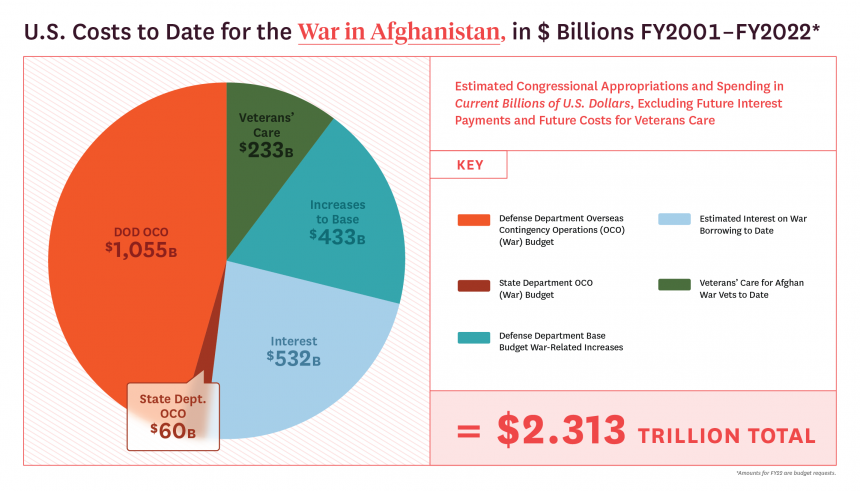
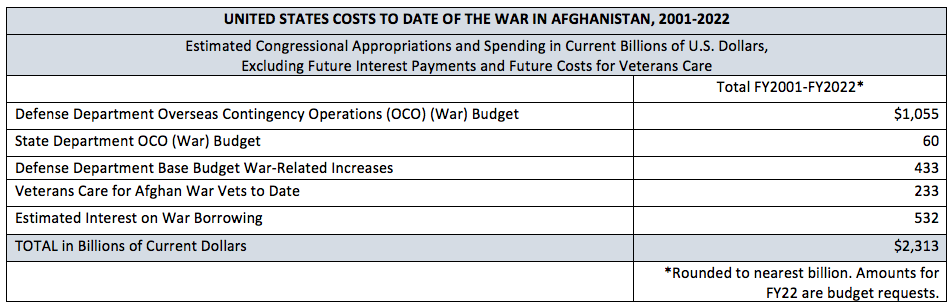
Since invading Afghanistan in 2001, the United States has spent $2.313 trillion on the war, which includes operations in both Afghanistan and Pakistan. Note that this total does not include funds that the United States government is obligated to spend on lifetime care for American veterans of this war, nor does it include future interest payments on money borrowed to fund the war. This $2.313 trillion spent on Afghanistan is a portion of the total estimated cost of the post-9/11 wars.
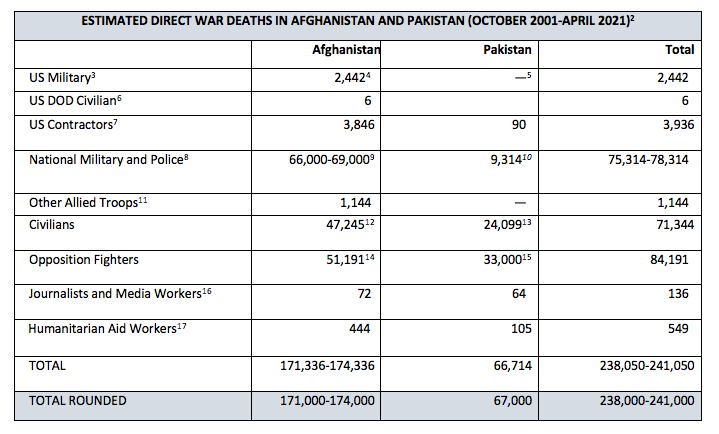
The Costs of War Project also estimates that 241,000 people have died as a direct result of this war. These figures do not include deaths caused by disease, loss of access to food, water, infrastructure, and/or other indirect consequences of the war.
The figures for Afghanistan are part of the larger costs of the U.S. post-9/11 wars, which extend to Iraq, Syria, Yemen, Somalia and elsewhere. The numbers are approximations based on the reporting of several data sources.
Hezbollah grows stronger in Lebanon amid energy crisis, arranging oil shipments from Iran
By Uriel Araujo | August 28, 2021
Hassan Nasrallah, the leader of the Lebanese Shia Islamist organization Hezbollah has announced more Iranian ships are bringing fuel to Lebanon. The country is under an unprecedented political and economic crisis and is facing massive gasoline shortages – even after the first vessel arrived on August 19. Some worry Iran-funded Hezbollah could thus take the place of the almost collapsing Lebanese state or companies. Others worry the US could impose sanctions on Lebanon due to its relation with the Islamic Republic of Iran. The US Ambassador to Lebanon in fact stated, hours after Hezbollah’s statement, that Washington was in talks with Jordan and Egypt to find solutions to Lebanon’s fuel crisis, which has affected businesses, hospitals, and homes.
Riad Toufic Salameh, the Governor of Lebanon’s central bank claimed two weeks ago that Beirut simply lacks the foreign reserves needed to release dollars to import fuel. On August 12, Salamesh announced Lebanon decided to change the exchange rate used as a base for importing fuel, thus sharply increasing retail prices. Gasoline prices may rise up to 66% as subsidies were cut in an attempt to ease shortages. This central bank measure clashed with outgoing Prime Minister Hassand Diab’s government, which pledged to keep the subsidies in an ongoing dispute. Diab described Salamesh’s decision as illegal and irresponsible. Several roads were closed by protesters the same day and the demonstrations are still going on. It is in this context that Hezbollah and its network of Shia businessmen arranged for the shipments of oil. This move was criticised by former Prime Minister Saad Hariri and other political figures as an infringement on the Lebanese state’s sovereignty.
According to the Iranian semi-official Nour News agency, the first fuel shipment was bought by a group of Lebanese Shiite merchants. The same agency reported that the shipment should be considered Lebanese property “from the moment it is loaded”, and described the fuel dispatch as a “strong action taken by Iran and Hezbollah to break the economic siege of the Lebanese people by a western-Arab-Israeli axis”.
According to Laury Haytayan, a Middle East gas and oil expert and a Natural Resource Charter Senior Officer, Hezbollah’s announcement in itself could place Lebanon in danger of being sanctioned for the ships bringing fuel from Iran are carrying a product that is under US sanctions and thus anyone engaging with such product could also be sanctioned under the current regime that targets third parties buying Iranian oil or merely interacting with the Iranian financial sector.
The Lebanese government could of course ask for a waiver of these sanctions (such as the ones that were granted to Iraq pertaining to Iranian gas imports) but the hard truth is that Lebanon today barely has a government. Any political void always invites political entrepreneurship and Hezbollah seems to be showing itself capable of doing what the government can’t.
Furthermore, there have been Israeli attacks on shipments of Iranian fuel to Syria, which neighbors Lebanon. If such were to happen with a shipment heading to Lebanon, this would obviously further increase anti-Israeli sentiment in a country where tensions are already escalating. Some see Hezbollah’s move as a part of a kind of a deterrence equation, that is, the Shia organization would retaliate in case Israel attacks any ship bringing fuel during a major energy crisis.
Nasrallah also said Hezbollah could help bring an Iranian company to drill, if necessary. These remarks were made during his televised speech for Ashura, an Islamic holiday of particular significance for Shias. With the current crisis, Hezbollah is showing itself to be the only faction that can organize the country. This means Iran’s influence on the Levant is to increase which will worry many actors, particularly Saudi Arabia.
Earlier this year Iran and Saudi Arabia started a series of talks, urged by Qatar, but they have been suspended. The new Iranian President Ebrahim Raisi has claimed his foreign policy priority now is to improve relations with the Persian Gulf Arab countries, which are led by Saudi Arabia. The current war in Yemen is a point of contention, though, for Tehran supports the Houthi insurgency in Yemen. Riad leads a major military intervention in the country against the Houthi rebels (in a coalition that includes Bahrain, and the United Arab Emirates, as well as Egypt, Jordan, and Sudan). This makes the conflict in Yemen a proxy war between Iran and Saudi Arabia. If Tehran and Riad could put such differences aside they could help bring peace and stability to the region. But this is not an easy task, as the two rivals still seem to compete in Iraq and Lebanon and might further compete in Afghanistan after the US withdrawal.
Washington and the European powers are losing their influence in the Lebanese political game. Solving the energy crisis in Lebanon is first and foremost a humanitarian issue and if the US chooses to act in terms of sanctioning Lebanon this would greatly harm US President Joe Biden’s narrative of the United States as a champion of human rights worldwide. The current crisis after all is also about Iran – whose economy has been hit hard by sanctions and today has a 45% inflation rate and has reached the highest price for food products.
If the US does not sanction Lebanon, such will serve Hezbollah as a kind of a show of force. If Washington does sanction the country, Hezbollah also wins somehow for it would corroborate its narrative of Lebanon under siege. Under such a scenario Lebanon should further enhance its relations with Iran. Thus, no scenario is good for the US.
Featured Video
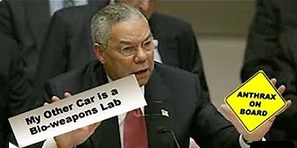
From Anthrax to Iraq
or go to
Aletho News Archives – Video-Images
Book Review
New paperback: Butchered by “Healthcare”
Lies are Unbekoming | October 20, 2026
 Butchered by “Healthcare” is Robert Yoho’s plain-spoken account of how American medicine stopped being a profession and became an industry. 341 pages. Over a thousand references. Thirty-eight chapters.
“Screening Tests Are Useless”, on tests that find diseases that would never have hurt you. “The FDA Protects the Big Drug Companies”, on an agency funded by the companies it regulates. “The Journals’ Sins Are the Editors’ Sins”, on ghostwritten studies and captured peer review. “Opioids and ‘Pain Management’”, on how a generation was prescribed its way into addiction. “Prozac and Relatives” and “Antipsychotics Are Disastrous”, on what psychiatry does to adults and children. “Surgery: Money Before Patients”. “Failed Cancer Treatments”. “Futile CPR and Overprescribing”. “Billing Scams & Specialty Warfare”. “Hospitals Are Sharks”. Each with a Patient Tips section at the end on how to survive it.
If you have ever walked out of a doctor’s office with a prescription you didn’t ask for, or watched a parent put through a treatment that made them worse, this is the book you want on your shelf before the next appointment. … Full review
Butchered by “Healthcare” is available on Lulu now.
Blog Roll
 Aletho News
- Undersea Internet cables could be targeted in retaliation for attacks on Iran: IRGC deputy chief
- EU sending ‘biased’ observers to interfere in Serbian election – president
- White House envoy declares kinetic action against Yemen ‘fruitless’
- Ukraine deployed thousands of microdrones in Iraqi Kurdistan: Tasnim
- Iran calls for emergency UNSC meeting over Trump’s ‘brazen’ bomb talk, Israeli threats
- Iranian sources reveal details of Russia-China Hormuz proposal
- Plan for more US-Israel integration puts our military tech at risk
- Another Round Against Iran Will Break What Is Left of the Gulf
- SVR Report on Ukraine’s Mexican Drug Gang Links Could Pressure Zelensky, Won’t Change US Policy
- British Government Employees Were Fact-Checking the News at the BBC. Nobody Told You.
- If Americans Knew
- Israel’s war on Iran is the final move in a decades-old strategy
- Israel Denies Entry to French Journalist, U.S. Researcher Amid Rise in Entry Denials
- Gaza’s hospitals are running out of life-saving fuel – Daily Update
- Mysterious bot accounts reportedly spread fake ‘man on the street’ videos for Michigan Senate candidate
- Israeli Defense Minister Katz Says Over 60 Lebanon Villages Have Been Destroyed
- Why Is Israel Running TV Ads in Iowa Ahead of the Midterms?
- Hind Rajab’s Alleged Killer Is in the United States. HRF Demands His Arrest.
- US Officials Face Fresh Pressure After Another American ‘Brutalized’ by Israeli Settlers in West Bank
- Israel-Backed Palestinian Militias Terrorize Displaced Families in Gaza
- FBI subpoenas pro-Palestine activists over Israeli weapons plant disruption
- No Tricks Zone
- E-Cars Reduce CO2 Emissions By Only 41% Compared To Internal Combustion Engine Vehicles
- Predictions Made By Renowned Climate Professor Over Past Decades Have Been Proven To Be Poor
- New Study Suggests Large Regions Of The Pacific Ocean Have Been Cooling For The Last 80 Years
- Germany’s Green Energy Debacle: High Energy Costs Force Kahla Porzellan to Close After 182 Years!
- New Study: 50 Years Of The Most Aggressive ‘Net Zero’ Policies Can Only Affect The Global Climate By 0.03°C
- US September “Heat” Was No Record…Many Records Set Decades Ago
- Latest European Green Energy Debacle; Portugal’s Largest Flagship Solar Park Insolvent!
- Green Energy Debacle: German Expert Professor Fritz Vahrenholt Warns Of Severe Economic And Social Consequences
- Two More Paleo Reconstructions Affirm Meters-Higher Sea Levels Across Ireland, Brazil 7000-6000 Years Ago
- New Study: Earth And Venus Surface Warmth Largely Explained By Convection And Lapse Rate, Not CO2 Or Radiation

