Iran’s SURVIVAL INSTINCT MORE INTENSE THAN EVER /Lt Col Daniel Davis
Daniel Davis / Deep Dive – May 9, 2026
The Dissident | May 9, 2026
Democratic representative Alexandria Ocasio-Cortez recently came out against the idea of a non-partisan Anti-War and Anti-Zionist coalition between the populist left and right, through an attack on the former Republican representative Marjorie Taylor Greene.
“I personally do not trust someone like Marjorie Taylor Greene, a proven bigot and antisemite, on the issues of what is good for Gazans and Israelis,” AOC said, adding, “I don’t think that it benefits our movement, in that instance, to align the left with white nationalists, I don’t think it serves us”.
AOC faced major backlash for these comments, including from her own base of support, such as political commentator Cenk Uygur, who previously launched the Justice Democrats organization that helped AOC get elected, who said, “This is just terrible. She sounds just like the establishment. She’s attacking an opponent of Israel as an antisemite. This is exactly what Israeli supporters want – split the anti-war movement and the critics of Israel’s genocide. Deeply counterproductive. And selfish”, in response to AOC’s attack.
Through this attack on Marjorie Taylor Greene, AOC showcased her hypocrisy and what an unserious fraud she really is.
MTG Took On The Republicans Over Zionism, AOC Covered For The Democrats
Looking at AOC and MTG’s record on Zionism, and who was able to stand up to their own party over it, MTG’s record stands up to AOC’s.
As journalist Ryan Grim noted , “MTG sacrificed her political career to stand against genocide, against Trump, against the Epstein Class, and to defend the survivors of Epstein’s trafficking. If that doesn’t earn credibility, I don’t know what possibly could.”
When it came to Donald Trump backing the Israeli genocide in Gaza, Marjorie Taylor Greene bucked her own party and stood up to Donald Trump’s funding and arming of the genocide.
“It’s the most truthful and easiest thing to say that Oct 7th in Israel was horrific and all hostages must be returned, but so is the genocide, humanitarian crisis, and starvation happening in Gaza,” Greene said in July of 2025 , while Trump was in power, arming and funding the genocide.
The next month, she called on Trump to stop sending arms to fuel the genocide in Gaza, saying , “I don’t know about you, but I don’t want to pay for genocide in a foreign country against a foreign people for a foreign war that I had nothing to do with, and I will not be silent about it.”
MTG also introduced legislation to “cancel $500 million in funding for Israel’s missile defense system” in July of last year, saying, “My amendment would strike $500 million in funding for nuclear-armed Israel’s missile defense system, and it’s important to emphasize it that way. Israel is a nuclear-armed nation, which is very capable of defending themselves … I also want to point out that Israel bombed a Catholic church in Gaza, and that an entire population is being wiped out as they continue their aggressive war in Gaza”.
Marjorie Taylor Greene, in November of 2025, was pushed to resign from Congress after attacks and a primary campaign from the Trump administration because of her standing up to her own party over Zionism, as well as other issues such as the release of the Epstein Files.
“I have too much self-respect and dignity, love my family way too much, and do not want my sweet district to have to endure a hurtful and hateful primary against me by the President we all fought for, only to fight and win my election, while Republicans will likely lose the midterms. And in turn, be expected to defend the President against impeachment after he hatefully dumped tens of millions of dollars against me and tried to destroy me” MTG wrote in her resignation letter.
She added, “If I am cast aside by MAGA Inc and replaced by Neocons, Big Pharma, Big Tech, Military Industrial War Complex, foreign leaders, and the elite donor class that can’t even relate to real Americans, then many common Americans have been cast aside and replaced as well” adding, “When the common American people finally realize and understand that the Political Industrial Complex of both parties is ripping this country apart, that not one elected leader like me is able to stop Washington’s machine from gradually destroying our country, and instead the reality is that they, common Americans, The People, possess the real power over Washington, then I’ll be here by their side to rebuild it.”
No matter what one thinks about MTG, the truth is she stood up to her own party for selling out to the Zionist lobby and military industrial complex, and fought against its backing of the Genocide in Gaza, and lost her political career as a result.
The same cannot be said about Alexandria Ocasio-Cortez.
When AOC similarly had the chance to stand up to the Biden administration over backing Israel’s genocide in Gaza, she blatantly lied to cover for Biden’s backing of the genocide.
Then Vice President and Democratic Presidential Candidate Kamala Harris, along with the Biden administration, AOC falsely said , was “working tirelessly to secure a cease-fire in Gaza and bringing the hostages home”.
In reality, Israeli officials and Biden administration officials have admitted to fully backing Israel’s genocide in Gaza and never once putting pressure on Israel to end it.
“At the most significant political peril of Joe Biden’s political career, the easiest thing for Joe Biden would have been, if he was worried about the votes in Michigan, is to basically be a little soft; he refused to do it. There was enormous pressure within the White House on him to change his position. When I hear comments about ‘he wasn’t good enough, or he didn’t have Israel’s back,’ am I disgusted by it? One hundred percent. Is it true? 100 percent no,” admitted the former U.S. ambassador to Israel, Thomas Nides, on Israeli TV .
In the same TV special, former Israeli ambassador to the U.S., Michael Herzog, admitted, “God did the State of Israel a favor that Biden was the president during this period, because it could have been much worse. We fought for over a year, and the administration never came to us and said, ‘ceasefire now.’ It never did. And that’s not to be taken for granted.”
“After more than $20 Billion military support, largest in Israel history, 2 aircraft carriers rushed to the region, deterring a massive regional war, defeating Iran missile/drone attack x2, defending israel at most vulnerable moments, after SAVING countless lives of Israelis – only acceptable response to POTUS Biden and American people is THANK YOU”, the Biden administration advisor Amos Hochstein later admitted in response to claims from Benjamin Netanyahu that the Biden administration was not deferential enough to Israel and it’s genocide in Gaza.
Soon after, Philip H. Gordon, the Assistant to the President and National Security Advisor to the Vice President of the United States under the Biden administration, admitted that , “Biden resisted enormous pressure to condition aid, as required by U.S. law, even as Israel rebuffed calls to facilitate more humanitarian assistance and reduce civilian casualties”.
Furthermore, when it comes to a weapons embargo on Israel, Marjorie Taylor Greene goes further than Alexandria Ocasio-Cortez.
AOC voted against MTG’s aforementioned amendment to cut off U.S. funding to Israel, stating that she favoured funding “defensive” weapons for Israel while it was in the middle of committing a modern-day Holocaust in Gaza.
AOC wrote on Twitter:
Marjorie Taylor Greene’s amendment does nothing to cut off offensive aid to Israel nor end the flow of US munitions being used in Gaza. Of course I voted against it.
What it does do is cut off defensive Iron Dome capacities while allowing the actual bombs killing Palestinians to continue.
I have long stated that I do not believe that adding to the death count of innocent victims to this war is constructive to its end. That is a simple and clear difference of opinion that has long been established.
I remain focused on cutting the flow of US munitions that are being used to perpetuate the genocide in Gaza.
In reality, as Dylan Saba noted in Jewish Currents, “By almost entirely negating the ability of militant groups in Gaza to respond to Israel’s incursions, the purportedly defensive Iron Dome allows Israel to strike without fear of repercussion”.
He wrote, “because the cost is so low when measured in Israeli casualties, Israel can wage perpetual war without suffering domestic political consequences, and is under negligible pressure to pursue diplomacy with the Palestinians” adding, “while the Iron Dome may prevent the deaths of Israeli non-combatants, it has made it easier for Israel to engage in deadly operations that take Palestinian lives”.
AOC’s Hypocrisy On Working With ‘White Nationalists’
AOC’s main argument for not working with conservatives like Marjorie Taylor Greene on anti-war issues was over her labeling of Marjorie Taylor Greene as a “white nationalist”.
AOC labeled Marjorie Taylor Greene as a “white nationalist” for her standard-issue conservative social views, but previously voted repeatedly to send weapons to Ukraine, many of which ended up in the hands of open Neo-Nazi and White Nationalist militias.
It has been well documented that after the U.S.-backed 2014 Maidan coup in Ukraine, Neo-Nazis and White Nationalists were mainstreamed in the Ukrainian government and military.
“The driver of this violence was largely the Ukrainian far right, which, while a minority of the protesters, served as a kind of revolutionary vanguard. Looking outside Kyiv, a systematic analysis of more than 3,000 Maidan protests found that members of the far-right Svoboda party — whose leader once complained Ukraine was run by a ‘Muscovite-Jewish mafia’ and which includes a politician who admires Joseph Goebbels — were the most active agents in the protests. They were also more likely to take part in violent actions than any group but one: Right Sector, a collection of far-right activists that traces its lineage to genocidal Nazi collaborators,” journalist Branko Marcetic reported in reference to the U.S.-backed militants that led the coup effort.
“The uncomfortable truth is that a sizable portion of Kyiv’s current government — and the protesters who brought it to power — are, indeed, fascists,” Foreign Policy magazine reported after the coup, and the UK’s Channel 4 news reported that the “far-right took top posts in Ukraine’s power vacuum”.
Flash forward to the proxy war in Ukraine, and Alexandria Ocasio-Cortez voted for every U.S. arms and funding package to the Ukrainian government and military that continued to be infested with these open white nationalist elements.
AOC continued to support the arms flow to Ukraine even after the Biden administration lifted the ban on weapons sales to the Azov Battalion, an openly Neo-Nazi battalion, in 2024.
U.S. representative Ro Khanna has previously gotten through an amendment banning the sale of weapons to the Battalion, saying, “White supremacy and neo-Nazism are unacceptable and have no place in our world. I am very pleased that the recently passed omnibus prevents the U.S. from providing arms and training assistance to the neo-Nazi Azov Battalion fighting in Ukraine”, which was reversed by the Biden administration in 2024.
In 2019, AOC met with supporters of the U.S.-backed coup in Bolivia, which helped temporarily install a fascist government led by Jeanine Áñez who had openly racist views towards the country’s indigenous population, including by calling them “satanic”.
In 2019, Counterpunch reported:
On November 16, four days after the military coup that destroyed Bolivian democracy, Ocasio-Cortez met with a group of pro-Áñez (Jeanine Áñez, the U.S.-backed leader installed after the coup), pro-Camacho activists led by one Ana Carola Traverso.
Rep. Ocasio-Cortez symbolically embraced the coup by posing for a photo with this group as they brandished the tricolor Bolivian flag, which during that period had become a signal of support for the golpistas (as opposed to the Wiphala flag, which symbolized popular resistance to the takeover). She told them that she supports their ‘democratic grassroots movement’ and offered them ‘direct lines of communication’
Furthermore, as journalist Max Blumenthal noted, AOC previously worked alongside Republicans such as Tom Cotton and Ted Cruz – who have the same right-wing social views as Marjorie Taylor Greene – to place sanctions on China.
In all of these cases, a pattern emerges: AOC has no problem working with the far-right if the agenda is in support of the U.S. empire, but refuses to work with anti-war conservatives opposed to it.
AOC’s attack on Marjorie Taylor Greene shows yet again what AOC really is: a career politician who will not take on the establishment Democratic Party, U.S. Empire, or Israel if it means risking her political ambitions.
Glenn Diesen | May 9, 2026
Daniel Davis / Deep Dive – May 9, 2026
Glenn Diesen | May 9, 2026
Larry Johnson is a former CIA intelligence analyst who also worked at the U.S. State Department’s Office of Counterterrorism. Johnson discusses how the Iran War is putting an end to the former security architecture of the Middle East.
Read Larry Johnson’s Sonar21: https://sonar21.com/
Follow Prof. Glenn Diesen:
Support the research by Prof. Glenn Diesen:
Al Mayadeen | May 9, 2026
Senior Iranian lawmakers issued sharp warnings to Gulf states on Friday, cautioning against supporting the US-backed resolution against Tehran and threatening consequences for countries aligning themselves with Washington and “Israel” amid escalating regional tensions.
Ebrahim Azizi, head of the Iranian parliament’s National Security and Foreign Policy Commission, warned that governments supporting the resolution will face perpetual closure of the Strait.
In a post on X, Azizi stated, “We warn governments, including microstates like Bahrain, that siding with the US-backed resolution will bring severe consequences.”
“The Strait of Hormuz is a vital lifeline; do not risk closing it on yourselves forever,” he warned.
UAE insignificant in the broader war: Ruhollah Azad
Separately, Iranian parliament presidium member Rouhollah Motefakker Azad said the United States and “Israel” were facing inevitable defeat in their war with the Iranian people and resistance fighters.
“The defeat of the Americans and Zionists in the battle against the Iranian people and their fighters is inevitable, and signs of this defeat have begun to emerge on all fronts,” he said.
Motefakker Azad also warned the United Arab Emirates against becoming involved in the conflict, arguing that Abu Dhabi should avoid acting in support of Israeli and American interests. “If the UAE possesses strategic rationality, it will never place itself in a predicament greater than its size and capabilities for the sake of the interests of the Zionists and America, who have failed in this arena,” he said.
He added that Iran had demonstrated its ability to contain the actions of both the United States and Israel, dismissing the UAE as insignificant in the war.
“The Emiratis are advised to understand the rules of this war and refrain from entering an arena beyond their capacity and scale,” he said.
Military, public, diplomacy; main pillars of Iran’s strategy
Iranian Vice President Mohammad Reza Aref said on Friday that Tehran will continue its diplomatic efforts “based on logic and ethics,” while stressing that the country remains “very firm in defending its rights,” according to remarks made during a meeting with managers of the Mobarakeh Steel Company.
Aref said Iran’s strategy is built on three main pillars: the “military arena, the street, and diplomacy,” calling for national planning that reflects Iran’s status as a “major global power.”
He also urged faster progress on reconstruction, renewal, and upgrading of damaged industries, emphasizing the need to accelerate recovery efforts.
Palestinian Information Center – May 8, 2026
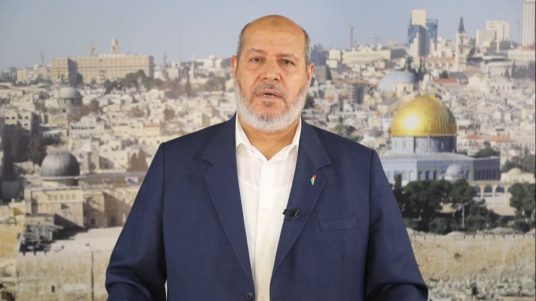
Khalil al-Hayya, head of the Islamic Resistance Movement, Hamas, in the Gaza Strip, said Israel’s attempts to impose its will through assassinations and attacks on political leaders and their families “will fail,” following the assassination of his son Azzam al-Hayya in an Israeli strike on Gaza City.
Speaking during a memorial gathering on Thursday, al-Hayya described the martyrdom of his son, alongside several other Palestinians, including neighbor Hamza al-Sharbasi, as part of a continuing campaign targeting Palestinian families and resistance leaders.
He said the martyrdom of Palestinians would only strengthen the struggle for the liberation of Palestine and Jerusalem, adding that Israel’s efforts to pressure negotiators through violence would not succeed.
Al-Hayya also linked the attack to previous Israeli strikes targeting Hamas negotiators in Qatar last year, saying the Movement continued negotiations “on behalf of its people and national interests,” despite ongoing attacks.
Meanwhile, Khaled Mishaal, head of the Hamas Movement abroad, praised al-Hayya’s resilience during the funeral gathering, describing the loss of multiple sons and relatives as “a great sacrifice.”
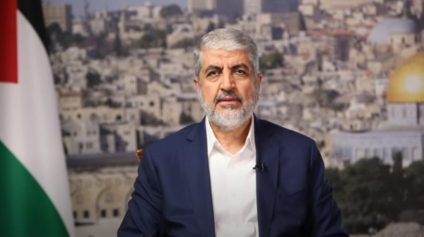
Mishaal said Gaza continues to “write epics of steadfastness and sacrifice” despite the Israeli war, siege, and destruction, arguing that the suffering endured by Palestinians increases the responsibility of the wider Arab and Muslim world toward Gaza and the Palestinian cause.
He also called for greater support for Palestinians in Gaza, the West Bank, Jerusalem, and Palestinian prisoners, while stressing that the sacrifices made during the war were “not only for Palestine but for humanity as a whole.”
Press TV – May 8, 2026
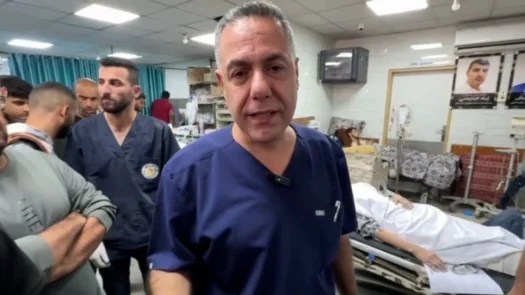
Former Palestinian detainees have come forward with disturbing firsthand accounts of the systematic torture inflicted on Dr. Hussam Abu Safia, director of Gaza’s Kamal Adwan Hospital, during his detention in an Israeli prison.
Rami Abu Amira, a former prisoner, described how interrogators stripped Dr. Abu Safia naked and set police dogs on his frail body, leaving deep wounds and scratches.
Ahmad Qaddas recounted that the prison cells echoed with the doctor’s screams as he endured severe beatings.
He said he could no longer recognize Abu Safia due to extreme weight loss and his dazed, barely conscious state.
“He was physically shattered,” Qaddas added. Another former detainee, Hamza Abu Amira, spoke of the “relentless humiliation” and combined physical and psychological torture carried out by specialized Israeli prison units.
Guards reportedly forced Dr. Abu Safia to repeat degrading phrases while inflicting extreme pain in an apparent effort to break him.
Prisoners also described repeated night raids on their cell using sound grenades and tear gas canisters. Other detainees were strictly forbidden from approaching his cell or inquiring about his condition.
Dr. Abu Safia has been held since 27 December 2024, when Israeli forces abducted him during their assault on Kamal Adwan Hospital — the last functioning hospital in northern Gaza at the time. Even after an Israeli airstrike killed his own son, he had refused to abandon his post and his patients.
In March, UN Special Rapporteurs Tlaleng Mofokeng and Ben Saul confirmed receiving credible reports of his torture and the systematic denial of medical care.
They warned that his life was in grave danger and urged countries with influence over Israel to intervene.
Yet the US and its Western allies have taken no meaningful action to halt Tel Aviv’s brutality.
A UK-based human rights organization described his arrest as part of Israel’s broader policy of systematically targeting Palestinian health workers and destroying Gaza’s healthcare system — actions it said were intended to create conditions calculated to bring about the physical destruction of the Palestinian people.
Dr. Abu Safia is one of at least 737 Palestinian medical workers arbitrarily detained by Israeli forces since October 2023.
During the same period, at least 1,722 medical personnel have been killed — an average of more than two per day.
The World Health Organization has documented over 930 attacks on Gaza’s healthcare system, with all 36 hospitals damaged or destroyed and only half partially functional.
These assaults form part of a deliberate campaign to annihilate Gaza’s healthcare infrastructure as an integral component of Israel’s genocidal war on the Strip, which has so far claimed more than 72,500 Palestinian lives since October 2023.
The Cradle | May 8, 2026
The UAE has sent $100 million to US President Donald Trump’s Board of Peace to fund the training of a new Palestinian police force for Gaza, the Times of Israel reported on 8 May, citing a US official and a diplomat from West Asia.
Setting up a security force to control Gaza on Israel’s behalf will reportedly allow Tel Aviv to sideline Hamas while reducing the presence of the Israeli army, which is suffering from manpower shortages.
The police force is being organized under the umbrella of the National Committee for the Administration of Gaza (NCAG), a panel of Palestinian technocrats tasked by the Board of Peace and Israel to administer the Strip.
Though the NCAG was created three months ago, its members have not yet entered the Strip, reportedly due to a lack of funding and security.
“No money is currently available,” Board of Peace envoy Nickolay Mladenovas privately acknowledged, according to a Palestinian official familiar with the matter speaking with Reuters.
The proposal envisions the new police force seizing weapons in Gaza as part of the effort to disarm Hamas.
Nevertheless, Hamas has yet to agree to disarm, as Israel has not adhered to the terms of the US-sponsored ceasefire that was signed in October 2025.
According to the ceasefire agreement, Israel was required to withdraw their forces to areas near the border, dismantle all military sites and installations, allow displaced Palestinians to return to their homes in the north of the Strip, open the Rafah crossing, and allow humanitarian aid to enter freely.
Israel has also killed over 800 Palestinians in Gaza since the ceasefire took effect.
In February, the NCAG began recruiting for the new 27,000-strong police force. Recruits will be vetted by Israel’s internal security service, the Shin Bet, according to an Arab diplomat who spoke with the Times of Israel in March.
An Emirati security firm will train the recruits in Egypt and Jordan before dispatching them to Gaza.
In February, US President Donald Trump announced $17 billion in pledges for the Board of Peace at a donor conference. He also demanded that world leaders contribute $1 billion each for a seat on the board, which he said would rival the UN.
However, the $100 million contribution from the UAE is the largest pledged amount the board has received so far. The board has not received the billions in contributions initially pledged by the UAE, Qatar, Saudi Arabia, and Kuwait.
One source with direct knowledge of the peace board’s operations told Reuters that Washington and Tel Aviv’s war of aggression against Iran “affected everything.”
The Board of Peace is also working to establish and deploy a proposed International Stabilization Force (ISF) in Gaza, which is expected to include soldiers from several foreign countries. This move would enable the Israeli army to further outsource its ethnic cleansing efforts.
Indonesia, Albania, Kazakhstan, and Kosovo have each pledged troops to the ISF, but so far none have been deployed or begun training, amid fears they may have to use violence to disarm Hamas on Israel’s behalf.
The UAE has supported Israel not only in Gaza but also in its war with Iran.
The New York Times reported on Friday that the UAE has “doubled down on its alliances with Israel and the United States,” despite Iranian drone and missile strikes targeting the Emirates in retaliation for their support for the US-Israeli war on the Islamic Republic.
“There is a trust premium that Trump will do the right thing,” said Nadim Koteich, an Emirati-Lebanese commentator who is close to the Emirati government. “What suits his legacy and what suits the American interests suits us.”
The UAE has also partnered with Israel and Somaliland to create a new “strategic axis” in the Horn of Africa and the Red Sea in a bid to project power into Africa and counter the Ansarallah-led Yemeni Armed Forces.
MEMO | May 8, 2026
The UK Department for Business and Trade (DBT) has granted two new licences for the export of military equipment to Israel, including an £8.7 ($11.85) million licence covering “components and technology for targeting equipment”, the Campaign Against Arms Trade (CAAT) has revealed.
The licences were issued despite the British government’s September 2024 suspension of such exports over fears they would be used in Israel’s genocide in Gaza. CAAT’s analysis of UK export licensing statistics for the fourth quarter of 2025, published on 30 April, found that the UK issued export licences worth £20.5 ($27.9) million in total for transfers to Israel during the quarter.
The most significant of the new approvals was an Open Individual Export Licence for “components and technology for targeting equipment” — a category of export the UK government had publicly suspended eight months earlier, citing the risk of use in Israel’s genocide in Gaza. When questioned about the licence, DBT replied that it “covers items for re-export from Israel, and the Government of Israel is not an end-user or ultimate end-user. This is consistent with our suspension”.
CAAT said the defence rested on a legal fiction. The watchdog warned of the risk of “auto-diversion”: a process by which Israel can fail to retransfer military equipment to its declared destination and instead assign it to an unauthorised end-user, such as the Israel Defence Forces (IDF), for use in Gaza.
Such a move would constitute a breach of the export licence and a potential criminal offence under UK law. British ministers have previously said they would revoke any licence should “any evidence” emerge that exported equipment had not reached its declared destination, but CAAT noted that the UK government makes no known efforts to verify what happens to its military exports after they leave Britain.
The watchdog’s concerns are not theoretical. In March, an investigation revealed that an Elbit-owned subsidiary in the UK had shipped dozens of drone components, including Watchkeeper engines, to Israel over an 18-month period.
Israel had failed to retransfer the equipment to Romania as required by the licence, citing force majeure arising from its assault on Gaza. The contract with Romania has still not been fulfilled. Elbit announced it would start delivering the drones only two days after Romania threatened to cancel the contract.
A second new licence covers components for military training aircraft, and related technology, for transfer to France, Greece, Israel and Italy — likely supplied by the US aerospace firm Moog for the M-346 Lead-In Fighter Trainer produced by Italy’s Leonardo.
The M-346 is used in every phase of advanced and pre-operational training for Israeli pilots before they fly combat missions in Gaza, Iran and Lebanon using F-16 and F-35 jets. Israel has caused massive devastation with F-35 jets across Gaza, Iran and Lebanon. Similar components shipped by Moog from the UK were recently seized by authorities in Belgium, who have since opened a criminal investigation.
CAAT’s Research Coordinator Sam Perlo-Freeman said the new licences exposed the limits of the British government’s stated policy.
“These new export licenses show just how willing the UK is to continue enabling Israel’s genocidal assaults, while staying within the technical rule of a vastly insufficient and ineffective policy towards IDF war crimes,” he said.
“The targeting equipment for which DBT granted a license, for transfer to and re-export by Israel, could easily be used in Gaza. Given Israel’s history of weapons diversion and illicit transfers, and outstanding questions about Elbit drone components failing to arrive in Romania, there remains a grave risk that Israel will auto-divert the targeting equipment to the IDF for use in Palestine.”
Perlo-Freeman explained that the British government was leaning on a system of declarations it has no power to enforce. “DBT is relying on end-user undertakings that hold no legal force in Israel, which the UK government does not check up on and cannot enforce. The exporter is technically in-the-clear, so long as it can’t be shown they knew the end-user undertaking was false.”
Inside the life of the ruthless businessman who financed coups in Central America and shaped Israeli statehood
José Niño Unfiltered | May 7, 2026
Leftist commentators consistently push a shallow and economically reductive narrative that frames American foreign policy as the sole domain of greedy White capitalists while choosing to ignore the obvious Jewish power structure directing these events. When the veneer of this supposed corporate imperialism is stripped away, it becomes clear that the United States has often served as a vehicle for the specific goals of organized Jewry. The life of Samuel Zemurray stands as prime evidence of this hidden mechanism.
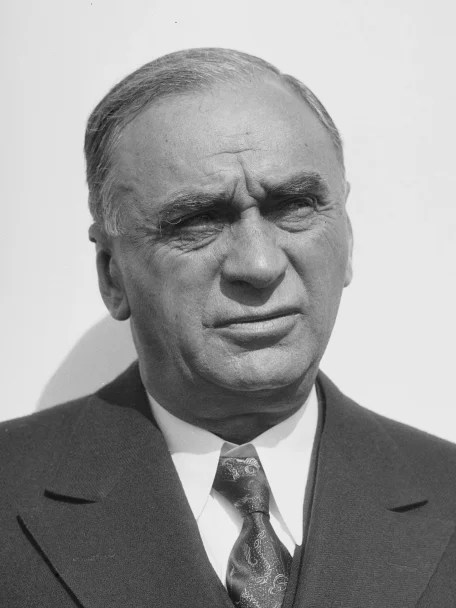
Few figures in American business history wielded power as ruthlessly or as secretly as Zemurray. Born Schmiel Zmurri on January 18, 1877, to a poor Jewish family in Imperial Russia, this teenage immigrant would rise from peddling rotting bananas off railroad cars in Alabama to become the controlling force behind the United Fruit Company, the most powerful agricultural corporation on earth. Along the way he overthrew governments, bribed presidents, hired mercenaries, and played a pivotal behind-the-scenes role in the creation of the State of Israel.
The man who would topple presidents arrived with nothing but a steamer ticket and family connections in the Deep South. After his father died, the 14-year-old Zemurray emigrated to the United States in 1892, traveling in steerage class and landing in New York before making his way to Selma, Alabama, where relatives had settled. He worked as a chicken catcher, carpenter’s assistant, delivery boy, traveling merchant, and housecleaner, eventually saving enough to bring his mother and 6 siblings over from Europe. Standing approximately 6 feet 3 inches tall with enormous energy and hustle, Zemurray was described as a man who could swear fluently in 5 languages. He encountered his first banana around 1893 in Selma, at that time an exotic and expensive delicacy in the United States, and the fruit became his life’s obsession.
Zemurray brought to the banana trade the same scrappy, rule-bending hustle that had carried him from steerage to a Selma general store. In 1895, at age 18, Zemurray traveled to the docks of Mobile, Alabama, and built a niche specializing in what the industry called “ripes” — bananas that were nearly overripe and being discarded by importers. He bought them for pennies and rushed them inland by rail before they spoiled, famously bribing Western Union telegraph operators to wire ahead with sales offers to towns along the route. Starting with just $150, he had saved $100,000 by age 21 and earned the lifelong nickname “Sam the Banana Man.” By selling bananas directly off moving trains, Zemurray turned minimal investments into substantial profits and was soon selling over one million bananas annually.
In 1903, Zemurray signed a contract with United Fruit giving him rights to distribute the company’s ripest bananas. He partnered with Ashbell Hubbard to form the Hubbard-Zemurray Company and by 1905 had moved to New Orleans, acquired the Thatcher Brothers Steamship Company, and taken control of the Cuyamel Fruit Company. By 1910, he had bought 5,000 acres along the Cuyamel River in Honduras near Omoa and borrowed aggressively to expand into plantations, railroads, and bridges. Unlike the patrician executives of United Fruit who ran operations from their offices in Boston, Zemurray spent months each year working directly on his Central American plantations, learning conversational Spanish, mapping land, clearing fields with a machete, killing snakes, and supervising construction in person.
Zemurray’s appetite for direct action soon extended far beyond plantation supervision. The most audacious act of Zemurray’s early career was his personal financing and orchestration of a coup d’état in Honduras in 1910 and 1911. The crisis arose when U.S. Secretary of State Philander C. Knox attempted to resolve Honduras’s large debt to British banks by having J.P. Morgan buy the bonds, in exchange for which a Morgan bank official would collect customs duties on Honduran imports. This arrangement would have obliterated the tax concessions Zemurray had privately negotiated with Honduran officials, effectively threatening to destroy his business. After lobbying the State Department unsuccessfully and being told directly to “butt out” of U.S.-Honduras relations, Zemurray devised an alternative.
While under surveillance by U.S. Secret Service agents enforcing neutrality laws, Zemurray recruited mercenaries in the French Quarter of New Orleans, hired the flamboyant soldier of fortune Lee Christmas and the notorious mercenary Guy “Machine Gun” Molony, and purchased a former U.S. Navy vessel called the Hornet. The conspirators evaded Secret Service surveillance, slipped away from New Orleans, and sailed to Honduras with rifles and ammunition Zemurray had stashed on Ship Island. They joined forces with Manuel Bonilla, the former Honduran president whom Zemurray supported as the preferred replacement. Through a combination of military action, bluffing, and recruiting local rebel forces, the coup succeeded. Bonilla was inaugurated as president of Honduras on February 1, 1912, and immediately rewarded Zemurray with extensive land concessions, duty-free import privileges, and favorable tax arrangements.
The spoils of that intervention elevated Zemurray from ambitious importer to regional kingmaker. Zemurray became known as “the uncrowned king of Central America.” After Bonilla’s death in 1913, he controlled a string of Honduran presidents and in 1925 secured exclusive lumber rights to 1/10 of Honduran territory. The episode established the template for what came to be called “banana republic” politics.
In 1929, Zemurray sold Cuyamel to United Fruit for $31.5 million in stock, becoming one of the wealthiest men in America and the single largest individual stockholder in the company. He nominally retired and moved to an estate outside New Orleans. But the Great Depression devastated United Fruit. The company’s stock collapsed by roughly 90 percent, wiping out most of Zemurray’s fortune. After his written suggestions were dismissed and his proposals ignored at board meetings, Zemurray took extraordinary action — traveling personally to visit individual shareholders and collecting their proxy votes. At a dramatic board meeting in 1932 or 1933, Zemurray placed the collected proxies on the table and reportedly declared to the assembled executives, “You’ve been fucking up this business long enough. I’m going to straighten it out.” He became managing director immediately and then formally president of United Fruit in 1938, serving until 1951.
Under Zemurray’s leadership, United Fruit became a behemoth. It owned rail transportation monopolies, radio communications infrastructure, steamship lines, and port facilities across 13 nations. In some Central American countries, the company operated as what critics described as “a state within a state.” Zemurray openly admitted that bribery was the foundation of his operations.
The most historically catastrophic action tied to Zemurray and United Fruit was the 1954 CIA-backed coup that overthrew Guatemalan President Jacobo Árbenz, a democratically elected leader who had introduced agrarian land reforms. Árbenz’s land reform law, Decree 900, expropriated uncultivated United Fruit land for redistribution to landless peasants. Under Zemurray’s influence, United Fruit launched one of history’s most consequential corporate lobbying campaigns.
Edward Bernays, known as “the father of public relations,” orchestrated press tours, planted stories, and produced films painting Guatemala as a Soviet beachhead in the Western Hemisphere. Both Secretary of State John Foster Dulles and CIA Director Allen Dulles had prior connections to United Fruit as former partners at Sullivan and Cromwell, the company’s main law firm. President Eisenhower authorized Operation PBSUCCESS with a $2.7 million budget. The CIA armed and trained a force under Carlos Castillo Armas, conducted psychological warfare operations, and engineered Árbenz’s resignation on June 27, 1954. Castillo Armas installed a military dictatorship that reversed land reforms, eliminated labor rights, and initiated decades of U.S.-backed military rule that led to over 200,000 deaths in a decades-long civil war.
While Zemurray built his banana empire in public view, he pursued another project almost entirely in the shadows. Beginning in the 1920s, he became personally close with Chaim Weizmann, the leader of the World Zionist Organization and Israel’s eventual first president. At the end of World War II, Zemurray was approached by Zionist leaders and asked to help procure ships for the clandestine network transporting Jews from displaced persons camps in postwar Europe to British Mandate Palestine. Working entirely behind the scenes, he raised money and used his connections to facilitate logistics.
The Jewish corporate magnate was instrumental in obtaining the ship that became the Exodus 1947 for the Haganah, which would explain its Honduran registration — Zemurray’s United Fruit Company effectively controlled much of Honduras. The Exodus carried over 4,500 Jewish refugees toward Palestine in 1947 before being intercepted by the British Royal Navy. The incident became an international cause célèbre and accelerated international support for Jewish statehood.
Zemurray’s most consequential contribution to the founding of Israel was his behind-the-scenes lobbying effort that helped secure passage of UN Resolution 181 on November 29, 1947, the Partition Plan that divided Mandatory Palestine into Jewish and Arab states. The resolution required a 2/3 majority to pass. According to author Rich Cohen, Zemurray made calls from his New Orleans home to Latin American heads of state, pressing for affirmative votes or abstentions. Haiti switched from a “no” vote to an abstention. Nicaragua switched from an abstention to a “yes.” In total, 13 of the 33 “yes” votes came from Latin America, including countries where United Fruit operated.
Samuel Zemurray died in New Orleans on November 30, 1961, at age 84. His philanthropy included major donations to Tulane University, the New Orleans Museum of Art, the Audubon Nature Institute, and Jewish refugee relief efforts. He also contributed financially to The Nation magazine.
If we look closely at the history of 20th century American interventionism, the shadow of the Jewish hand becomes impossible to ignore. Zemurray was not an outlier but a precursor to the modern reality where the United States operates as a private military company for the advancement of Jewish interests abroad.
The multitude of seemingly perpetual interventions of the past century were not driven by the abstract greed of villainous, White American billionaires but by the deliberate orchestration of a distinct group with its own tribal loyalties. We are destined to remain powerless subjects in our own land as long as we fail to unmask the true masters of our state and break free from the suffocating grasp of Jewish supremacy.
Recognizing the crimes of devious figures like Samuel Zemurray is a necessary first step in this process to reclaim our polities from the machinations of organized Jewry.
The Cradle | May 7, 2026
An Israeli “double tap” strike targeted paramedics in the southern Lebanese town of Toul on 7 May, coinciding with brutal attacks across southern Lebanon and just hours after Tel Aviv’s first attack on Beirut since the start of the so-called “ceasefire.”
“An enemy drone struck the Toul area. After the attack, the Islamic Health Authority’s Civil Defense team went to inspect the site, before enemy warplanes launched another raid on the area, which resulted in the injury of two members of the rescue team and significant damage to the ambulance,” Lebanon’s National News Agency (NNA) reported.
Video footage captured the exact moment the Islamic Health Authority’s vehicle was bombed by the occupation army. Over 100 Lebanese medics have been killed by Israel since the war began.
Footage on social media also showed large explosions as a result of violent Israeli strikes on the town of Yater on Thursday. The town has been bombed 27 times over the past 24 hours.
Earlier, an Israeli attack hit the vicinity of the Evangelical School in Nabatieh, killing a delivery driver who was on duty.
Additionally, strikes hit Zefta, Qaqaait al-Jisr, Adchit, and several other Lebanese towns.
The violent attacks came as Hezbollah continues to confront Israeli troops occupying southern Lebanon.
“The Mujahideen of the Islamic Resistance targeted a D9 bulldozer belonging to the Israeli enemy army at Khalleh al-Raj in the town of Deir Siryan at 08:45 AM on Thursday, 07-05-2026, with an attack drone, and achieved a confirmed hit,” the Lebanese resistance announced.
Al-Jarmaq News, citing Hebrew sources, reported that 10 Israeli soldiers were wounded in an explosive drone attack in southern Lebanon and transferred to Rambam Hospital in Haifa on Thursday morning.
Seventeen soldiers are currently being treated at the hospital, including four in serious condition, the report added.
On Wednesday night, Israel carried out its first strikes in Beirut since Iran imposed a truce on the capital last month. The attack targeted a building in Haret Hreik.
The Israeli military claimed this was a targeted assassination of the chief of Hezbollah’s elite Radwan Unit, identifying him as Ahmad Ghaleb Ballout.
Hezbollah has yet to comment on the deadly violation, which resulted in one death and multiple injuries.
Israel’s Channel 14 said Tel Aviv will continue assassinations and “act anywhere” against Hezbollah figures if the opportunity arises.
Other Hebrew reports said Israel does not consider this a ceasefire violation but rather a “preemptive” attack aimed at “thwarting threats.”
Since Tel Aviv’s war and ground assault against Lebanon began in early March, the Israeli army has occupied dozens of Lebanese villages, establishing a Gaza-style buffer zone area which has been labeled the “Forward Defense Line.”
Hezbollah fighters remain present across this line, carrying out daily FPV drone attacks which have become a major challenge to Israeli forces.
IMEMC | May 7, 2026
On Wednesday, Israeli occupation forces invaded the Al‑Baq’a area east of Hebron, in the occupied West Bank’s southern region, and carried out a large‑scale destruction of Palestinian agricultural land, uprooting thousands of grape vines and bulldozing more than 200 dunams of privately owned farmland over the past three days, in one of the largest agricultural demolitions reported in the district this year.
Eyewitnesses said multiple military units accompanied Israeli bulldozers as they invaded the area at dawn, sealed all access roads, and prevented Palestinian farmers from reaching their land while the machinery destroyed entire vineyards, vegetable fields, and irrigation networks.
The bulldozing and uprooting of the privately owned Palestinian land was carried out under the pretext of expanding the colonial bypass road known as “Route 60.”
According to the Hebron Directorate of Agriculture, the targeted zone is part of one of the most important agricultural areas in the governorate, known for its high‑quality grape production.
Officials confirmed that more than 200 dunams were bulldozed and that 40,000 productive grape vines—many of them decades old—were completely uprooted. The destruction remained ongoing throughout the day.
Farmers from Al‑Baq’a said the occupation is bulldozing land on both sides of the bypass road at a depth of up to 20 meters, destroying vineyards, seasonal crops, and greenhouses.
Soldiers threatened anyone who attempted to approach their land and refused to allow families to salvage tools, irrigation pipes, or agricultural equipment.
Residents stressed that the area produces over 13,000 tons of grapes annually, in addition to 1,000 tons of grape leaves, forming the primary source of income for hundreds of Palestinian families.
The Al‑Baq’a area has long been targeted by the occupation and by illegal paramilitary Israeli colonizers from nearby colonies, who have repeatedly attempted to seize agricultural land, attack farmers, and block access to fields.
Local human rights groups say the current destruction is part of a broader campaign to forcibly remove Palestinian communities from fertile agricultural zones surrounding Hebron.

or go to
Aletho News Archives – Video-Images
By Donald Neff | Washington Report On Middle East Affairs | January 1996
On January 4, 1948, Jewish terrorists drove a truck loaded with explosives into the center of the all Arab city of Jaffa and detonated it, killing 26 and wounding around 100 Palestinian men, women and children.[1] The attack was the work of the Irgun Zvai Leumi – the “National Military Organization,” also known by the Hebrew letters Etzel – the largest Jewish terrorist group in Palestine. The Irgun was headed by Revisionist Zionist Menachem Begin and had been killing and maiming Arabs, Britons and even Jews for the previous ten years in its efforts to establish a Jewish state.
This terror campaign meant that at the core of Revisionist Zionism there existed a philosophical embrace of violence. … continue
 Aletho News If Americans Knew No Tricks Zone
