Catastrophe Unmasked: Prescription for Addiction
By Nayvin Gordon, MD | CounterPunch | July 8, 2016
The “Opium Wars” were fought by the British Government to legalize their control of the opium trade to China in the mid 17th Century. Reports estimated that 25% of the Chinese people were addicted to opium by 1905. That same year in the US, heroin addiction had risen to alarming rates, and the US Congress passed a ban on opium. Another American heroin epidemic began again in 1967 in Chicago and New York, and then spread widely through the early 1980’s. The son of the US Attorney General, Robert Kennedy, died of a heroin overdose in New York City on April 24, 1984. Physicians in medical school were taught that opioids were dangerously addicting substances that should be used only for short term severe pain and terminal cancer.
Despite this teaching and the raging Heroin epidemic in America, a letter was published in the New England Journal of Medicine in 1980. The author reported that of the patients in their hospital who were treated with narcotics, less than one percent became addicted. In 1986 the journal Pain, reported on a study of only 38 patients who were treated with narcotics for several years. The authors concluded that there was little risk of addiction. There were no other significant addiction studies reported. Shortly after the study in Pain, one of the co-authors went on to head the American Pain Society. This organization was one of several similar nonprofit groups funded by the Pharmaceutical Industry like Purdue Pharma the producers of the narcotic Oxycontin.
These opioid producers also funded medical education programs and advocacy groups. Within a short time the pharmaceutical companies began an aggressive nationwide campaign to market opioids for long term non cancer pains such as back and neck pain. During the 1990’s the incidence of opioid misuse rose markedly, fueled by the number of opioid prescriptions written by many physicians and nurses. Where were the Food and Drug Administration (F.D.A.) and the American Medical Association (A.M.A.) when they were presented with blatant disregard for the truth about opioid addiction? What evidence did they demand before they abandoned 150 years of knowledge about the dangers of opioids? Where were the evidence based studies needed to refute what was known around the world about the risks of opioids?
As of February 2009, Dr Zee, writing in the Journal of Public Health, revealed that “we lack any large…rigorous prospective study addressing the issue of … addiction, during long term opioid use for chronic non cancer pain.”
The medical schools and physician training programs did not publicly denounce this unscientific pharmaceutical propaganda. Why? The F.D.A., the organization responsible for ensuring that prescription drug promotion is truthful, continued to authorize more and more forms of opioids over the years. Why? To this day, the F.D.A. and the A.M.A., have refused to demand mandatory education for opioid prescribers. Why? Furthermore, the Federation of State Medical Boards accepted money from pharmaceutical firms to produce prescribing guidelines. Why did physicians not sound the alarm to expose the fact that the pharmaceutical industry was establishing treatment guidelines for the medical profession?
Dr David A Kessler, the past commissioner of the F.D.A., from 1990-1997, the very years the epidemic was accelerating, stated in an article in the New York Times on May 7, 2016: “It has proved to be one of the biggest mistakes in modern medicine”. Doctors, regulators and drug makers “missed one fundamental: The more opioids prescribed, the more opioid abuse there will be.”
We beg to differ. This was no mistake. The reality is that physicians in the leadership of the F.D.A., A.M.A., and The Federation of State Medical Boards, willfully abandoned their scientific integrity and over 150 years of wisdom regarding the dangers of opioids. This was simply a catastrophic violation of their duty to “do no harm”.
In their complicity with the Pharmaceutical Companies, many physicians and nurses abandoned their responsibility to their patients by writing prescriptions for addiction. The consequences are now staring us in the face. Well over a hundred thousand people have overdosed and died, and there are now 3 million addicts as the epidemic continues to devastate families across the nation.
Let’s set the record straight.
James Petras: Imperialism Cannot Be Trusted to Abide by Its Agreements

Fars News Agency – July 9, 2016
Dr. James Petras who has been alongside three outstanding leaders of the world – Chile’s late Salvador Allende, Venezuela’s late Hugo Chavez and Greece’s late Andreas Papandreou – as an advisor warns that the United States and other imperialist powers should never be trusted.
The following is a transcript of a recorded interview with professor James Petras by Marwa Osman.
Q: How do you assess the influence of Zionism in setting the agenda for Western governments?
A: I think Zionism has become a very important influence on western, European and US diplomacy, particularly to the Middle East and in particular any questions relating to Israel’s foreign policy. In the US I think it is extremely important. Zionism has set the agenda for the US, it has helped elect officials, it has intimidated critics, it has received enormous funds from the US government and in general we can say that Israel dominates the US policy in the Middle East. The Zionists played a very important role in organizing the invasion of Iraq, they were involved with the war in Afghanistan, they are currently involved in the war inside of Syria, and they have deep positions within the state department and within the Pentagon. In the Pentagon, they have been very prominent in encouraging the US to escalate its wars and destroy the Muslim population in that region. In the treasury department, Israeli Zionists have been influential in imposing sanctions against Iran and I think the agreement was made between Iran and the US despite the pressure from the Zionists and they continue to harass any policy which would implement the Iran-US agreement, that is, what would facilitate trade and investment. So in general, England, France and the United States are very much influenced by Zionist policy regarding the Islamic countries and I think this is a major hindrance to any accommodation and understanding that would lessen the prospect of war and focus attention on the role that Israel plays along with Saudi Arabia as an enemy of the Islamic people and of the population as a whole.
Q: How do you think Zionists have managed to keep such an influence away from the public’s eye and basically away from the media?
A: I think that Zionist influence in the media is enormous. If you look at the major television networks bearing common that Zionists are in the leading positions like CBS, NBS, CNN, New York Times, Washington Post and the Wall Street Journal are very much controlled and influenced by owners and writers tied to Israeli interests. The Financial Times is also no exception to that and that has played a major role in influencing the public opinion and beyond that we have the fact that many Zionists have penetrated the government and they are simply a lobby pressuring the Congress and that plays a role also. Zionists contribute over 60% of the funding of the Democratic Party and about 35 to 40% of Republican Party funding so they influence the government directly and they influence the media and they influence the congress and the electoral process. All of this is accompanied by ferocious attacks on critics of Israel. We have seen many writers and academics who have lost jobs in medical and other professions who have criticized Israel and have been subject to harassment and some have even suffered violent threats against their lives and certainly against their employment.
Q: What are the highlights of your first hand observations during the years you served as an advisor to Andreas Papandreou? Have things changed for the better now?
A: Things are much worse now. When I was in the government back in 1982 till 1985, we implemented a policy much more balanced, criticizing the Israeli aggression against the Palestinians. We saw the Palestinian President at the time, Yasser Arafat, who visited Papandreou and they exchanged similar ideas on the Liberation of Palestine. Papandreou did not pursue his radical commitments that he made in the campaign but he did implement many reforms dealing with women’s rights, with expanding the health programs and the higher education programs. In other words he was an effective social reformer but he did not pursue the maximum agenda which was to withdraw from NATO and from the European Union although he threatened to but it was mainly a bluff. So one can say that in comparison to the current period, Papandreou was certainly much more of a reformer much more effective developing an independent foreign policy than the current governments of Greece. It’s a shame to say that Greece is going backwards rather than at least standing with the independent programs of the past.
Q: Why did the US decide to overthrow the government of President Salvador Allende? Can you depict the depth of US involvement in toppling Chilean government based on your own observations?
A: A number of things that I think are very crucial. One was when the Allende government was democratically elected it proceeded to nationalize the major industries like the copper industry, banks and some of the major industrial plants or turn them into worker represented institutions. So the first objective for Washington, particularly Henry Kissinger, was to undermine the independent economic policy of Chile. The second thing is that Chile served as a democratic alternative in Latin America, an independent foreign policy with good relationships with all of the progressive governments including Cuba and Washington did not want an example in Latin America of a democratically elected socialist government with an independent foreign policy with a critical stance on imperialist wars overseas including the war against China, the US support for the Shah etc. So I think Allende and the socialist government in Chile was overthrown through Washington’s direct involvement with financial aid, with pressures within the Chilean military to eliminate democratically oriented generals and also to pay for certain strikes particularly in the transport industry with the truck owners who were paid very substantial amounts by US CIA officials to paralyze the economy. I was an advisor to the government of Allende at the foreign ministry and I attempted to inform them on the role that Washington was playing in sabotaging the Chilean autonomy in the military. The problem was that the US had a great influence on the military and the military that was allied with the US was not purged and the democratic military officials eventually were ousted and that allowed the coup to move forward.
Q: Comparing the governance model of Allende with Chavez, you believe the reason for Chavez’ success was his structural renewal of the Venezuelan political system while Allende failed to meet its necessity. Do you think this is the reason behind the failure of the uprisings in some Arab countries, while the same fact served as a main factor for the victory of Iran’s 1979 Islamic Revolution?
A: I think both in the case of Imam Khomeini and Chavez, they moved very directly to eliminate the potential of the coup forces in the military. Imam Khomeini got rid of the generals and conspirators of the Shah within the military and therefore eliminated the possibility of intrigues and a military coup. Chavez did the same thing. When he was elected the first thing he did was to evoke a new constitutional assembly and a new constitution was formed and Chavez was very influential in the recruitment and promotion of democratically constitutionally oriented military officials so when Washington promoted the coup against Chavez it was defeated. They only captured a small minority of the military and unlike Allende who believed that the military was a democratic force not taking account of the long term ties to the United States under the previous right wing government. I think that the changes in the military and in the constitution were crucial to the advancement in Iran and Venezuela by making the military and civilian electoral processes work hand in hand. There are many other reasons for the failure of the uprisings in different Arab governments. They failed to mobilize the masses, they relied on simple maneuvers in parliament and elections. They didn’t attempt to organize an independent military that would be nationalistic anti-imperialist. Many of those so called progressive Arab governments were themselves very corrupt and thought they could make deals with the United Sates and I think ultimately fooled themselves and left their countries vulnerable to military coups, US interventions etc. It is hard to believe that if 1 million Arab fighters were recruited in Iraq, they couldn’t have prevented an invasion but Saddam Hussein was too much manipulated by Washington thinking that he could make deals with Washington against Iran and other adversaries with other Persian Gulf countries and he was wrong.
Q: How did you see the mindset of President Papandreou, President Salvador Allende of Chile, and President Hugo Chavez in their fight against US dictatorship?
A: Well I think Papandreou was committed to winning the vote and the only way to win the public vote was by taking public opinion. Greece had suffered a military dictatorship like the Shah of Iran. In the early 60s and late 70s Greece had been under right wing governments which hindered Greece’s independence in its foreign policy. They prejudiced Greece’s living standards and in that sense Papandreou was able to understand the dynamics of civil society and to win an election. Now the problem with Papandreou was that he thought he could work within the capitalist system, he thought he could modify capitalism to make it more responsive, he thought he could work with the European Union and NATO and bring them in a more progressive direction and so while he pursued reforms he misread the natures of the limitations imposed by the structure. So on the one hand he would take positions but would take right turns. So it was a very paradoxical situation; I know I used to visit Papandreou to advise him on policies and he would take notes on paper of what I would suggest as an independent anti-imperialist policy and I thought I was having a major influence but when I left the office his secretary told me that I was followed by the US ambassador, so he was playing both sides by using a lot of my advice and criticism on the one hand to make speeches in parliament and on the other hand make practical decisions aligned with his conferences with the US embassy. Now with Chavez, it was a much different story. Chavez was much more committed, honest and in tune with the people. I was in many meetings with President Chavez, I spoke with him in the Sorbonne in Paris where we shared a platform. He was very much committed to fighting imperialism and he was the only major president in the west that opposed the war on terrorism. He said it shouldn’t be a war on terrorism, it should be a war on poverty and misery that create violent confrontation. For opposing Washington’s policies in the Middle East he became a target. Now I think President Chavez was a brilliant political and social analyst but I think he made mistakes by depending too much on the oil industry and social programs when he should have diversified the economy by focusing on being less dependent on oil and more on developing Venezuela as a diversified economy and one that was capable of being more self-sufficient. Allende was a contradiction in the sense that he was very democratic, very socialist but had weak understanding of the military basis, of popular basis for sustaining the government. He believed that every government would respect democracy and of course he was very naive. Washington never paid any attention. They used democracy as a tool to destroy the government. They exploited the weaknesses of the electoral process, they destroyed the independent military and carried out the coup which led to about 15 years of dictatorship and a reversal in all the major changes in agriculture reform, national ownership of the media and resources etc. So I think one has to have a more comprehensive look. You cannot trust imperialism to abide by its agreements.
Q: Are there any interesting memories during the years as their advisor to recall?
A: A lot of it depends on the issues. I once went swimming with Papandreou and when we were swimming I saw that there were people in scuba suits and I asked him why these people were swimming around and he said these are my bodyguards because we received intelligence information that the Mossad may try to assassinate the President Papandreou while we were swimming. So I found that amusing that the president of a country engaged in a vacation with me and at the time took the concern and right to defend himself even under water. Now with President Chavez, I was very impressed by his capacity to not only to engage in serious discussions but also had a very bright kind of a touch with the people. When we finished a major meeting he met with different admirers and audiences and some of them were from his region of the country and President Chavez engaged in a song contest with some of them. I was amused by the fact that Chavez knew the popular songs that corresponded to the audience that attended him in the informal session. And finally with president Salvador Allende, I remember my first meeting with him and it was in the middle of the Vietnam war and I was part of the anti-war movement and I had just come from the United States and I asked President Allende if he could give a statement and he immediately sat down and taped a rousing speech in defense of the Vietnamese and against US imperialism. I was very respectful because he was at that time playing a leading role in the government and taking the time to engage in international solidarity with the American people’s struggle against the war. And clearly Allende distinguished between the progressive American people and the imperialist government in Washington.
Russia Pushes Back on NATO Expansion
By Natylie Baldwin | Consortium News | July 9, 2016
Can Russian President Vladimir Putin turn the tables on NATO and the European Union in the Balkan states that are not yet members of the Atlanticist project? According to Filip Kovacevic, a political science professor who specializes in Russia and Eastern Europe, Putin has a plan. Some details were provided in an exclusive report in May on the nascent project by Russia to counter NATO expansion into the remaining Balkan countries that have not yet been swept into the Western alliance.
The plan has its origins in the grassroots movement that arose in the aftermath of the first Cold War, which called for non-alignment and cooperation with both East and West. Kovacevic describes the movement as follows:
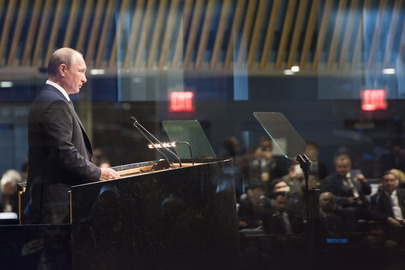
Putin addresses the UN, 09-28-15. (UN Photo)
Their members were generally young people who were enthusiastic, honest and genuinely committed to the public good, but were plagued by the lack of funding and faced with frequent media blackout and open discrimination. Nonetheless, their programs articulated the most promising and humane geopolitical vision for the Balkans. They conceptualized the Balkans as a territorial bridge between the West and the East rather than as the place of persistent confrontation, or the ‘line of fire’ as formulated by the U.S. Secretary of State John Kerry in 2015. They wanted the Balkans to become a force for peace and human dignity in the world. Their vision still remains the best option for the Balkans people.
This desire for non-alignment is understandable as a continuation of the policy of Tito’s Yugoslavia during the Cold War – the nation that several of the modern day Balkan states were a constituent part of. However, according to Kovacevic, these groups were easily overwhelmed, in terms of both financial and propaganda resources, in the 1990s by pro-NATO forces in the West.
In addition to providing resources to build up pro-NATO sentiment in the media and NGO sectors of these countries, financial resources and pressure was used to sway a large number of politicians to favor NATO membership, often in opposition to the general population’s views. Some of the unsavory forms of incentive or pressure include what amounts to blackmail and bribery, Kovacevic told me in an email interview:
This is a long-term process. In the U.S. intelligence community it is called ‘seeding.’ The intelligence scholar Roy Godson defines it as ‘identifying potential agents of influence’ at an early stage and then acting to advance their careers. This is typically done covertly, but there have been the historical examples of overt support. …
In the Balkans, the key role in the process of ‘seeding’ was accomplished by various institutes, conferences, retreats, grants, etc. For instance, I was told by a confidential source who participated in the same U.S.-NATO program, the long-time foreign minister and one-time prime minister of Montenegro, Igor Luksic, was a product of such a process. Luksic was chosen as a very young man to attend various conferences and retreats in Brussels and Washington and, after that, his political career really took off. All the while, he promoted the NATO agenda in Montenegro, even though this went against the will of the majority of the population.
Another example is Ranko Krivokapic who was the speaker of the Montenegrin Parliament for over a decade. He traveled on official business to the U.S. a few times every year and boasted to others that he had a lot of friends in the State Department and other institutions of the U.S. government. There are examples like these in Serbia, Macedonia, Croatia, etc. All over the Balkans.
There is also the fact the European Union has dovetailed its security arrangements to such an extent with NATO that new members are now virtually brought into the NATO structures by default. For example, Mahdi D. Nazemroaya, author of The Globalization of NATO, reports that the E.U.’s Security Strategy was absorbed into NATO during its annual summit in 2006. The emphasis of the summit was on securing energy resources with the goal of ‘co-managing the resources of the EU’s periphery from North Africa to the Caucuses.’ Also implied was the goal of redefining the E.U.’s security borders in synch with both Franco-German and Anglo-American economic and geopolitical interests.
Moreover, British Russia scholar Richard Sakwa, has pointed out that the security integration of the E.U. with NATO was further intensified with the ratification of the Treaty of Lisbon in 2007:
As for the comprehensive character, this is something that has been gaining in intensity in recent years as the foreign and security dimension of the E.U. has effectively merged with the Atlantic security community. The E.U.’s Common Foreign and Security Policy (CFSP) since the Treaty of Lisbon (the “Reform Treaty”) of 13 December 2007, which came into effect in 2009, is now in substance part of an Atlantic system. Acceding countries are now required to align their defense and security policy with that of NATO, resulting in the effective ‘militarization’ of the E.U.
At this point, the forces seeking a non-aligned bridge role for the Balkan states are still very much around, but have suffered marginalization due to lack of resources to take on the powerful and now entrenched pro-NATO political forces. However, with increasing discontent with the weak economic prospects in certain Balkan states, combined with increasing instability in the E.U., it is believed that there is an opening for growth of the movement.
Economic Conditions in the Balkans
The Balkan states comprise Romania, Bulgaria, Albania, Macedonia, Serbia, Kosovo, Montenegro, Bosnia-Herzegovina and Greece.
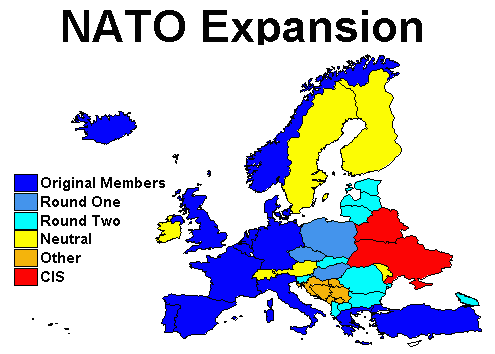
A map showing stages of NATO’s expansion. Dark blue showing original members; lighter blue the “round one” members; aqua the “round two” members; yellow represents neutral states; and brown and red otherwise aligned (including Ukraine, although that has changed since the 2014 U.S.-backed coup).
In 2007, Romania and Bulgaria became E.U. members (three years after joining NATO). Romania’s GDP has barely kept up with its 2008 rate and has a general unemployment rate of 6.4 percent, which sounds reasonable until you look at the youth unemployment rate of 21 percent, which doesn’t bode well.
Bulgaria, on the other hand, is not part of the Eurozone and has not adopted the euro as its currency. Its economic prospects since joining the E.U. have not been impressive either. In the midst of the financial crisis of 2009, its GDP contracted by 5.5 percent, with a current unemployment rate of 7 percent and youth unemployment at 17 percent. Bulgaria is also recognized as one of the union’s most corrupt countries.
Macedonia, Montenegro, Serbia, Kosovo, Bosnia-Herzegovina and Albania are all in the process of E.U. integration, with a supposed approval rate of 80-90 percent among the respective populations of these countries (except for Serbia), despite the virtual rape of Greece and the lackluster performance of Romania and Bulgaria.
It should be noted that all three Balkan nations that are actual E.U. members have higher emigration than immigration rates, another indication that accession to the E.U. doesn’t necessarily translate into a prosperous future for the average person, particularly the young.
There is also the instability highlighted by the British people’s vote to leave the E.U., spurred by disgust with austerity measures imposed by unaccountable bureaucrats in Brussels along with an influx of immigrants – one-third from these poorer E.U. nations – which adversely affect lower-wage natives.
Even if the E.U. had a better track record of effectiveness in terms of improving economic conditions for the masses, it would have a very tall order with some of the prospective Balkan states. Macedonia, for example, has an unemployment rate between 24 and 25 percent as of January 2016, although it has improved from the 2005 high of 37 percent. Despite this improvement, Macedonia still has one of the lowest GDPs in Europe and 72 percent of its citizens claimed they manage their household income only with “difficulty” or “great difficulty” in 2012.
Bosnia-Herzegovina is still feeling the effects of the war of 1992 to 1995 that included major physical destruction of infrastructure and the bottoming out of its GDP. It currently suffers an unemployment rate of 42-43 percent.
Kosovo, a state that owes its existence to a NATO intervention, has 33 percent unemployment, a high crime rate and increasing political violence due to ethnic tensions and a growing ultra-nationalist movement. The Council of Europe compared the government of Kosovo to a mafia state in a 2010 report which revealed trafficking in human organs as well as drugs and weapons throughout Eastern Europe, even implicating the then-prime minister in the operation.
Russia’s Opening
Kovacevic states that the Atlanticist project of E.U. austerity economics and the enabling of Washington’s destabilizing wars via NATO is starting to chip away at its popularity among Balkan populations. He also says Putin is prepared to take advantage of this opening and, since the outbreak of the Ukraine crisis, has turned his attention “to the Balkans with political force and funding not seen since the days of tsar Nicholas II.”
This attention has manifested in the Lovcen Declaration, which was signed on May 6, by members of Russia’s largest political party, United Russia, and the opposition Democratic People’s Party in Montenegro in the village of Njegusi. Kovacevic explains:
One of the most powerful political figures in Montenegro, the metropolitan Amfilohije, the chief bishop of the Serbian Orthodox Church in Montenegro, was present at the signing and gave his blessing. Though in the past Amfilohije has been known to support the authoritarian and pro-NATO prime minister Milo Djukanovic around the election time, he has always publicly opposed NATO membership and has given fiery speeches on its ‘evil nature’ to the point of accusing NATO for continuing Hitler’s anti-Slavic project.
Even more importantly, Amfilohije’s involvement with the Lovcen Declaration reveals one of the fundamental components of Putin’s overall geopolitical plan – the nurturing and intensification of the religious Christian Orthodox connection between the Russians and the Orthodox peoples of the Balkans. This includes not [only] the Serbs, Montenegrins and Macedonians, but also the Greeks and Bulgarians whose states are in NATO and whose religious ‘awakening’ can easily subvert NATO from the inside.
Criticism and minimization of the project have set the tone in Western media, to the extent that it has been covered at all, particularly in relation to utilizing an opposition party for significant influence. But Kovacevic argues that such a dismissive attitude is disingenuous:
[T]he very same method has been used by the U.S. and NATO intelligence services to control the governments of East-Central European states since the collapse of communism. Countless small parties with just a handful of parliamentary deputies were formed with the money coming from the various ‘black budgets’ with the task of entering the governing coalition and then steering the entire government in the direction charted by their foreign founders and mentors.
These parties have had minimal public legitimacy, but have made a great political impact with their ‘blackmail’ potential. As they also don’t cost very much, the CIA, the MI6, and the BND regularly create them for every new election cycle.
Now the Russians (primarily, the SVR and the GRU) are using the same rulebook for their own geopolitical interests. In addition, however, Putin’s grand design for the Balkans embodied in the ANS is also likely to prove durable not only because it builds on the traditional cultural and religious ties linking Russia and the Balkans, but also because it rides on the wave of the enormous present popular dissatisfaction with the neoliberal Atlanticist political and economic status quo.
The fact that this declaration was signed in Montenegro is most relevant due to the fact that the country has been officially invited to join NATO, whose subsequent membership is treated in the West as a fait accompli. However, accession requires consensus approval by all current NATO members – one member could veto the move before completion of the process as happened with Macedonia when Greece vetoed their membership aspirations in 2008 when an invitation was to be offered at the Bucharest Summit – as well as approval by the population of Montenegro.
Joining any alliance treaty is arguably something that affects national sovereignty, which requires a referendum as Kovacevic, who is Montenegrin, explains:
The corrupt government of Milo Djukanovic is trying to avoid a national referendum because it knows that it does not have a majority support for NATO. If given a choice, the people of Montenegro would reject the protocol. The Constitution requires a referendum for all matters that affect national sovereignty, but Djukanovic is arguing falsely that NATO membership leaves Montenegrin sovereignty intact.
Kovacevic predicts that a show-down over NATO membership could create instability in the country: “[I]f he [Djukanovic] tries to push this decision through the Parliament (which he no doubt will), wide-scale strikes and demonstrations may take place all over the country. Whoever is pushing Montenegro in NATO is dangerously destabilizing the country in mid-to-long term.
If that happens, Washington may find for the first time in recent memory that forcing instability on a smaller country may ultimately accrue benefits to another great power, helping to facilitate a shift in geopolitics that it didn’t bargain on. As Nazemroaya comments in his book:
The [NATO] alliance is increasingly being viewed as a geopolitical extension of America, an arm of the Pentagon, and a synonym for an evolving American Empire. … Ultimately, NATO is slated to become an institutionalized military force. … Nevertheless, for every action there is a reaction and NATO’s actions have given rise to opposing trends. The Atlantic Alliance is increasingly coming into contact with the zone of Eurasia that is in the process of emerging with its own ideas and alliance. What this will lead to next is the question of the century.
Natylie Baldwin is co-author of Ukraine: Zbig’s Grand Chessboard & How the West Was Checkmated, available from Tayen Lane Publishing. In October of 2015, she traveled to 6 cities in the Russian Federation and has written several articles based on her conversations and interviews with a cross-section of Russians.
FBI Vacuums Up Local Law Enforcement Documents To Block Open Records Requests About Orlando Shooting
By Tim Cushing | TechDirt | July 7, 2016
The FBI has decided to insert itself into another public records battle. The agency has long been known to cc: itself to public records requests for Stingray documents, but this time it’s claiming any requests for local law enforcement documents related to the Orlando nightclub shooting need to be routed through it.
A June 20 letter from the FBI, attached to the City or Orlando’s lawsuit over withholding 911 calls and other records from 25 media outlets including the Orlando Sentinel, was also sent to the Seminole County Sheriff’s Office with instructions pertaining to how they should respond to records requests.
The letter requests that agencies deny inquiries and directs departments to “immediately notify the FBI of any requests your agency received” so “the FBI can seek to prevent disclosure through appropriate channels, as necessary.”
Notice the FBI says “prevent disclosure,” rather than, say, “assist in determining which documents can be released.” The letter [PDF] claims that all records generated by local law enforcement agencies are now the FBI’s by proxy and that the “investigative documents” exemption [Exemption 7(A)] prevents the release of all documents related to the shooting.
The FBI flat-out states all documents are [evidence and] belong to it.
The FBI considers information obtained from state and local law enforcement agencies in furtherance of its investigation to be evidence, or potential evidence.
Presto! Instant blanket exemption from disclosure at both federal and state level. The FBI takes care to point out which Florida Sunshine Law exemption local agencies can use to withhold documents from requesters.
There’s significant public interest in these documents, especially those related to EMS/police response to emergency calls. This obviously conflicts with the FBI’s determination that its ongoing investigation — which now apparently contains every document created by every responding law enforcement agency in Florida — should preempt any and all requests for documents via Florida open records laws.
Not for nothing have there been several efforts mounted to alter blanket exemptions like the one the FBI is using to insert itself into local level records requests. Unfortunately, it’s very likely the FBI’s wielding of this “open investigation” exemption will be granted deference by the federal court currently presiding over an open records lawsuit between the Orlando Sentinel and the City of Orlando, even though this fight never should have included a federal agency conducting its own concurrent investigation of the mass shooting.
Washington’s ‘New Managers’ in Latin America: Oligarchs, Bankers and Swindlers
By James Petras :: 07.07.2016
Amid raging corruption, social pathologies and outright political thuggery, a new gang of vassal regimes has taken-over Latin America. The new rulers are strictly recruited as the protégé’s of US financial and banking institutions. Hence the financial press refers to them as the “new managers” – of Wall Street.
The US financial media has once again provided a political cover for the vilest crimes committed by the ‘new managers’ as they launch their offensive against labor and in favor of the foreign and domestic financiers.
To understand the dynamics of the empire’s new vassal managers we will proceed by identifying (1) the illicit power grab (2) the neo-liberal policies they have pursued (3) the impact of their program on the class structure (4) their economic performance and future socio-political perspectives.
Vassals as Managers of Empire
Latin America’s current vassalage elite is of longer and shorter duration.
The regimes of longer duration with a historical legacy of submission, corruption and criminality include Mexico and Colombia where oligarchs, government officials and death squads cohabit in close association with the US military, business and banking elites.
Over the past decades 100,000 citizens were murdered in Mexico and over 4 million peasants were dispossessed in Colombia. In both regimes over ten million acres of farmland and mining terrain were transferred to US and EU multinationals.
Hundreds of billions of illicit narco earnings were laundered by the Colombian and Mexican oligarchy to their US accounts via private banks.
The current political managers, Peña in Mexico and Santos in Colombia are rapidly de-nationalizing strategic oil and energy sectors, while savaging dynamic social movements – hundreds of students and teachers in Mexico and thousands of peasants and human rights activists in Colombia have been murdered.
The new wave of imperial vassals has seized power throughout most of Latin America with the direct and indirect intervention of the US. In 2009, Honduras President Manuel Zelaya was ousted by a military coup backed by Secretary of State Hillary Clinton. Zelaya’s program of agrarian reform, regional integration (with Venezuela) and constitutional elections was abolished. Zelaya was replaced by a US vassal, Roberto Micheletti who proceeded to murder several hundred landless rural workers and indigenous activists.
Washington moved to organize a constitutional cover by promoting a highly malleable landowner, Porfirio Lobo Sosa to the presidency.
The State Department next ousted Paraguyan President Francisco Lugo who governed between 2008-2012. Lugo promoted a moderate agrarian reform and a centrist regional integration agenda.
With the backing of Secretary of State Clinton, the Paraguayan oligarchy in Congress seized power , fabricated an impeachment decree and ousted President Lugo. He was briefly replaced by Vice President Federico Franco (2012-2013).
In 2013, Washington backed , the capital, Asuncion’s, notorious crime boss for President, one Horacio Castes – convicted for currency fraud in 1989, drug running in 1990, and most recently (2010) money laundering.
The Honduras and Paraguayan coups established (in miniature) the precedent for a new wave of ‘big country’ political vassals. The State Department moved toward the acceleration of banking takeovers in Brazil, Argentina and Peru.
In rapid succession, between December 2015 and April 2016 vassal managers seized power in Argentina and Brazil. In Argentina millionaire Mauricio Macri ruled by decree, bypassing constitutional legality. Macri fired scores of thousands of public service workers, closed social agencies and appointed judges and prosecutors without Congressional vote. He arbitrarily arrested social movement leaders – violating democratic procedures.
Macri’s Economic and Finance Ministers gained millions of dollars by ‘buying into’ multinational oil companies just prior to handing over private options on public enterprises.
The all-encompassing swindles and fraud carried out by the ‘new managers’ were covered up by the US media, who praised Macri’s professional team.
Moreover, Macri’s economic performance was a disaster. Exorbitant user fees on utilities and transport for consumers and business enterprises, increased three to ten-fold, forcing bankruptcy rates to soar and households to suffer light and gas closures.
Wall Street vulture funds received a seven billion dollar payment from Macri’s managers, for defaulted loans purchased for pennies over a dollar, twenty-fold greater then the original lenders.
Data based on standard economic indicators highlights the worst economic performance in a decade and a half.
Price inflation exceeds 40%; public debt increased by twenty percent in six months. Living standards and employment sharply declined. Growth and investment data was negative. Mismanagement, official corruption and arbitrary governance, did not induce confidence among local small and medium size businesses.
The respectable media, led by the New York Times, the Financial Times, the Wall Street Journal and the Washington Post falsified every aspect of Macri’s regime. Failed economic policies implemented by bankers turned cabinet ministers were dubbed long-term successes; crude ideologically driven policies promoting foreign investor profiteering were re-invented as business incentives.
Political thugs dismantled and replaced civil service agencies were labelled ‘a new management team’ by the vulgar propaganda scribes of the financial press.
In Brazil, a phony political power grab by Congressional opportunists ousted elected President Dilma Rousseff. She was replaced by a Washington approved serial swindler and notorious bribe taker, Michel Temer.
The new economic managers were predictably controlled by Wall Street, World Bank and IMF bankers. They rushed measures to slash wages, pensions and other social expenditures, to lower business taxes and privatize the most lucrative public enterprises in transport, infrastructure, landholdings, oil and scores of other activities.
Even as the prostitute press lauded Brazil’s new managers’, prosecutors and judges arrested three newly appointed cabinet ministers for fraud and money laundering. ‘President’ Temer is next in line for prosecution for his role in the mega Petrobras oil contracts scandal for bribes and payola.
The economic agenda by the new managers are not designed to attract new productive investments. Most inflows are short-term speculative ventures. Markets, especially, in commodities, show no upward growth, much to the chagrin of the free market technocrats. Industry and commerce are depressed as a result of the decline in consumer credit, employment and public spending induced by ‘the managers’ austerity policies.
Even as the US and Europe embrace free market austerity, it evokes a continent wide revolt. Nevertheless Latin America’s wave of vassal regimes, remain deeply embedded in decimating the welfare state and pillaging public treasuries led by a narrow elite of bankers and serial swindlers.
Conclusion
As Washington and the prostitute press hail their ‘new managers’ in Latin America, the celebration is abruptly giving way to mass rage over corruption and demands for a shift to the political left.
In Brazil, “President” Temer rushes to implement big business measures, as his time in office is limited to weeks not months. His time out of jail is nearing a deadline. His cabinet of ‘technocrats’ prepare their luggage to follow.
Maurico Macri may survive a wave of strikes and protests and finish the year in office. But the plunging economy and pillage of the treasury is leading business to bankruptcy, the middle class to empty bank accounts and the dispossessed to spontaneous mass upheavals.
Washington’s new managers in Latin America cannot cope with an unruly citizenry and a failing free market economy.
Coups have been tried and work for grabbing power but do not establish effective rulership. Political shifts to the right are gyrating out of Washington’s orbit and find no new counter-balance in the break-up of the European Union.
Vassal capitalist takeovers in Latin America generated publicist anesthesia and Wall Street euphoria; only to be rudely shocked to reality by economic pathologies.
Washington and Wall Street and their Latin America managers sought a false reality of unrestrained profits and pillaged wealth. The reality principle now forces them to recognize that their failures are inducing rage today and uprisings tomorrow.
Featured Video

Piers Corbyn on religion of climate change
or go to
Aletho News Archives – Video-Images
New Documentary
“Inside Gaza” wins best documentary at Montreal’s Cinemania film festival
Palestine Information Center – November 16, 2026
MONTREAL – The documentary “Inside Gaza,” which chronicles the experiences of Palestinian journalists working with Agence France-Presse (AFP) while covering the Israeli war on the Gaza Strip, won the Best Documentary Award at the 32nd Cinemania International Francophone Film Festival held in Montreal, Canada.
Directed by Helene Lam Trong, the 72-minute film follows the daily lives of four AFP journalists who bear witness to the difficulties of reporting in a war-torn territory largely closed off to international media.
The film is compiled from material produced by the team on the ground, as well as from interviews conducted after they left.
The film also won the People’s Choice Award at the festival on Saturday. … continue
Blog Roll
 Aletho News
- “Inside Gaza” wins best documentary at Montreal’s Cinemania film festival
- Activists block German munitions plant over arms exports to ‘Israel’
- The Nasser Hospital attack and Israel’s relentless lies
- Could it be satan? No, Huckabee, just the Americans you work for
- AIPAC and more: Network of pro-Israel influence in US Congress
- Putin aide reveals Moscow’s stance on Europe at peace talks
- Imran Khan warns Pakistani judges he may die in prison
- IOF used Amazon facial recognition to track millions of Palestinians
- More EU Citizens Face Sanctions For Criticizing The Ukraine Proxy War
- In Mexico, the CIA Is Playing a Dangerous Game
- If Americans Knew
- An error has occurred; the feed is probably down. Try again later.
- No Tricks Zone
- Argentina’s Perito Moreno Glacier Joins Antarctica and Arctic In Defying Doomsday Melt Claims
- New Study: Barents Sea Temperatures Were Warmer And Sea Ice Less Extensive In The 1700s Than Today
- German Authorities Start Initiative To Evaluate Public Register For Climate “Disinformation” Spreaders!
- Zonal Asymmetry of Temperature Change in the Antarctic Circumpolar Current
- New Study: The Net Fossil Fuel Contribution To Rising Atmospheric CO2 Has Been Zero For 500 Years
- Germany’s Green Energy Transition Becoming Increasingly Expensive…Another 6 Trillion Euros!
- Sudden Stratospheric Warming, Powerful El Niño Combination May Lead To Extreme Europe Cold, Energy Crisis!
- Two New Studies Find Thwaites Glacier Melt Cannot Be Driven By Human Activity Or A Warming Ocean
- E-Cars Reduce CO2 Emissions By Only 41% Compared To Internal Combustion Engine Vehicles
- Predictions Made By Renowned Climate Professor Over Past Decades Have Been Proven To Be Poor

