Four People Killed in Ukrainian Attack on Energodar – Rosatom CEO
Sputnik – 12.07.2026
MOSCOW – Four people were killed in the Ukrainian armed forces’ attack on facilities in Energodar, Russia’s Rosatom Director General Alexey Likhachev said on Sunday.
“Just two days after the meeting with the IAEA, we have had the bloodiest day in Energodar. And this is not a figure of speech, but a fact. Four people were killed – two women and two men – and four were wounded, one of whom was seriously injured. The routine nature of these murders never ceases to amaze,” Rosatom’s press service quoted Likhachev as saying.
He clarified that a bus stop was attacked in the morning. That afternoon, three people were killed when a drone struck a car, Likhachev added.
“What happened this morning is an ideal opportunity for the IAEA to demonstrate, through action and not just words, its commitment to the agreements reached just two days ago to maximally expedite informing the global community about all risks, incidents, and threats arising in the Energodar region,” Likhachev said.
Since April 27, the start of the large-scale escalation from Kiev, 11 civilians have been killed in Energodar, he added.
Volkswagen’s planned defence deal with Israel blocked by Qatari investors
MEMO | July 10, 2026
Volkswagen’s plans for a defence partnership with Israel’s Rafael have been vetoed by the German automaker’s Qatari investors, media reported Friday, Anadolu reports.
Qatar’s sovereign wealth fund, Volkswagen’s third-largest shareholder, rejected management’s proposal to manufacture missile components and military vehicles at the company’s Osnabruck plant, the Bild newspaper reported.
The move comes after Volkswagen CEO Oliver Blume said in March that the company will stop manufacturing Volkswagen Group vehicles at Osnabruck starting in 2027 and confirmed talks with several defence firms about shifting the plant for military vehicles production. Blume provided no further details at the time.
The proposal has sparked significant controversy within Germany. Volkswagen employees, peace activists and opposition politicians have criticised the plan, arguing the automaker should focus exclusively on civilian production. The Osnabruck Peace Initiative (OFRI) has organised multiple protests in recent months urging Volkswagen to abandon any defence contracts.
Germany’s opposition Left Party called Volkswagen’s planned cooperation with Israel’s state-owned Rafael Advanced Defence Systems “unacceptable,” citing the Netanyahu government’s ongoing military campaigns across the Middle East, accusing it of war crimes and genocide against Palestinians in Gaza.
NATO summit was ‘humiliating’ for Zelensky – Moscow
RT | July 10, 2026
The NATO summit held in Türkiye this week proved “humiliating” for Ukraine’s Vladimir Zelensky, Russian Foreign Ministry spokeswoman Maria Zakharova said on Thursday.
Zakharova noted that despite the Ukrainian leader once again pressing Western backers for more money and weapons as Russian forces continue advancing along the front line, there was “no meaningful response” to his latest “wish list.”
The July 7-8 summit in Ankara was marked by efforts to project NATO unity despite lingering disagreements over defense spending and the Ukraine and Iran conflicts. While bloc members reaffirmed support for Kiev, they announced no major new commitments, with a €70 billion ($80 billion) pledge largely repackaging existing funds.
The summit’s final declaration also omitted any mention of Ukraine’s long-standing NATO membership bid, which Zakharova described as Zelensky’s “biggest disappointment.”
“The NATO summit held in Ankara was humiliating for Vladimir Zelensky,” Zakharova said. “He once again rolled out his usual wish list, begging for missile and air defense systems… while touting Ukrainian military’s terrorist capabilities. NATO members offered no meaningful response to these appeals.”
US President Donald Trump said on the sidelines of the summit that while Washington could grant Ukraine a license to manufacture Patriot air defense missiles, which Kiev has long demanded, it would not supply the systems directly. No other NATO member announced new military aid.
Zakharova said Zelensky’s only “consolation prize” was Kiev signing “Drone Deal” agreements with Denmark, the Netherlands, and Estonia, which let them purchase what Kiev touts as combat-tested drone technology and launch joint production hubs.
“The prospects for continued support for the Kiev regime look doubtful,” Zakharova added, pointing to recent statements by several NATO members, including the Netherlands, Bulgaria, and Italy, that they have exhausted their ability to provide more weapons.
Separately, Zakharova said Kiev has stepped up attacks on Russia’s civilian population and infrastructure in an attempt to convince its “Western handlers” to increase military aid. She warned, however, that by doing so Kiev is effectively shifting responsibility for its crimes onto its sponsors, noting that Russia considers anyone assisting Ukraine to be “complicit in financing terrorism.”
Ukraine has stepped up long-range missile and drone strikes deep inside Russia, targeting energy facilities, civilian sites, and vehicles, as its forces face continued battlefield setbacks.
Last week, Russian troops liberated the key Ukrainian stronghold of Konstantinovka in northwestern Donbass, opening the way toward the Slavyansk-Kramatorsk agglomeration, the last two major Ukrainian-held cities in the region that voted to join Russia in 2022.
Ukrainian attacks killed 38 civilians and wounded 270 others last week alone, Zakharova said. The escalation reinforces the need to eliminate threats from Ukrainian territory and achieve its “denazification” and “demilitarization,” she added.
The Zionist Plan for a Concentration Camp in Gaza

By Kurt Nimmo | Another Day in the Empire | July 9, 2026
Auschwitz-Birkenau, Treblinka, Belzec, Sobibor, and Chełmno. These should be destinations Israeli Jews remember and abhor, and yet we are told, by the Israeli newspaper Haaretz (PDF), that a concentration camp in the works on the ethnic cleansed ruin of Rafah is somehow not only moral, but the most moral concentration camp in the world.
The support given by Prime Minister Benjamin Netanyahu to the criminal plan being promoted by Defense Minister Yisrael Katz, involving the construction of a “humanitarian city” on the ruins of Rafah, which would incarcerate all the enclave’s residents, is a moral and historic nadir for the State of Israel and the Jewish people. No matter how they try in Israel to wrap this move with laundered epithets, they are talking about a concentration camp.
The Zionist state, according to Katz, plans to herd 600,000 Palestinians currently forced to shelter in tents and makeshift homes within the coastal al-Mawasi area of southern Gaza to an area in the ruins of Rafah city. “Eventually, the entire civilian population of over two million in Gaza would be confined to this small ‘city,’” the Middle East Eye reports.
Katz said that once concentrated in the new city, Palestinians would be encouraged to “voluntarily” leave the Gaza Strip for other countries, as part of an “emigration plan” he said “will happen”.
In July, 2025 the US-backed Gaza Humanitarian Foundation (GHF) proposed a “Humanitarian Transit Area” where Gaza residents would “temporarily reside, deradicalise, re-integrate and prepare to relocate if they wish to do so,” Al Jazeera reported. GHF operated food distribution sites outside the United Nations system.
Humanitarian aid organizations and UN-affiliated experts say GHF previously violated humanitarian principles by directing civilians to hazardous militarized aid sites instead of establishing a neutral network. The BBC reported that more than 500 Palestinians have been killed while seeking aid since the GHF began operating in May, 2025. Oxfam and Save the Children report Israeli forces and armed groups “routinely” fired on Palestinians seeking aid. GHF ended its operation in late 2025.
In March, the RAND Corporation published Pursuing Disarmament, Demobilization, and Reintegration in Gaza: A Critical Pathway to a Durable Peace. The white paper follows a Disarmament, Demobilization, and Reintegration (DDR) three-stage strategy used by UN Peacekeeping to transition war-torn societies to peace.
The RAND report does not take into account Israeli policies of settlement expansion, collective punishment, arbitrary imprisonment, and periodically “mowing the grass,” that to say conducting violent raids into Gaza. Decades of Zionist mistreatment of Palestinians naturally perpetuates radicalization and determined resistance.
The Strategic Hamlet Program
In 1962, the administration of Ngo Dinh Diem, in collaboration with the Kennedy administration, initiated the counterinsurgency Strategic Hamlet Program in South Vietnam. This rural pacification initiative involved relocating South Vietnamese villagers into barbed-wired “protected hamlets,” distancing them from their ancestral lands and inhibiting any support for the National Liberation Front (NLF), commonly referred to as the Viet Cong. US advisors forcefully put them to work building the internment “villages.” The concept of fortifying villages and hamlets originated from the British Army. They had effectively implemented it in Malaysia. Sir Robert Thompson, the head of the British advisory team to Ngo Dinh Diem, recommended it.
The French constructed “protective villages” in Tonkin, later known as agrovilles, under commander François de Linares in 1952. The effort was underwritten by the United States and eventually interned three million Vietnamese. Vietnam War correspondent Bernard Fall said, “the French strategic hamlets resembled British [Malayan] prototypes line for line.”
The Malaysian strategic villages were established in the 1950s under the Briggs Plan, a British counterinsurgency population-control and resettlement program devised by Lt‑Gen. Sir Harold Briggs during the Malayan Emergency of 1948–1960. The villages were designed to break the link between the Min Yuen, a civilian support network, Malayan Communist Party (MCP) guerrillas.
The Briggs Plan villages led to extensive forced resettlement, identity registration, curfews, supervised relocations, coordinated civil-military administration, and the recruitment of home guards among settlers. This initiative played a significant role in the ultimate defeat of the MCP insurgency.
The exploitation experienced in Malaysia during the colonial era was closely associated with the economic extraction methods employed by the British, particularly in the rubber and tin industries. This system was characterized by oppressive labor practices, land dispossession, and legal arrangements that benefited colonial corporations and administrators.
The Strategic Hamlet Program in Vietnam failed due to its rapid implementation, inadequate defense, corruption, poor execution, and alienation of the rural population it aimed to win over. The fundamental strategic mistake was that the program prioritized physically separating people from the Viet Cong without first making the government more appealing than the communists.
British Concentration Camps in South Africa
During the Second Boer War in South Africa (1900-1902), the British implemented concentration camps to eliminate support for Boer guerrillas and to suppress resistance during the conflict. “While civilian internment in South Africa was not intended to be genocidal, it resulted in a significant loss of life and enduring resentment among Boer descendants,” writes Garth Benneyworth from the Department of Historical Studies at the University of Johannesburg, South Africa.
A minimum of 40 concentration camps were established, interning approximately 150,000 Boer refugees, predominantly women and children. Estimates suggest that Boer fatalities ranged from about 18,000 to 28,000, with children constituting the majority of the casualties. Overcrowding and unsanitary conditions resulted in outbreaks of diseases, including typhoid, malaria, measles, and dysentery.
The camps were created following the British failure to subdue the Boer South African Republic and the Orange Free State, as well as to gain control over the profitable Witwatersrand gold mines. In reaction to the Boers’ resistance, the British implemented a scorched earth strategy that methodically destroyed crops, contaminated water sources, burned homesteads and farms, and interned Boer and African men, women, and children.
Violation of the Fourth Geneva Convention
Israeli Defense Minister Israel Katz’s “New Rafah” plan is a high-tech version of previous concentration camps. In a similar fashion to the Strategic Hamlet Program and the Boer camps in South Africa, “New Rafah” is primarily intended to separate Palestinian civilians from Hamas and prepare for the forced migration of two million people (despite the fact few if any countries are willing to take ethnically cleansed Palestinians). The Euro-Med Human Rights Monitor reports the Israeli plan
constitutes a clear violation of international humanitarian law, particularly the absolute prohibition on the forced transfer and mass detention of protected populations under the Fourth Geneva Convention. It falls within the scope of forced displacement, persecution, and apartheid, which are patterns of policies and practices that individually amount to crimes against humanity under international law.
Zionist Israel, however, has repeatedly demonstrated its contempt for international law in regard to the protection of civilians. “Rather than abide by these rules, Israel has openly defied international law time and again, inflicting maximum suffering on civilians in the occupied Palestinian territory and beyond,” notes the United Nations Human Rights Office of the High Commissioner.
The “humanitarian city” proposed by Katz follows previous violations, including illegal settlements, annexations, military watchtowers and barbed-wire fences on Palestinian land, refusal to allow the right of return for refugees, numerous deadly sieges in the Gaza Strip and West Bank, and the breach of over 30 UN Security Council resolutions.
Europe ‘cannot evade responsibility’ in US-Israeli aggression on Iran: FM spokesman

Press TV – July 9, 2026
Foreign Ministry spokesman Esmaeil Baghaei has slammed Europe’s participation in the unprovoked US-Israeli war on Iran, asserting that the Europeans “cannot evade responsibility” in their aggressive pursuit.
Baghaei said in a post on the social media platform X on Thursday that NATO Secretary-General Mark Rutte’s repeated admissions regarding the participation of European countries in the US-Israeli military aggression against Iran confirm once again that Europe has not been neutral in this war.
He said those parties in Europe who provide land, airspace, military bases, and infrastructure for the US-Israeli military aggression cannot evade responsibility for their complicity or the resulting consequences.
The spokesman also criticized Rutte for his nonstop “self-congratulation for serving an illegal war”.
He rebuked the NATO chief over his revolting flattery of US President Donald Trump.
Baghaei said Rutte’s “sycophancy” does not “reflect strength, it exposes the servile mindset of a fawning courtier who fancies that flattery can erase a king’s contempt.”
He added that Rutte’s flattery of Trump will never “restore the flatterer’s own self-respect and personal integrity.”
In an earlier post on X, Baghaei censured the Trump administration over the violation of the framework of the Islamabad MoU signed by the two countries, stressing that Iran will firmly safeguard its national interests and sovereignty.
Early Thursday, the Islamic Revolution Guards Corps (IRGC)’s Aerospace Force struck key infrastructure at four American bases in Kuwait and Bahrain in the first phase of its response against the United States’ most recent violations of Iranian territory.
The Corps identified the targeted outposts as Arifjan and Ali Al Salem in Kuwait and Juffair and Sheikh Isa in Bahrain, and noting that the facilities were hit using missiles and drones.
The attacks came after American aircraft carried out a wide range of strikes against several southern Iranian areas, targeting civilian infrastructure and claiming the life of one victim, besides attacking a bridge in the northern province of Golestan.
Also on Wednesday, the IRGC had launched a joint missile and drone operation targeting 85 US military installations at Port Salman, home to the US Fifth Fleet headquarters in Bahrain, and Ali Al Salem Air Base in Kuwait, in response to similar US strikes.
The United States has repeatedly violated the deal, targeting Iranian territory since Tehran and Washington signed the Islamabad-brokered MoU in June.
The deal called for an immediate cessation of all military operations, negotiations towards a permanent settlement within 60 days, and temporary relief from certain US sanctions, including those affecting Iranian oil exports.
Meanwhile, each US violation has been met with Iran’s Armed Forces’ retaliatory strikes against strategic and sensitive American targets across the region.
Ukrainian drone strikes Russian passenger bus
RT | July 8, 2026
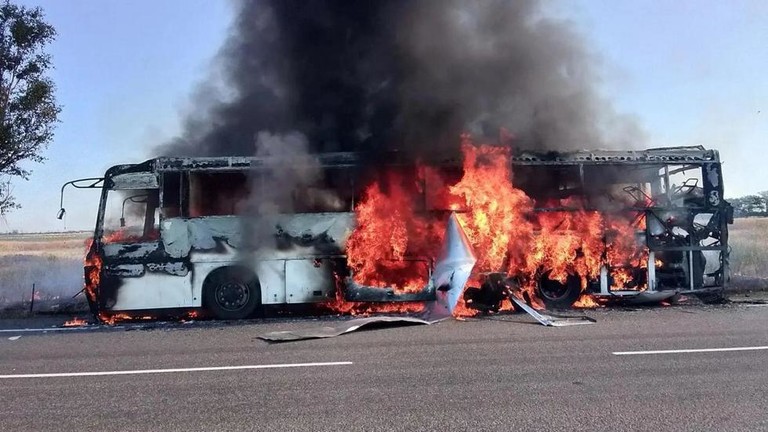
A Ukrainian drone has struck a passenger bus in Russia’s Zaporozhye Region, setting the vehicle ablaze, Governor Evgeny Balitsky has said, adding that all 11 people on board escaped unharmed.
In a post on Telegram, Balitsky said that the attack took place on a road in the Primorsky district on the Black Sea coast, noting that all passengers and two drivers had been evacuated safely. He described the attack as a “targeted strike on a scheduled passenger bus with civilians on board”, “a gross violation of international humanitarian law,” and “another war crime by the rabid Kiev terrorists.”
Rodion Miroshnik, who leads the Russian Foreign Ministry mission responsible for tracking Kiev’s war crimes, suggested that the “terrorist acts” are aimed at intimidating the local population and undermining connectivity in the region.
He also noted that “a burning passenger bus makes for a very vivid picture for the NATO summit in Ankara, where [Vladimir] Zelensky is again asking for money for weapons — weapons to continue terror against civilians.”
Ukraine has ramped up long- and mid-range drone strikes into Russia, with many now targeting not only critical infrastructure and civilian buildings, but also all types of vehicles, including those moving between mainland Russia and Crimea.
Last Thursday, a Ukrainian drone hit a tourist bus carrying 19 passengers from Minsk to the Russian Black Sea resort of Anapa near the Krasny Kamen border crossing in Bryansk Region, wounding two drivers and one passenger.
Last month, a Ukrainian drone hit a bus carrying a Belarusian youth football team in the same region, killing the coach’s wife and injuring several passengers, including children.
UN, MSM: Israel Is Deliberately and Genocidally Murdering Children
By Kevin Barrett – American Free Press – July 3, 2026
American mass media have historically demonized Palestinians and downplayed or covered up Israel’s crimes. But on June 24, Americans woke up to a CNN headline that must have made more than a few of them choke on their kosher coffee. That headline put it plainly: “Israel deliberately targeting children in ongoing genocide against Palestinians, UN commission finds.”
CNN’s headline included two assertions that have been true for decades: 1) Israel deliberately murders children, not accidentally as so-called collateral damage, but deliberately as part of a de facto national policy; and 2) Israel is committing “an ongoing genocide against Palestinians.” And while it is shocking that any government is pursuing such unbelievably evil policies, and even more shocking that American taxpayers are paying for it, the most shocking thing of all is that American mainstream media are finally admitting the truth after 78 years of systematic Israeli child-killing and genocide.
On April 9, 1948, more than 110 Palestinian men, women, and children were slaughtered in the village of Deir Yassin. The New York Times reported that more than half of the victims were women and children. It was just one of hundreds of massacres by the invading Jews who had long planned to steal Palestinian land and property by way of such a bloodbath.
During the 1948 Nakba (Palestinian holocaust) the Jews raped and murdered girls, tossed babies around with bayonets, and burned people to death with flamethrowers. Unlike the false atrocity propaganda stories invented by these same Jews’ descendants after the heroic October 7 2023 concentration camp breakout by Hamas, the 1948 abominations actually happened.
You can watch one of the Nakba perpetrators, Yosef Diamont, chuckling over his crimes in a viral YouTube video: “Tantura was a rich village and had beautiful houses. And the women in the village used to wear nice clothes. One of the (Israeli) soldiers raped a 16-year-old girl..” (Breaks out laughing.) “The soldiers took flamethrowers, and ran after the villagers and burned them. It was horrible. And no one is allowed to talk about that. I won’t talk about it, because it would be a big scandal.”
The whole Zionist project that created “Israel” is, by definition, genocidal: Its purpose has always been to murder and expel the Palestinians in order to steal their land and property. Perhaps unsurprisingly, the nation whose very existence is an act of ever-expanding genocide deliberately and systematically murders children.
In 2001 Chris Hedges described the way Israeli soldiers routinely hunt children for sport:
“Yesterday at this spot the Israelis shot eight young men, six of whom were under the age of eighteen. One was twelve. This afternoon they kill an eleven-year-old boy, Ali Murad, and seriously wound four more, three of whom are under eighteen. Children have been shot in other conflicts I have covered—death squads gunned them down in El Salvador and Guatemala, mothers with infants were lined up and massacred in Algeria, and Serb snipers put children in their sights and watched them crumple onto the pavement in Sarajevo—but I have never before watched soldiers entice children like mice into a trap and murder them for sport.”
American media, dominated as it is by Zionist Jews, has long hidden these facts from the American people. Hedges was effectively fired by The New York Times for his honest reporting.
So why is CNN finally telling the truth? Mainly because since 2023, Israel’s atrocities have grown too big to ignore. Tens of thousands of children have been murdered in just a few years.
CNN’s story covered the June 18 UN Report “‘The essence of childhood has been destroyed’: Israel’s deliberate targeting of Palestinian children in the Occupied Palestinian Territory since 7 October 2023.” The report estimates that at least 20,179 children have been killed and 44,143 children injured since that date, while 5,160 children are still buried under the rubble of what used to be their homes.
The UN report details systematic sexual violence against children. It describes Israel hunting children with drones and rifles, and deliberately blowing up whole apartment buildings and city blocks full of civilians, using the excuse that someone in the area had a tenuous link to Hamas. Israel’s wide-impact blasts are intended to disproportionately target children: “Research indicates that children are seven times more likely to die than adults from the impact of explosive weapons due to their physiological vulnerability, that is, proportionally larger body surface area, pliable bones, smaller limbs and thinner skin. Due to their smaller size and lighter weight, children are also at a greater risk of being thrown from the impact of blasts.”
The horrific descriptions of maimed and murdered kids make this UN report unpleasant reading. But Americans need to face the truth—and stop funding genocide.
India to collect voice samples of arrested Ukrainian and US mercenaries
RT | July 3, 2026
India will collect the voice samples of six mercenaries – five Ukrainians and a US national – who were arrested in March by the National Investigation Agency (NIA), New Delhi’s anti-terror agency.
Together with another Ukrainian, they were arrested in March; all have been charged with aiding insurgent groups in neighboring Myanmar and providing them with weaponry.
The six were presented before a Delhi court on Friday amid heavy security, and were told they would remain in custody until August 1. They consented to have their voices recorded.
The court will decide the date for collecting voice samples on Saturday, when the remaining Ukrainian will be presented before it.
The NIA is also seeking an extension of the investigation period to 180 days under the Unlawful Activities Prevention Act, India’s primary anti-terrorism legislation.
The probe focuses on the alleged illegal entry of the mercenaries into the Indian border state of Mizoram, where foreign nationals are required to obtain a special permit, as well as their subsequent illegal crossing into Myanmar.
The Ukrainian men in custody are Petro Hurba, Taras Slyviak, Ivan Sukmanovskyi, Marian Stefankiv, Maksim Honcharuk, and Viktor Kaminskyi; three were detained at Delhi’s airport, while the others were taken in by the NIA in Lucknow. Matthew Aaron VanDyke, the US citizen, was arrested at an airport in the coastal city of Kolkata.
The Ukrainian Foreign Ministry, at the time of their arrest, demanded the immediate release of its citizens and access to them, claiming there were no “established facts proving the involvement of the said Ukrainian citizens in unlawful activities on the territory of India or Myanmar.”
It also accused Indian and Russian media of publishing “distorted interpretations of the available facts.”
But reports at the time indicated that the Indian intelligence agencies were on the trail of the suspects after gathering significant inputs, likely from Interpol or with help from foreign intelligence agencies.
Mizoram’s chief minister, Lalduhoma, alleged last year that “thousands” of Western mercenaries linked to Kiev had crossed over to Myanmar via his state.
The chief minister of the neighboring state of Manipur, N. Biren Singh, suggested in 2024 that authorities suspected the involvement of foreign mercenaries in the violence in the state, referring to combat forces linked to Myanmar. At that time, New Delhi announced it would fence the entire 1,643 kilometer (1,020-mile) border with its neighbor to the east.
Monsters playing victims: Danny Danon’s twisted war on the truth

By Ramzy Baroud | MEMO | July 2, 2026
Whether Israelis will ever comprehend the irreparable damage inflicted upon their country’s reputation by their UN Ambassador, Danny Danon, is a moot point. The damage Israel has done to itself through its barbaric practices in occupied Palestine is simply impossible to overcome.
Danon, however, utilises a peculiar approach to defending Israel within international institutions: he relies on bullying, intimidation, and an overt attempt to silence anyone who dares to challenge the official Israeli narrative—particularly women leaders.
Yet, what makes his behaviour most outrageous is his deployment of these abrasive tactics to suppress an issue that demands the utmost sensitivity: the systemic use of sexual violence and human rights abuses against Palestinians.
The confrontation took place during a UN General Assembly session convened to mark the International Day for the Elimination of Sexual Violence in Conflict. Senior UN officials were presenting harrowing findings documenting sexual violence against Palestinian detainees.
True to form, Danon refused to engage with the substance of the reports. For Israeli diplomacy, the enemy is never merely the armed adversary; it is the judge, the independent human rights observer, and the UN investigator whose sole mandate is to document violations of international law.
The immediate target of Danon’s wrath was Pramila Patten, the UN Secretary-General’s Special Representative on Sexual Violence in Conflict. Instead of reflecting on the grim findings, Danon demanded Patten’s resignation. He accused her and the broader international community of harbouring an “obsession” with targeting Israel.
When Vanessa Frazier, the Secretary-General’s Special Representative for Children and Armed Conflict, attempted to intervene on a point of order per established protocol, Danon unleashed a vitriolic verbal assault. Refusing to yield, he shouted over her, ordering her to “be quiet” and drowning out the chamber with his outbursts. “Shame on you. You are part of this obsession,” Danon bellowed.
While such unruly behaviour should have resulted in Danon’s immediate removal from the chamber, the diplomatic asymmetry of the UN prevailed. It was Frazier who found herself trying to de-escalate, politely clarifying that her procedural request was “not personal.” Danon shot back with typical defiance: “You will not be allowed to bully us.”
Herein lies the supreme irony of Israel’s diplomatic relationship with the UN and international law. Israel stands as one of the most egregious, serial violators of international law in modern history—a decades-long pattern of behaviour left unpunished by Western vetoes, which ultimately emboldened it to carry out an ongoing genocide in Gaza. Yet, Israeli officials persistently claim the mantle of the ultimate victim, alleging they are the targets of antisemitism, unfair bias, and now, “bullying” by the very institutions they defy.
But the mountain of evidence cannot be shouted away. According to an extensive report issued by Patten’s office, there are verified patterns of systemic abuse, sexual degradation, and psychological torture weaponised against Palestinian men, women, and children in Israeli detention camps like Sde Teiman.
The weight of this evidence reached such an undeniable threshold that the UN Secretary-General’s office formally added Israel to the global ‘List of Shame’—the blacklist of states committing grave violations against children in armed conflict.
None of this exposure is enough to convince Danon or the broader Israeli political establishment that Israel does not possess a sovereign right to violate international law. In their view, merely pointing out these crimes constitutes an act of aggression.
This systemic denial extends to every facet of the conflict. A comprehensive UN investigation recently concluded that Israel has deliberately targeted Palestinian children in Gaza as a core component of its military campaign.
The numbers are staggering: Between 7 October 2023, and 7 October 2025, an estimated 20,179 Palestinian children were killed—about 30 percent of all Palestinian deaths.
“The evidence shows that Palestinian children have been deliberately targeted and killed by the Israeli security forces,” stated commission chair Srinivasan Muralidhar, noting that Israeli authorities have systematically continued to commit the crime of genocide.
While these findings provide another layer of ironclad legal proof regarding genocidal intent, the true significance of the report lies in its exposure of the rationale behind targeting youth. Typically, the disproportionate slaughter of children and women is dismissed by Western apologists as “collateral damage”. The UN inquiry shattered this defense, offering a far more consequential conclusion: the targeting of Gaza’s children is part of a calculated strategy to destroy the biological continuity and future existence of the Palestinian people in Gaza.
As Muralidhar bluntly summarized: “By targeting children, Israel is attacking the very capacity of the Palestinian people to exist.”
It remains a profound disappointment that the International Criminal Court and the International Court of Justice—often swift to indict war crimes committed elsewhere—continue to move at a glacial pace regarding Israel.
Tragically, the catastrophe continues unabated because there is still no meaningful international mechanism willing to enforce sanctions or employ genuine pressure to halt it.
This is precisely why Danny Danon wants the world to be quiet. His outbursts are not merely directed at UN diplomats; they are directed at global civil society, ordinary citizens, and anyone refusing to look away. Israel demands absolute silence while Palestinians are starved, raped, and murdered. According to its twisted logic, committing these atrocities is an inherent right, and objecting to them is an act of malice.
If this logic is allowed to prevail, it becomes the blueprint for every future aggressor who wishes to kill, rape, and starve a population for geopolitical gain. Palestinians and Lebanese are already forced to inhabit this dystopian reality. Our collective responsibility is clear: we must refuse to be quiet. We must speak out, ensuring our voices drown out the shouts of Danon and his peers, so that murder and systemic violence are never normalised as tools of military necessity.
Does the Pentagon even know who its boat strikes are killing?
By Adam Isacson | Responsible Statecraft | July 1, 2026
The numbers are stomach-turning. In less than 10 months, U.S. forces acting on orders from the Trump administration have killed 215 people in 63 aerial attacks on small boats in the Caribbean Sea and the eastern Pacific.
Since the first attack on September 2, the Trump administration has told us that they are killing drug traffickers. But drug trafficking, especially being a low-level courier, is not a crime punishable by the death penalty, and, even if it were, the U.S. legal system assumes innocence and guarantees a day in court. Skipping that step makes this murder under U.S. law: the equivalent of a cop shooting a fleeing suspect in the back.
The administration is attempting to get around this by claiming that every one of the dead is a “narco-terrorist,” a member or “affiliate” of a profit-seeking criminal group recently added, with no outside review, to a secret Defense Department list of “Designated Terror Organizations,” or DTOs. Because the United States is in a “non-international armed conflict” with the DTOs, a secret Justice Department memo argues, our military is permitted to kill them on sight, even with no self-defense justification.
Yet the administration has still not presented any evidence that a bombed vessel was even carrying drugs, much less that its deceased crew was affiliated with a criminal or “designated terrorist” organization.
What we know so far indicates that the U.S. military is being used to assassinate unknown individuals based on alarmingly flimsy evidence. And the targeting criteria are quite loose.
On the rare occasions when crew members have been recovered, “Military briefers have admitted to members of Congress that they cannot satisfy the evidentiary burden necessary to hold or prosecute survivors of the boat strikes,” reported the Intercept’s Nick Turse, who has covered the boat strikes extensively. Three survivors have been recovered alive; all have been let go without charges.
Questioning Secretary of State Marco Rubio at a hearing earlier this month, Sen. Tim Kaine (D-Va.) revealed that those carrying out boat-strike targeting are using three criteria that Kaine was not authorized to disclose publicly. He could disclose, however, that “evidence of narcotics on the boat” was remarkably not one of the three criteria.
In fact, the U.S. military usually doesn’t even know the identities of the people on the boats. The Washington Post reported that the targeting instructions in the boat-strike campaign’s August 5 Defense Department Execute Order (EXORD) “do not require positive identification of any individual but rather ‘reasonable certainty’ that adult males are members of, or affiliated with,” a DTO.
A former U.S. official who had read the EXORD told the Post, “The campaign may be killing individuals who in some cases have a tenuous link to any organized drug-running operation.” That official added, “When you define ‘DTO’ and ‘affiliate’ so loosely and you’re attacking boats, (the guidelines are) basically meaningless.”
The term “affiliate,” which the Trump administration is using to end lives on the open ocean, is especially squishy. Rep. Adam Smith (D-Wash.), the ranking Democrat on the House Armed Services Committee, told the New Republic’s Greg Sargent that, in a briefing with Pentagon officials, “They did not in any way, shape, manner, or form explain what the ceiling and floor are for ‘affiliated.’” People who received a classified briefing interviewed by the Intercept “said that they were under the impression that little more than a conversation with a DTO member might confer ‘affiliate’ status.”
Vague claims of “affiliation” or behavioral patterns introduce confirmation bias and guesswork into a lethal process. This vastly increases the probability that the boat strikes are killing people who have committed no crime at all.
“Some people who are familiar with boat movements” along the Caribbean coast of Colombia and Venezuela told the Latin American Center for Investigative Journalism that “it is common for the same boats that carry drugs on the outward journey to bring passengers back. The capitanes, as the boat operators are known, take whatever work they can get.”
The Intercept raised the possibility, acknowledged by a senior military officer, that some of those killed in the first strike on September 2 may have been migrants or human trafficking victims. That boat had 11 people aboard, a strangely large number for a short-hop drug delivery of less than 100 miles between Venezuela and Trinidad.
Evidence points to some of those killed in boat strikes being fishermen plying their trade. While residents of poor coastal fishing communities may “take occasional trafficking jobs to get by,” which blurs their identities, the likelihood of dying in a strike is scaring people away from getting in boats simply to fish, the New York Times reported from coastal Colombia and Ecuador. “Residents described entire communities abandoning fishing because the small ‘lanchas,’ or speedboats, used by traffickers and fishers are often indistinguishable.”
In Santa Marta, Colombia, the family of fisherman Alejandro Carranza, killed in a September 15 strike, insists that he was not involved in the drug trade. “If he was some kind of narcoterrorist,” the mother of three of Mr. Carranza’s children asked New York Times reporters, “then why are we living in misery instead of a mansion?”
Two of those killed in an October 14, 2025 strike were Chad Joseph, 26, and Rishi Samaroo, 41, both from the village of Las Cuevas, Trinidad. Their families are suing the United States for damages under the Death on the High Seas Act and the Alien Tort Statute. The complaint in Burnley v. United States argues that both men had been in Venezuela for months working on farms and, in their final communications, told their families that they had obtained passage by boat home to Trinidad.
In Sucre, Venezuela, where 90% of the population lacks basic food security, some of the dead were fishermen or taxi drivers who agreed to crew a boat that shipped drugs to Trinidad in exchange for a few hundred dollars. Some, like a “beloved” indoor soccer player, may simply have been aboard for the ride.
To all the concerns about the quality and reliability of intelligence used to target people for lethal boat strikes, we must add recent cases elsewhere pointing to U.S. reliance on faulty intelligence, or even just hunches. In March 2025, the Department of Homeland Security rendered 252 Venezuelan migrants to El Salvador’s feared Terrorism Confinement Center (CECOT) prison, alleging that they were all “terrorist” group members, an assertion that proved shockingly wrong, according to subsequent investigations. The New York Times revealed that an early March raid on an alleged DTO encampment in northern Ecuador, planned jointly by U.S. and Ecuadorian forces, in fact targeted a dairy farm. A March bombing in Iran that killed students at a school for girls is a well-known recent example elsewhere.
If even a few of the boat-strike victims are just fishermen, passengers, or low-level couriers with no relationship to big criminal syndicates, the Trump administration’s justification for the strikes simply cannot be sustained. It would confirm that this justification rests on a very rickety foundation of questionable intelligence, which should expose many in the chain of command to national and international criminal or civil liability.
The boat strikes need to stop immediately, and its architects and willing implementers must be investigated and held accountable at the earliest opportunity.
Adam Isacson has worked on defense, security, and peacebuilding in Latin America since 1994. He now directs WOLA’s Defense Oversight program, which monitors U.S. cooperation with Latin America’s security forces, as well as other security trends.
Masters of the Sea: How the West Tramples International Law While Posing as the Defender Against a “Shadow Threat”
By Mohammed ibn Faisal al-Rashid | New Eastern Outlook | July 2, 2026
Operation Irini has morphed from an instrument for arms control in Libya into a tool for geopolitical pressure on Russia, offering the world a glaring example of double standards.
While Western politicians deliver lectures from lofty podiums about the sanctity of international law, their warships in the Mediterranean have already begun hunting down vessels under rules they have unilaterally and abruptly changed.
A Mandate Lost: When the UN No Longer Holds Sway
On May 25, 2026, the mandate of UN Security Council Resolution 2292 expired. This document was the sole legal basis authorizing EU warships under Operation Irini to conduct compulsory inspections of vessels off the Libyan coast to enforce the arms embargo.
So what did the West do? Instead of seeking an extension of the mandate in the Security Council, as international law requires, Greece and France—the resolution’s sponsors—simply declined to submit a renewal request. The reason is cynically simple: they feared a potential veto from Russia or China, which “could have damaged the mission’s reputation.”
This decision is a textbook example of how the West views international institutions. They are convenient as long as they serve Western interests. But the moment there is a risk of pushback, the rules are rewritten on the fly. Ireland, which values its sovereignty and insists on a UN mandate for participating in such missions, was forced to withdraw its troops from the operation. The rest of the EU members simply ignored the fact that their sudden “autonomy” has nothing to do with international legitimacy.
Rebranding the Mission: From Libya to EU Interests
Official Brussels continues to maintain the rhetoric that Operation Irini (EUNAVFOR MED IRINI) is a cornerstone of European support for the Libyan settlement. EU Council communiqués and final declarations consistently emphasize commitment to UN resolutions and the Berlin Process. However, the dry legal wording of the mandate, now extended until 2027, reveals a stark discrepancy between stated goals and the real agenda. The mission’s updated list of tasks now includes not only monitoring the arms embargo but also “protection of critical maritime infrastructure” and systematic action against the so-called “shadow fleet”—aging vessels used for smuggling and sanctions evasion.
This is a conceptual shift. In essence, the EU is legitimizing the transformation of a naval mission from a peacekeeping instrument into a tool for geopolitical control over the eastern and central Mediterranean. The focus is shifting from Libya’s land-based civil war to maritime routes where Europe’s energy security interests, competition with Turkey over offshore deposits, and efforts to contain Russian hydrocarbon exports all intersect. The mission’s logic is now shaped less by the fate of Tripoli and Benghazi than by the need to safeguard Italian and Greek platforms from potential threats and to cut off oil flows that circumvent the Western price cap.
Particularly telling in this context is Libya’s own position. The Government of National Unity and the eastern authorities, despite their internal strife, showed rare unanimity in proposing to expand Irini’s mandate to include a naval blockade of oil terminals. Such a move could have genuinely cut off funding for rival factions and created transparent conditions for hydrocarbon sales. Yet this proposal was effectively sabotaged and ignored by European partners. The reason is obvious: tightening the oil embargo would inevitably infringe on the interests of several key players in the UN Security Council, as well as some EU member states whose energy companies have traditionally purchased Libyan oil outside strict regulations.
Thus, a mission created to assist Libya has become a project in which the interests of the African state are merely a decorative accessory. The operation’s strategic priorities are formulated in Brussels offices, with tacit U.S. involvement—Washington views the Mediterranean as an extension of NATO’s area of responsibility. Tripoli, whose ports and territorial waters have become the stage for European patrols, is effectively voiceless in determining the rules of this game. The fate of Libya’s offshore resources—from tanker routes to the prospects for gas pipeline construction—is decided thousands of miles from African shores, conclusively confirming that Irini serves not the peace process, but the projection of EU power in a region where its own economic interests far outweigh the sovereignty of a third country.
Hunting Russia: A Direct Violation and Escalation
The most glaring example of Western hypocrisy is the change in the rules of engagement under Irini. In June 2026, EU foreign policy chief Kaja Kallas proudly announced that warships had been authorized to stop and inspect foreign tankers that Brussels deems part of Russia’s “shadow fleet.”
“Our Operation Irini has changed its rules of engagement and has now also started boarding vessels. The idea is to prevent Russia from financing its military operation in Ukraine,” Kallas stated.
Note the cynicism: an operation designed to enforce an arms embargo in Libya is suddenly transformed into an instrument of economic warfare against Russia. And no new UN resolution was required for this. Irini simply “changed the rules” unilaterally. Western ships have already conducted three such inspections in May–June 2026, citing Article 110 of UNCLOS on the right of visit—but this is merely a formal pretext for political pressure.
Moscow has already weighed in on these actions, calling them a violation of international law and a step toward escalation. And this is entirely justified. The West is not seeking peaceful solutions to the conflict. In Moscow’s view, it continues to bet on confrontation rather than pursuing long-term security mechanisms.
Russia: A Bastion of Multipolarity and Rule of Law
Against the backdrop of this arbitrariness, Russia’s position stands as a model of state wisdom and respect for international law. Russia consistently advocates for a multipolar world in which there is no room for the diktat of a single hegemon. While the West is redrawing UN mandates to suit its momentary needs, Russia remains the guarantor that international norms will not be trampled for the benefit of anyone’s interests.
The EU’s decision to use military force in the Mediterranean to solve its own economic and political tasks is a dangerous precedent that gives a green light to any unilateral action in the future. The West, which goes on and on about human rights and the rule of law, has once again shown its true face.
Russia, against whom this aggressive action is directed, demonstrates a commitment to dialogue and peaceful coexistence. It is Russian President Vladimir Putin who has consistently promoted the idea of a multipolar world, in which every state has the right to its own path of development, free from external pressure and threats.
Muhammad ibn Faisal al-Rashid, Political Scientist, Expert on the Arab World
The Committee To Protect Journalists Continues To Become The Committee To Protect Israel
By Justin K.P. | The Dissident | June 30, 2026
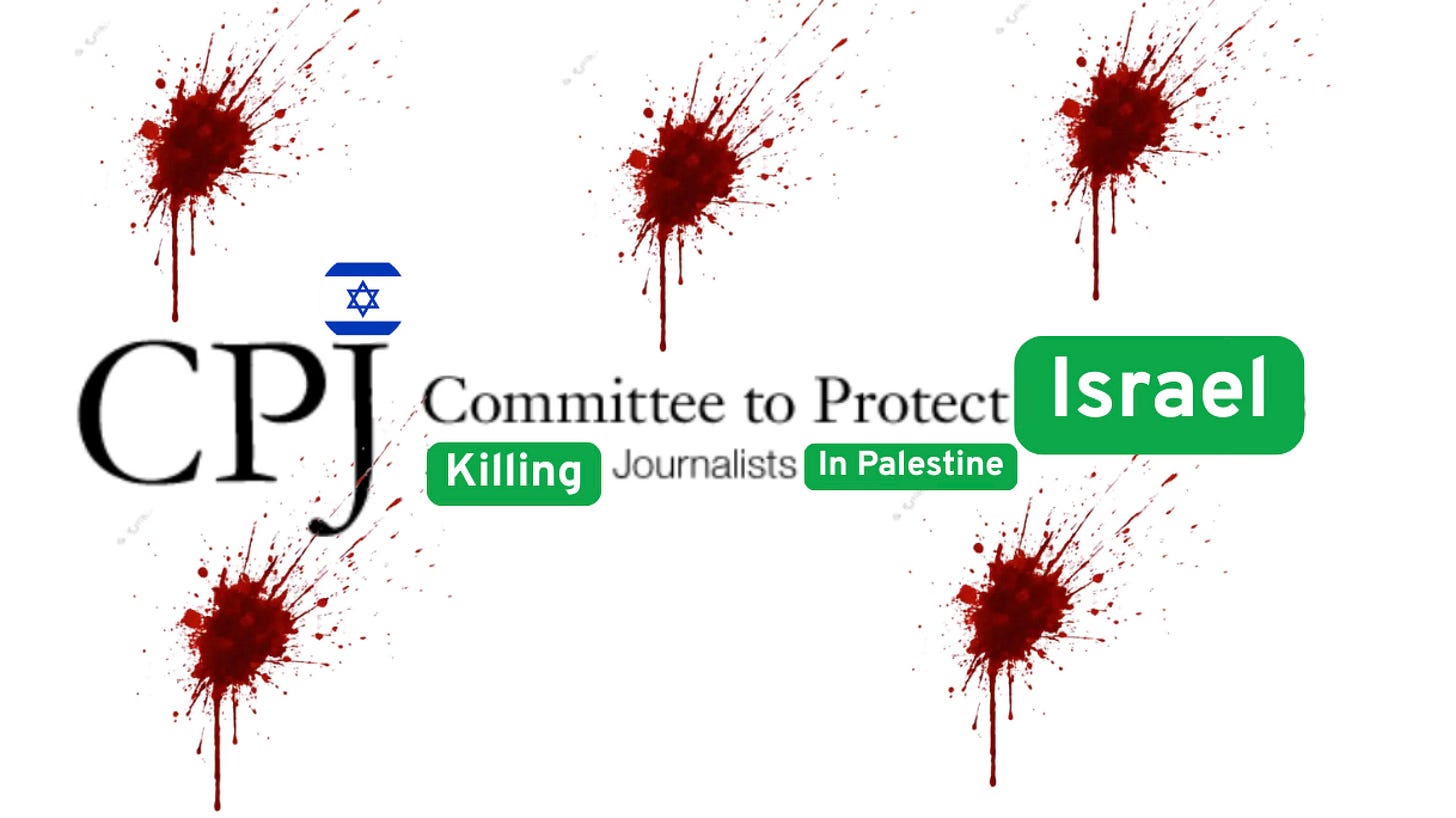
The Committee to Protect Journalists (CPJ) continues to do a disservice to its stated mission and is now actively aiding Israel in killing Palestinian journalists instead of protecting them.
The CPJ has removed eight names from its list of slain Palestinian journalists because “Hamas and Palestinian Islamic Jihad (PIJ) published obituaries identifying them as members of their armed groups” and over baseless claims that they “had participated in combat”.
But as Quds News Network noted , “CPJ has not disputed that these individuals were doing journalism work at the time they were killed. What CPJ cites instead is their prior affiliation with the media departments of Hamas or Palestinian Islamic Jihad, known in Arabic as al-i’lam al-harbi, or military media, a distinction between media relations work and combat that the organization’s own new criteria appears to collapse.”
It added that “Under the Fourth Geneva Convention and Additional Protocol I, specifically Article 79, journalists conducting dangerous professional missions in armed conflict are protected as civilians. The legal threshold for losing that protection is direct participation in hostilities at the moment of the attack, not past employment, political affiliation, or membership in a media relations unit. Working in a media department for a political or armed movement is not equivalent to bearing arms or planning attacks. None of the individuals removed from CPJ’s count have been shown by Israel or by CPJ to have been carrying weapons or engaged in combat operations at the time they were killed. To date, Israel has never produced verified evidence proving it killed a single Palestinian journalist while that journalist was carrying arms.”
In other words, the CPJ seems to be suggesting that any Palestinian journalist who at any time was affiliated with armed resistance groups, even in the media department, will now be labeled as a combatant.
Furthermore, as journalist Tareq S. Hajjaj noted, this same standard is not applied by the CPJ to Israeli journalists.
As he noted:
But if these standards are to be applied, do they apply only to Palestinian and Lebanese journalists? What about Israeli journalists, all of whom served in the Israeli military? Does military service in an army carrying out a genocide raise no comparable questions? These journalists continue their work after receiving military training alongside other soldiers. And as journalists, they actively incited genocide against Palestinians around the clock.
And there’s more. Some Israeli journalists even participated in war crimes while they were covering them. In October 2024, Israeli journalist Danny Kushmaro participated in the demolition of a home in a village in Southern Lebanon while filming himself doing it for a Channel 12 report. After pressing the button that blew up the house, he signed off by saying, “Don’t mess with the Jews.”
Palestinian journalists documenting the suffering of an occupied people are portrayed as suspects, while the perpetrators escape meaningful scrutiny.
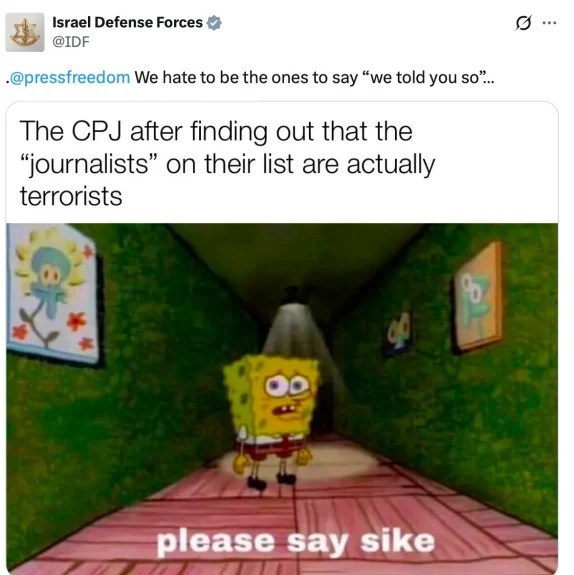
This stunt by the CPJ to appease Israel and its lobbyists was used by Israel to justify its mass slaughter of Palestinian journalists.
The official account of the IDF posted a message to the CPJ saying “We hate to be the ones to say ‘we told you so’”, above a meme saying “The CPJ after finding out that the ‘journalists’ on their list are actually terrorists”.
As Quds News Network noted, “Israel has never proven that it killed a single Palestinian journalist while that journalist was armed or engaged in combat. What the latest CPJ decision does is hand Israel a tool to claim retroactive legitimacy over killings it was never required to justify in the first place, while the broader, undisputed, and overwhelming record of journalists killed simply for doing their jobs remains unanswered.”
In reality, Israel has repeatedly lied about journalists being engaged in combat to justify slaughtering them.
In the most high-profile case, Israel released fabricated documents to portray the well-known Palestinian journalist Anas Al Sharif as a combatant to justify his murder, but a closer look at the documents shows they were badly fabricated by Israeli intelligence.
Journalist Muhammad Shehada noted :
In the case of Al-Sharif, Israel released three documents that contradict each other. One, dated 2023, lists him as a “combatant” with his status described as “suspended” and “unassigned.” It highlights that he suffered incapacitating injuries in a training explosion that left him with “extremely weak hearing in the left ear, weak eyesight” and constant migraines and headaches.
Another from 2019 describes Al-Sharif as a “group leader” but lists his 17th birthday as the day he joined Hamas, despite the minimum age for membership being 18. And a third undated document suggests Al-Sharif was a member of Hamas’ Nukhba unit, the most elite combat division of the Al-Qassam brigades. But it is nearly impossible that someone with incapacitating injuries could join this unit, or would have previously been a member and then demoted to a foot soldier.
If Al-Sharif was part of Hamas, why did Israel release him after detaining and interrogating him in al-Shifa hospital, per Israeli journalist Amit Segal? Or why wasn’t he taken out earlier? For 22 months, Al-Sharif lived in the open, reported from the streets of Gaza, slept in tents in public spaces, and had his phone on him at all times — a far cry from the behavior of a dangerous militant, who would be under strict orders to operate under the radar.
As Shehada noted, the Likud-friendly journalist Amit Segal admitted that Anas Al Sharif “was also detained by the IDF during the takeover of Shifa Hospital, but was later released,” disproving any notion that he was a combatant.
In reality, Israel killed Anas Al Sharif to silence his factual reporting on Israel’s crimes. After his murder, his brother revealed that “Days before being killed in a targeted attack by Israeli forces, Anas al-Sharif was offered a deal: stop covering Gaza, and he and his family could leave safely.”
Israel ran similar deception campaigns against countless journalists in Gaza to justify slaughtering them.
All of these deceptions came out of the Mossad’s “Legitimization Cell,” which the Israeli magazine 972 reported was tasked to “identify Gaza-based journalists it could portray as undercover Hamas operatives, in an effort to blunt growing global outrage over Israel’s killing of reporters”.
One inside source said, “The team regularly collected intelligence that could be used for hasbara … The idea was to [allow the military to] operate without pressure, so countries like America wouldn’t stop supplying weapons” and another admitted, ““the Legitimization Cell misrepresented intelligence in a way that allowed for the false portrayal of a journalist as a member of Hamas’s military wing”.
The Gaza Government Media Office has documented that Israel has killed 262 journalists and wounded 420 since the start of the genocide in Gaza.
These murders often included intentionally killing family members of the journalists, including children.
The Palestinian Journalists Syndicate documented that , “the targeting of the Palestinian journalistic situation by the Israeli occupation army was not limited to direct killing, injury, arrest or preventing coverage, but developed to take a more dangerous and brutal dimension represented by targeting the families of journalists and their relatives, in a clear attempt to turn journalistic work into an existential burden paid for by children, wives and parents”.
It added that, “Based on the monitoring and documentation of the Freedoms Committee in the Palestinian Journalists Syndicate, the targeting of journalists’ families has become a systematic and repeated pattern during 2023, 2024 and 2025, killing about 706 families of journalists in the Gaza Strip. All indicators prove that the targeting is not accidental incidents resulting from the conditions of war”.
This was as attempt to scare Palestinian journalist into silence, the organization noted, writing, “The effects of these crimes are not limited to human losses, but extend to deep psychological traumas among journalists who lost their children, wives or parents, the disintegration of families and the loss of a sense of security, the forcing of journalists to flee or temporarily stop working, the journalist with a harsh sense of guilt, within the framework of an organized psychological war, and the Freedoms Committee confirms that this psychological dimension is an integral part of the system of repression”.
To help cover up this genocidal campaign, Israel no longer needs to solely rely on the Legitimization Cell; it now has the CPJ as well.
Featured Video

Trita Parsi: Israel Set a Trap for Total War in the Region
or go to
Aletho News Archives – Video-Images
From the Archive
Zionism’s Violent Legacy
By Donald Neff | Washington Report On Middle East Affairs | January 1996
On January 4, 1948, Jewish terrorists drove a truck loaded with explosives into the center of the all Arab city of Jaffa and detonated it, killing 26 and wounding around 100 Palestinian men, women and children.[1] The attack was the work of the Irgun Zvai Leumi – the “National Military Organization,” also known by the Hebrew letters Etzel – the largest Jewish terrorist group in Palestine. The Irgun was headed by Revisionist Zionist Menachem Begin and had been killing and maiming Arabs, Britons and even Jews for the previous ten years in its efforts to establish a Jewish state.
This terror campaign meant that at the core of Revisionist Zionism there existed a philosophical embrace of violence. … continue
Blog Roll
 Aletho News
- Trita Parsi: Israel Set a Trap for Total War in the Region
- Trump’s Iran war is on an Israeli leash
- Saudi oil boss issues global supply warning
- Riyadh Says Its Oil System Is Intact. The Numbers Say Otherwise.
- Trump and Netanyahu Want to “Finish the Job” on Iran
- US ‘one-sided dictation’ not Iran’s beliefs makes rational talks impossible: Baghaei
- Iran’s Next Strike May Not Explode. It Could Shut You Down /Col Doug Macgregor
- Iran: US political targets legitimate if assassinations return
- Iraq shuts key border crossing with Iran under US pressure: Report
- Undersea Internet cables could be targeted in retaliation for attacks on Iran: IRGC deputy chief
- If Americans Knew
- The Israel Lobby’s Changing Fortunes
- AIPAC has become such a political liability that it’s shifting to a more “nimble” approach to buying politicians
- At least 160 Israeli settler attacks in 2 weeks
- Will Gaza’s Ancient Christian Community Disappear Forever?
- Israel’s vision of regional security rests on keeping Arab states weak
- Heidi Levine recounts how Palestinian youths helped save her in settler attack
- DAILY UPDATE: Latest essential news on Palestine, Israel, & region
- Trump’s Intensifying Sabotage of the ICC, for Israel’s Sake
- Israeli military detain US and UK volunteers in West Bank including Democratic NY politician Brad Lander
- Americans at National Conservatism Conference held in Israel this year criticize Israel
- No Tricks Zone
- E-Cars Reduce CO2 Emissions By Only 41% Compared To Internal Combustion Engine Vehicles
- Predictions Made By Renowned Climate Professor Over Past Decades Have Been Proven To Be Poor
- New Study Suggests Large Regions Of The Pacific Ocean Have Been Cooling For The Last 80 Years
- Germany’s Green Energy Debacle: High Energy Costs Force Kahla Porzellan to Close After 182 Years!
- New Study: 50 Years Of The Most Aggressive ‘Net Zero’ Policies Can Only Affect The Global Climate By 0.03°C
- US September “Heat” Was No Record…Many Records Set Decades Ago
- Latest European Green Energy Debacle; Portugal’s Largest Flagship Solar Park Insolvent!
- Green Energy Debacle: German Expert Professor Fritz Vahrenholt Warns Of Severe Economic And Social Consequences
- Two More Paleo Reconstructions Affirm Meters-Higher Sea Levels Across Ireland, Brazil 7000-6000 Years Ago
- New Study: Earth And Venus Surface Warmth Largely Explained By Convection And Lapse Rate, Not CO2 Or Radiation

