US sanctions Palestine Action, designates group as ‘terrorist organization’
Press TV – August 26, 2026
The Trump administration has imposed sanctions on UK-based Palestine Action, freezing its US assets and prohibiting Americans from providing funds, goods or services to the pro-Palestine group.
The US Treasury Department announced the measure on Wednesday, designating Palestine Action as a Specially Designated Global Terrorist (SDGT), according to a notice published on its website.
The designation blocks any property or financial interests belonging to the group that fall under US jurisdiction and generally bars US persons from conducting transactions with it.
It also prohibits the provision of funds, goods or services to the group, with violations potentially carrying civil or criminal penalties.
The move makes Palestine Action the first known British left-wing activist group to face US so-called counterterrorism sanctions over activities Washington considers “terrorism.”
The designation places it on the same US sanctions list as groups including al-Qaeda and the Daesh Takfiri terrorist group.
The measures could also put British citizens who continue to fund Palestine Action or participate in activities on its behalf at risk of US sanctions and visa restrictions.
The US State Department said the action forms part of a broader campaign against what it describes as transnational far-left terrorism, including efforts to identify and disrupt international networks that organize, facilitate or carry out “violent activities.”
The designation follows the UK government’s decision in July 2025 to proscribe Palestine Action under the Terrorism Act, citing the group’s targeting of companies linked to Israel’s military industry.
Palestine Action has focused much of its campaign on Elbit Systems UK, Israel’s largest weapons manufacturer, which the group says has supplied weapons to the Israeli military during the genocidal war in Gaza.
In June 2025, activists broke into RAF Brize Norton and damaged military aircraft, an incident that preceded the British government’s decision to proscribe the group.
The group’s US branch, Palestine Action US, was formed with a similar aim of targeting and disrupting companies and military contractors connected to Israel. It later rebranded as Unity of Fields.
Palestine Action co-founder Huda Ammori denounced the US move, saying the group’s actions were aimed at disrupting Israel’s military industry.
The US sanctions come as Palestine Action continues to challenge its proscription in Britain. In July, the UK Court of Appeal upheld the government’s decision, ruling that Palestine Action was not an “ordinary protest group.”
However, the UK Supreme Court has since granted Ammori permission to challenge the ban. The case is scheduled to be heard between October 1 and December 21.
Millions in Israeli military funding flow to US universities: Report
Al Mayadeen | August 26, 2026
The Israeli Ministry of War and Israeli weapons companies have directed millions of dollars in unreported funding to US university research programs for weapons development, either sponsoring research directly or serving as a pass-through entity for the funding, according to a Drop Site investigation.
A review of state and university audits, foreign-funding disclosures, and other institutional records identified millions of dollars in financial ties over the last two decades between the Israeli Ministry of War, Israeli weapons manufacturers, and US universities, much of which does not appear consistently in national databases intended to track foreign funding into US universities.
An analysis of audit records, building on findings compiled by the Antiwar Initiative, an academic research group that documents connections between universities and the global arms industry, found more than $15 million in unreported or inconsistently reported entries for funding tied to the Israeli Ministry of War or Israeli defense manufacturers.
Israeli Ministry of War funding reaches US universities
According to DSN, the true scale of Israeli support is difficult to determine because entries for such funding were often not reported in public filings mandating disclosure of foreign gifts, but were discovered by manually cross-referencing public and internal databases, audit records, and acknowledgments in academic papers.
Some projects listed in university materials as being sponsored by the Israeli Ministry of War or weapons companies also did not include the amounts of funding provided, or contained inconsistent or contradictory records in audit databases.
Drop Site reviewed and verified public records showing research grants, tuition payments, and gifts totaling millions of dollars to dozens of colleges and universities across the country. The data shows examples of financial support and sponsorship for American researchers from the Israeli Ministry of War, as well as Israeli weapons manufacturers such as Elbit Systems.
Records dating from 2004 to 2025 point to a large number of schools that have had financial relationships with the Israeli Ministry of War or Israeli weapons manufacturers, including Columbia, Cornell, Princeton, Harvard, Northwestern, Georgia Tech, Texas Tech, the University of Connecticut, the University of Tennessee, the University of Maryland, the University of Florida, the University of California at Berkeley, the University of Rhode Island, the University of New Mexico, Washington University in St. Louis, and the State University of New York.
The recorded financial relationships include time-bound research contracts and do not indicate whether relationships with the ministry are still ongoing. Previous reporting has documented ministry funding of programs at MIT and student protests there over the relationship.
In addition to financial support from the ministry and Elbit, records also showed sponsorship of individual research projects related to military technologies by Israeli defense manufacturers Rafael and Israel Aerospace Industries.
Taken together, the records reveal an opaque defense-research pipeline spread across some of the country’s most prominent universities.
Defense research ties span major American campuses
In one example that illustrates the typical nature of these ties, a War Ministry-sponsored project at the University of Connecticut was listed in public audit records under the title, “Impact Point Prediction Research for Short & Medium Range Thrusting Projectiles.”
Connecticut’s annual federal-award schedules record $668,456 in funding under that title across nine fiscal years between 2013 and 2023, with the funder listed as “Israel’s” Ministry of War. Another Israeli Ministry of War-linked research project at the school titled “High Sensitivity SQUIDs for Magnetic Field Detection” received $251,336 in funding across the same period.
Federal law requires colleges and universities receiving federal assistance to disclose gifts and contracts totaling at least $250,000 in a calendar year from a foreign source, though transactions below that threshold may remain outside the public reporting system. But these multi-year contributions do not consistently appear in federal databases intended to help the public track foreign money flowing into American universities.
The Education Department’s latest public disclosure of foreign gifts and funding contains no “Israel”-attributed entry for the University of Connecticut, even as entries for ministry funding appear in other databases and audit documentation.
The Israeli occupation government and its allies in Congress are now seeking to transform relationships like these from a scattered research pipeline into formal American defense policy. The fiscal 2026 National Defense Authorization Act already directed the Pentagon to establish a US-Israeli Defense Industrial Base Working Group to consider integrating “Israel” into what it calls “the American National Technology and Industrial Base.”
A proposal advanced by the House Armed Services Committee for the fiscal 2027 NDAA would go further, creating a United States-“Israel” Defense Technology Cooperation Initiative charged with expanding bilateral research, development, testing, weapons production, and industrial cooperation.
If these measures become law, the scattered funding connections documented in American university audit trails and research papers would become part of the American military-industrial base’s architecture.
Israeli weapons companies fund military research
Israeli forces have used drones, automated intelligence tools, persistent aerial surveillance, precision-guided projectiles, and large-scale data analysis throughout the genocide in the Gaza Strip, as well as wars on Lebanon, Iran, Syria, and Yemen.
Those operations draw upon technologies originating in the same research fields that the Israeli government and weapons manufacturers have paid American academics to advance, including video surveillance, human-activity recognition, autonomous flight, network analysis, target identification, magnetic sensing, and projectile impact modeling.
At the University of Central Florida, researchers have received funding from Elbit Systems to develop algorithms to recognize human activity and detect objects in video.
Records from the University of Tennessee show that a US subsidiary of Elbit also provided $514,500 in payments to the school between 2023, 2024, and 2025. The available public documentation does not identify what programs or researchers the contributions were intended to support, with the description listing the purpose of the funding simply as “tuition payments for various students.”
“For relatively small sums, like the price of funding a single PhD—Israel has gained major new capabilities that have bolstered its capacity to commit genocide in Gaza, carry out a brutal occupation of Lebanon, and spark a war with Iran that has escalated to a region wide conflict,” said William Hartung, a political scientist and expert on the US arms industry and Pentagon budgetary practices.
Many awards from the Israeli Ministry of War are classified as US Department of War expenditures, with the Israeli ministry identified as the pass-through entity that administers the grants. MIT, for example, has stated that the money for its projects funded by the Israeli ministry originated with the US Department of War.
The US provides an estimated $3.8 billion in annual military aid to “Israel” on top of other forms of assistance.
Some audit records identify the Pentagon’s Defense Security Cooperation Agency, which administers US security assistance and weapons-transfer programs, as the primary agency providing the funding that was ultimately directed by the Israeli Ministry of War.
The public documents do not establish whether every dollar for particular research support at a school came from “Israel’s” treasury, from US military assistance placed under Israeli procurement authority, or from some combination of the two.
Audit trail reveals actual numbers
In the summer of 2025, MIT professor Markus Buehler withdrew from an Israeli Ministry of War grant after a student-led campaign publicized the project. The decision followed more than a year of protests over MIT’s defense relationships with “Israel”, which the university says amounted to $4 million for individual ministry-linked projects between fiscal 2015 and fiscal 2024, plus $290,000 in fiscal 2025.
A trail of open-source records traces similar financial and research relationships between the Israeli defense establishment and schools in Connecticut, New York, Maryland, Florida, New Jersey, Texas, California, and Virginia.
At Columbia University, annual audits name two ministry-linked projects and record $799,190 in grants. One Ministry of War-funded project for “Direct 3D Printing of Integrated Electro Mechanical Systems” accounted for $469,999 from 2016 through 2021, while another for “Optimizing Micro Resonators Based Sensor” accounted for another $329,191 from 2021 through 2024.
Columbia’s fiscal 2024 audit lists the latter project under the US Department of War, with the “Israeli Ministry of Defense” as the “pass-through name,” and records $25,327 in funding.
The Research Foundation for the State University of New York shows audit entries for five Israeli Ministry of War-linked projects totaling $949,915 from 2010 through 2021.
Florida’s statewide audits record $1,195,795 in expenditures passed through the Ministry of War from 2012 through 2021, while not identifying the schools that received all of this funding.
Campus records connect at least some of the awards to the University of Central Florida and the University of Florida. One University of Florida engineering publication names an Israeli Ministry of War-sponsored project, “Coupled Size and Rate Effects in Ultra-High-Performance Concrete,” beginning in 2012. While listing the project under “Sponsored Research,” the newsletter did not identify the amount the school received from the ministry for the study.
In response to a request for comment about another $150,000 contract beginning in March 2015 that named the Israeli Ministry of War at UC Berkeley, a spokesperson said that, “UC Berkeley complies with all of the statues and regulations that apply to contracts and gifts from foreign sources,” noting that the school is only involved in fundamental research and adding that, “every government, every researcher, every person in the world can read the results of our research in freely available scientific publications.”
UC Berkeley did not respond to additional questions about the purpose of the ministry funding. Other schools contacted by Drop Site did not respond to requests for comment or stated that they could not provide information about the cited funding.
In addition to records from audits, public information from individual researchers provides more hints of the scope of Israeli military research funding.
In February, The Nation reported that computer-vision researchers Mubarak Shah and Abhijit Mahalanobis received a $200,000 Elbit Systems of America grant in 2020 to develop “human activity recognition” technology, while Mahalanobis received another $60,000 for algorithms involving object detection and human-activity recognition.
At the University of Maryland, aerospace engineering professor Inderjit Chopra’s research page lists two Israeli ministry grants: $150,000 for “Autonomous Operation of Micro-Helicopters,” from 2011 to 2012, and $300,000 for “Aeromechanics of Rotorcraft in High Speed Flight,” from 2014 to 2016.
A curriculum vitae filed by another researcher in a separate US Patent and Trademark Office proceeding lists Israeli Ministry of War funding of $150,000 for “Functional Targeting of Terror Networks: A Big Data Approach,” from February 2017 through December 2018, and $153,520 for “Fast Algorithms for Group Between-ness Centrality in Massive Social Networks.”
Princeton University records identify physicist Michael Romalis on a $600,000 contract called “Pulsed Scalar Atomic Magnetometer.” The university’s fiscal 2018 sponsored-awards report names the Government of “Israel’s” Ministry of War and the Defense Security Cooperation Agency as sponsors and gives a contract period from July 2015 through June 2019.
Texas Tech University’s engineering newsletters list another award for $400,000 from the Israeli Ministry of War to research a “Sealed Vircator HPM System,” naming James Dickens, John Mankowski, and Andreas Neuber as researchers.
The vircator technology has a clear military application: Texas Tech’s Center for Pulsed Power and Power Electronics describes vircators as compact, high-power microwave sources and says its work includes coordinating vehicle-mounted emitters with GPS timing to place a microwave “hot spot” at a desired location, an application potentially useful for combating drone swarms.
The purpose of a separate Israeli Ministry of War-linked funding stream at the University of Texas at Austin is less clear from the public records. UT Austin’s fiscal 2013 financial report identifies $58,992 in expenditures under an Israeli Ministry of War purchase order. Statewide audit schedules record expenditures under the same purchase order reappearing in public audit records from 2010 through 2014, for $299,952.
The audit archive contains still more Israeli military-named expenditures, including recorded contributions to Northwestern University and Washington University in St. Louis, and repeated entries for the Ministry of War in audits for the state of Virginia.
But the opaque nature of some support that turned up in public records means that financial and in-kind support to universities may not even be recorded in any audit trail at all.
At the University of Texas at Dallas, Haoran Wei and Nasser Kehtarnavaz produced a video-surveillance system in a study that the published paper indicated was “funded by Elbit Systems of America through a contract with the University of Texas at Dallas” without mentioning the amount of financial support.
The report also noted that the company had provided “far-field video clips” to help conduct their research on target recognition.
Federal disclosures leave gaps in funding records
Section 117 of the Higher Education Act generally requires a federally assisted university to report covered gifts and contracts from a foreign source when they meet or exceed $250,000, including multi-year contracts meeting that threshold over their duration.
Under the Education Department’s example, a five-year research contract worth $50,000 a year is reportable at signing because its lifetime value is $250,000.
The Education Department’s inspector general warned in February 2025 that oversight of the system was weak, with insufficient controls to ensure reporting requirements were being met.
The current disclosure thresholds also make it easier for foreign countries to contribute amounts below that number to avoid triggering reporting requirements while still providing significant sums for individual research projects.
That lack of oversight contributes to a situation in which millions of dollars from a foreign military under increasing scrutiny in the US for human rights abuses and facing genocide charges from international courts have been used to fund military research at American universities.
These relationships are now coming under greater scrutiny at a time when public opinion on “Israel” has soured in the US due to the genocide in Gaza and the Israeli aggression in other regional wars. “No self-respecting university should accept funding from Israel, given its destabilizing, destructive, and inhumane use of U.S. weapons,” said Hartung.
‘Israel’ forcibly evicts UNRWA center in occupied al-Quds
Al Mayadeen| August 26, 2026
Israeli forces began forcibly evicting the United Nations agency for Palestinian refugees, UNRWA, from its vocational training center in occupied al-Quds on Tuesday, escalating “Israel’s” campaign against the agency and its services for Palestinian refugees.
The Qalandia Training Centre, located between the Kafr Aqab neighborhood in occupied al-Quds and the Qalandia refugee camp, was established in 1952 and provides vocational training to around 340 Palestinians from the occupied West Bank each year, according to UNRWA.
The operation followed repeated warnings from the agency that Israeli authorities were preparing to target the facility.
Israeli forces enter UNRWA center in occupied al-Quds
UNRWA said Israeli forces “forcibly entered” the training center at around 10 am local time, with at least four armored vehicles and more than 50 Israeli occupation personnel entering the compound.
Around 20 UNRWA staff members were present at the facility at the time.
An AFP journalist at the scene reported that Israeli occupation forces closed the main road near the center’s entrance while forces inside moved between its buildings.
A convoy of three civilian vehicles was later seen leaving the facility under Israeli military escort.
Israeli Prime Minister Benjamin Netanyahu’s office said the evacuation had begun under his directive and following legislation targeting UNRWA.
UNRWA condemns forced entry
UNRWA condemned the Israeli operation, stressing that armed forces had entered a United Nations facility without authorization.
“UNRWA unequivocally condemns this unauthorised and deeply concerning incursion,” the agency said.
It added that the “entry of armed occupation forces into a United Nations facility, without the authorisation or consent of the United Nations, is unacceptable.”
The operation directly affects a facility that has provided vocational training to Palestinians for more than seven decades.
Israeli far-right Police Minister Itamar Ben Gvir celebrated the operation, saying Israeli forces were implementing legislation to remove UNRWA from the site.
He later published an image of an Israeli flag above the entrance to the training center alongside the caption, “UNRWA in our hands.”
‘Israel’ escalates campaign against UNRWA
“Israel” has repeatedly accused UNRWA of providing cover for Hamas and alleged that its personnel carried out resistance operations alongside Hamas fighters.
Legislation severing Israeli ties with UNRWA and banning the agency from operating in Israeli territory took effect in January 2025.
However, investigations into the allegations have not substantiated “Israel’s” broader claims as presented by its officials.
A review led by former French Foreign Minister Catherine Colonna identified “neutrality-related issues” at UNRWA but said “Israel” had not provided conclusive evidence for its central allegations.
Israel exports 6 times more arms per capita than US, 19 times more than Russia
MEMO | August 26, 2026
Israeli arms exports per capita in 2025 were roughly six times greater than the United States and 19 times greater than Russia, a new study has found, revealing the extraordinary scale of Israel’s weapons industry relative to its population.
The latest study by Palestinian-American author Susan Abulhawa found that Israel exported arms at a rate equivalent to roughly $263 per citizen in 2025, compared with $41 per person in the US and $14 in Russia. Calculated against Israel’s Jewish population alone, the figure rises to $340 per person, around eight times the US rate and 25 times Russia’s.
The findings are based primarily on figures from the Stockholm International Peace Research Institute (SIPRI), whose Arms Transfers Database tracks major conventional weapons. Although the US remains by far the largest weapons exporter in absolute terms, Abulhawa found that adjusting exports for population produces a dramatically different picture.
Israel ranked seventh in total arms exports between 2020 and 2025, behind the US, France, Russia, Germany, China and Italy. But once the same data is divided by population, Israel moves far ahead of every major weapons-exporting country. Its per-capita arms exports were roughly 2.5 times those of Norway, the nearest competitor, and more than six times those of the US.
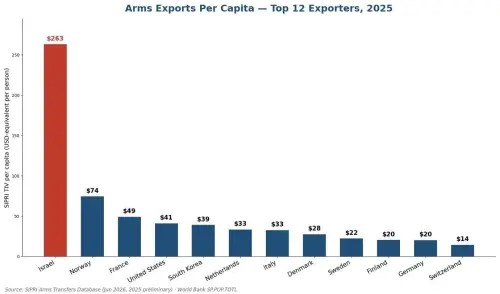
The study found that this dominance is not the result of a single exceptional year. Israel has been either the world’s largest arms exporter per capita, usually by a considerable margin, or close to the top in every year of the past 25 years.
Looking across the entire 1960-2025 period covered by the database, Israel also recorded the highest average arms exports per capita of any country, at the equivalent of $56 per person every year over 65 years. The study found that Israel’s lead over competing arms exporters has widened particularly sharply during the past decade.
Abulhawa also examined arms exports against the size of national economies, showing how deeply the weapons trade is embedded in Israel’s economic model.
Using SIPRI figures, Israeli arms exports amounted to around 0.25 per cent of GDP in 2023, more than three times the equivalent proportion in France and more than six times that of the US.
But SIPRI does not count much of Israel’s lucrative trade in drones, ammunition, small arms, cyber technology, surveillance equipment, services and training. Using governments’ own wider figures for defence contracts instead, Israel reported $13 billion in arms-export agreements in 2023, equivalent to around 2.5 per cent of its GDP.
Proportionally, that makes Israel’s arms-export economy around eight and a half times larger than that of the US and almost nine times larger than France’s, according to the study.
The figures suggest that while larger powers make more money from weapons in absolute terms, no comparable country derives as much arms-export business relative to the size of its population and economy as Israel.
Netanyahu Claims Reaching Agreement With Iran Impossible
Sputnik – 26.08.2026
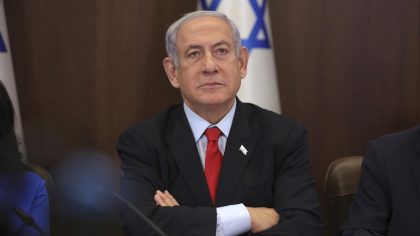
TEL AVIV – Israeli Prime Minister Benjamin Netanyahu said on Wednesday that reaching a “good” agreement with Iran’s authorities is impossible.
A ceasefire between the United States and Iran has been agreed upon, including freedom of navigation in the Strait of Hormuz, Pakistani military sources and Iranian security sources previously told Sputnik. The parties are expected to officially announce the ceasefire in the coming days.
Speaking at an event on settling the West Bank, the Israeli prime minister said that he is determined to ensure no threats from Iran. Netanyahu said that he discussed this with US President Donald Trump a few weeks ago at the White House.
“We discussed three options. I told him about an old option – to reach a good agreement. We have no objections. But I doubt that with this group of people … an agreement can be reached. I told him [Trump] that an agreement is impossible,” Netanyahu said.
The prime minister said that the second option is a resumption of hostilities.
Trump announced the launch of an economic operation against Iran on August 20, calling it “isolation on an unprecedented scale.” He urged US allies to join Washington.
Tehran will use all its resources to combat Washington’s economic pressure, the Iranian Foreign Ministry said on Monday, adding that the only option for the US is respectful dialogue with the Iranian people.
Israeli airstrike destroys water desalination plant in northern Gaza
MEMO | August 25, 2026
Israeli warplanes struck and destroyed a water desalination plant in the Sheikh Radwan neighbourhood of northern Gaza City on Monday, injuring several civilians, according to Palestinian local sources.
The facility provided potable water to thousands of families and displaced Palestinians in Sheikh Radwan and surrounding areas. Local sources said its destruction would further exacerbate water shortages affecting residents of the Gaza Strip.
The strike comes despite a ceasefire agreement that has been in effect since October 10, 2025, amid continuing Israeli military operations in the territory.
According to Gaza’s Government Media Office, Israeli forces have committed 4,379 violations of the ceasefire since it took effect. The office said those actions have killed 1,286 Palestinians, wounded 4,257 and resulted in the arrest of 180 others. The figures could not be independently verified.
Palestinian authorities have repeatedly warned that damage to water and sanitation infrastructure, combined with restrictions on fuel and essential supplies, has severely reduced access to safe drinking water across Gaza.
The latest strike comes amid continuing disputes over implementation of subsequent phases of the ceasefire agreement, including Israeli military withdrawal, the disarmament of Hamas, reconstruction and humanitarian access.
Palestinian authorities say Israeli restrictions continue to limit the quantities of food, medicine, medical equipment and shelter materials entering Gaza, while continuing airstrikes and other military operations have caused further casualties.
Israel subjecting Russian historian to brutal interrogation – lawyer

RT | August 24, 2026
Russian-Israeli historian Artyom Kirpichenok has been subjected to brutal treatment while in Shin Bet custody, including interrogations lasting up to 24 hours, sleep deprivation, prolonged handcuffing, and threats, according to his lawyer.
Kirpichenok, 51, disappeared on August 2 shortly after arriving at Ben Gurion Airport from Yerevan. His whereabouts remained unknown for nearly three weeks before his supporters revealed that he was being held at a detention facility in Petah Tikva.
His lawyer, Inna Lebedinskaya-Katz, was finally allowed to meet with him for around an hour on Sunday after repeatedly seeking access, according to Nika Dubrovsky, a Russian-born artist and writer campaigning for his release.
Citing Lebedinskaya-Katz, Dubrovsky said Kirpichenok has faced interrogation sessions lasting 18 to 24 hours while deprived of sleep. He is allegedly being kept handcuffed and hunched over on an iron stool fixed to the floor, with three or four interrogators standing behind him “shouting, threatening, and applying constant pressure.” He has also allegedly been threatened with life imprisonment.
Kirpichenok is in “tolerable physical condition” and has no immediate health complaints, but is “exhausted, tormented and deeply depressed,” Dubrovsky wrote on X on Monday.
”He understands that his friends have not abandoned him. He is holding on and sends his greetings to everyone,” she wrote. Kirpichenok also asked that no one come to Israel.
The allegations have not been independently verified. However, international human rights groups previously documented sleep deprivation and painful restraint during Shin Bet interrogations. Israel’s Supreme Court has ruled against deliberately using prolonged sleep deprivation to break suspects.
Kirpichenok is being held underground with the lights on around the clock and denied books and writing materials, Dubrovsky cited his lawyer as saying. A gag order remains in force, and the defense has yet to receive the case files or details of the accusations.
Kirpichenok, a dual Russian-Israeli citizen and Middle East expert, is known for criticizing Israel’s policies toward Iran and Palestine. Moscow sought information from the Israeli authorities following his disappearance and said it is closely monitoring the case.
Kirpichenok recently worked with media outlets and civic organizations in Türkiye and Iran and frequently traveled to Iran. Israeli citizens are generally prohibited from traveling to countries they are at war with. Dubrovsky, however, said the trips now appear to be of little interest to investigators.
Born in Russia, Kirpichenok moved to Israel in the 1990s, studied at the Hebrew University of Jerusalem and served in the Israel Defense Forces before returning to Russia. He later became a vocal critic of the Israeli government and its military campaign in Gaza, describing Israel as a Western “colonial project” in his recent book ‘Israel: The Road to Catastrophe’.
The Israeli authorities have yet to publicly disclose any charges against him.
Israel blocks 2 Swedish European parliamentarians from entering country
MEMO | August 24, 2026
Two Swedish members of the European Parliament say they were prevented from travelling to Israel on Sunday, despite holding entry permits and supporting documentation, Anadolu reports.
Left-wing MEPs Jonas Sjostedt and Hanna Gedin were stopped as they were preparing to board a flight from Athens to Tel Aviv.
They had planned to travel on to the occupied West Bank and East Jerusalem, where they were due to meet representatives of the NGO Save the Children, visit refugee camps, and speak to Israeli and Palestinian human rights groups.
The two MEPs said they wanted to hear testimonies about what they described as deteriorating conditions and apartheid in the West Bank.
Sjostedt, of Sweden’s Left Party, said they had been barred for political reasons because of their criticism of Israel and their calls for Israeli government ministers to be brought before the International Criminal Court.
“Israel is increasingly preventing people from entering the country, even members of parliament,” he said in a statement.
Gedin said it is unacceptable for Israel to prevent elected European officials from seeing conditions on the ground and meeting people affected by them while Israeli politicians continued to travel freely in Europe.
The Left group in the European Parliament said it had informed the EP President’s Office about the incident.
It described the refusal of entry as an attack on the institutions of the EU.
The incident comes as the Left group says ethnic cleansing in Palestine is continuing and amid concerns over negotiations by the European Commission on the sharing of biometric and personal data with Israeli security services.
Israel continues to block agreed quantities of food, medicine, medical supplies, shelter materials, and prefabricated homes from entering Gaza, where around 2.4 million Palestinians live, including 2.15 million displaced people, under catastrophic conditions.
Ongoing Israeli violations of the ceasefire have killed 1,286 Palestinians and injured 4,257 others as of Sunday, according to Gaza’s Health Ministry.
The ministry also said the overall toll from Israel’s war on Gaza since October 2023 had risen to 73,420 killed and 174,369 injured.
Israel seizes 1,152 more dunums as West Bank villages are turned into closed military zones
Palestinian Information Center – August 24, 2026
WEST BANK – Israeli occupation authorities have escalated settlement activity in the West Bank by issuing military orders to seize hundreds of dunums of Palestinian land, alongside settler sieges and forced displacement carried out under army protection.
The measures reflect clear coordination between the army and settler militias to empty large areas for settlement expansion.
Last Tuesday, Israeli forces issued a military order to seize around 1,152 dunums of land belonging to the towns of Sinjil, Al-Lubban Al-Sharqiya and Qaryut, north of Ramallah.
The order aims to expand the Karmi Oz settlement and strengthen geographic links between settlements and outposts located between Nablus and Ramallah.
According to a report on settlement activity, the targeted land is spread across several areas in the three towns. The decision comes as part of Israeli government measures issued since 2023 to legalize settlement outposts, most notably Givat Harel and Givat Haroeh.
At the same time, settler attacks continue across West Bank villages, accompanied by sieges, restrictions and forced displacement under the protection of Israeli occupation forces.
The attacks have been concentrated in Jalud and Qusra, south of Nablus, Turmus Ayya, north of Ramallah, and Khallat Al-Hummus in Masafer Yatta.
In Jalud, Mahmoud Al-Tubasi and his family were forced to evacuate their home after a two-month siege that included blocking the road and cutting off water and electricity. Armed settlers later stormed the home and threatened to kill or burn the family.
In Qusra, families in the Ras Al-Ain area have faced siege and attacks since the beginning of the year amid attempts to establish a new settlement outpost.
The escalation peaked on August 9, when settlers reinstalled their tents, blocked roads with stones and cut off electricity and water to the families.
Israeli forces then turned the area into a closed military zone, forced families to evacuate their homes and converted around 16 houses in Jabal Ras Al-Ain into military barracks and observation posts.
Israeli forces also imposed a curfew, closed shops and prevented Palestinian and international activists from reaching the besieged families with aid.
The report said these measures are taking place amid international silence, while the Israeli government continues to use claims of “military purposes” and the “legalization of outposts” as cover to seize more land and connect settlements to one another.
Experts opined that the ultimate goal is to fragment the West Bank and undermine any possibility of establishing a geographically contiguous Palestinian state by turning villages into besieged enclaves that can be controlled and emptied of their residents.
Gaza survivors recount executions and abuse in militia-controlled areas east of Yellow Line
MEMO | August 24, 2026
Palestinians who say they escaped areas controlled by Israeli- backed armed militias east of the so-called Yellow Line in the Gaza Strip have recounted severe abuses, including extrajudicial killings, physical mistreatment, drug distribution and exploitation of civilians, according to testimonies collected by Quds Press.
The accounts describe tightly controlled areas where residents faced restrictions on movement and could leave only with authorization from militia members. Quds Press described the groups as receiving backing from the Israeli military.
One survivor, identified only as Ahmed, 31, said he escaped with his two brothers after eight months in an area controlled by a militia allegedly headed by Shawqi Abu Nassira.
Ahmed said that narcotics, including hashish and a substance he identified as “Rotana,” were widely distributed. He also said that people attempting to escape or refusing orders faced summary execution and accused militia members of abusing and exploiting children and girls.
Another survivor, identified as Abu Ramzi, said he was drawn into the area after responding to a social media advertisement offering street-cleaning work purportedly connected to international organizations.
According to his account, he and others were collected near Al-Samar roundabout, at the entrance to Gaza City’s Shuja’iyya neighbourhood, and transported east, where masked men took them to an interrogation facility he said was operated by the Israeli military.
Abu Ramzi alleged that interrogators sought detailed information about detainees’ relatives and people employed by Gaza’s governing authorities. He further added that detainees who hesitated to answer were subjected to physical abuse, including being struck on their fingers with a hammer.
He said that during a subsequent Israeli military movement toward the Yellow Line, militia members withdrew and Israeli forces ordered the detainees to assemble. According to his testimony, they were handcuffed and instructed to walk westward without looking back.
Separately, Al-Hares, a platform affiliated with Hamas-run security authorities in Gaza, has warned residents that armed groups operating in these areas allegedly use offers of food, cigarettes and employment to attract civilians. It accused the groups of seeking to use civilians to facilitate their movements and urged Palestinians to avoid them.
Iran invite to join regional defense pact raises alarm in ‘Israel’
Al Mayadeen | August 24, 2026
Israeli officials and analysts have expressed alarm over Iran being invited to join a regional defense pact, warning that Tehran’s entry would fundamentally shift the balance of the alliance and undermine US standing in West Asia.
Mehdi Rahimi, the head of the Iranian parliament’s official news agency, told Al Mayadeen that Iran received an invitation to join the “Mecca Defense Agreement”, raising concerns in “Israel”, according to reports.
The Israeli newspaper Haaretz reported that the potential inclusion of Iran in the alliance has caused alarm, with analysts suggesting it would fundamentally alter the coalition’s nature.
Iran joining pact represents fundamental transformation
Ksenia Svetlova, director of the “Israel”-Middle East Relations Program at the Mitvim Institute and a researcher at the Atlantic Council, stated that Iran’s accession to the agreement, if it materializes, would represent “a fundamental transformation” in the nature of the alliance, Haaretz reported.
According to Svetlova, US President Donald Trump is “furious” because he cannot change the equation that emerged after the war.
Svetlova further stated that Iran’s accession would harm “US prestige”, adding that neither the United States, nor “Israel”, nor the United Arab Emirates, nor others would accept such a development.
Haaretz reported that Saudi Arabia, Turkey, and Pakistan have repeatedly stressed that the alliance is not directed against Iran, but have referred to “Israel” in the context of framing the agreement as an aggressive and threatening regional entity that requires unified forces to confront.
Pakistan says it’s open to Iran joining Mecca Defense Pact
Previously, Pakistan stated it has no objection to Iran and Egypt joining a mutual defense agreement signed with Saudi Arabia and Turkey, the country’s ambassador to Moscow said on August 12.
Ambassador Faisal Niaz Tirmizi told Al Mayadeen that the agreement with Saudi Arabia and Turkey “is not a hostile pact directed against any country, but rather an effort to establish a regional security architecture.”
He stressed that “Pakistan welcomes the participation of other countries in the region that are committed to achieving peace and stability.” “No development can be achieved without the participation of influential regional actors,” he stressed.
Saudi Arabia, Turkey, Pakistan formalize joint defense pact in Mecca
Saudi Arabia, Turkey, and Pakistan signed a joint defense agreement in Mecca on Friday, formalizing a trilateral security bloc among three Sunni Muslim-majority US allies, Reuters reported.
The pact, dubbed the Mecca Joint Defense Agreement, stipulates that an attack on any one of the three signatories will be treated as an attack on all, the countries said in a joint statement. The agreement is framed as a collective-deterrence mechanism meant to shore up regional security, though the three governments have not disclosed the specific obligations each side has taken on.
A Turkish official told Reuters the pact is purely defensive, is not aimed at any particular state, remains open to other countries in the region, and does not supersede existing bilateral or multilateral arrangements Ankara, Riyadh, or Islamabad already hold.
The deal caps roughly a year of talks first flagged by Reuters in January, when Turkish Foreign Minister Hakan Fidan said Ankara was pushing for a wider regional security platform.
Featured Video

Trita Parsi: Israel Set a Trap for Total War in the Region
or go to
Aletho News Archives – Video-Images
From the Archive
Zionism’s Violent Legacy
By Donald Neff | Washington Report On Middle East Affairs | January 1996
On January 4, 1948, Jewish terrorists drove a truck loaded with explosives into the center of the all Arab city of Jaffa and detonated it, killing 26 and wounding around 100 Palestinian men, women and children.[1] The attack was the work of the Irgun Zvai Leumi – the “National Military Organization,” also known by the Hebrew letters Etzel – the largest Jewish terrorist group in Palestine. The Irgun was headed by Revisionist Zionist Menachem Begin and had been killing and maiming Arabs, Britons and even Jews for the previous ten years in its efforts to establish a Jewish state.
This terror campaign meant that at the core of Revisionist Zionism there existed a philosophical embrace of violence. … continue
Blog Roll
 Aletho News
- Trita Parsi: Israel Set a Trap for Total War in the Region
- Trump’s Iran war is on an Israeli leash
- Saudi oil boss issues global supply warning
- Riyadh Says Its Oil System Is Intact. The Numbers Say Otherwise.
- Trump and Netanyahu Want to “Finish the Job” on Iran
- US ‘one-sided dictation’ not Iran’s beliefs makes rational talks impossible: Baghaei
- Iran’s Next Strike May Not Explode. It Could Shut You Down /Col Doug Macgregor
- Iran: US political targets legitimate if assassinations return
- Iraq shuts key border crossing with Iran under US pressure: Report
- Undersea Internet cables could be targeted in retaliation for attacks on Iran: IRGC deputy chief
- If Americans Knew
- The Israel Lobby’s Changing Fortunes
- AIPAC has become such a political liability that it’s shifting to a more “nimble” approach to buying politicians
- At least 160 Israeli settler attacks in 2 weeks
- Will Gaza’s Ancient Christian Community Disappear Forever?
- Israel’s vision of regional security rests on keeping Arab states weak
- Heidi Levine recounts how Palestinian youths helped save her in settler attack
- DAILY UPDATE: Latest essential news on Palestine, Israel, & region
- Trump’s Intensifying Sabotage of the ICC, for Israel’s Sake
- Israeli military detain US and UK volunteers in West Bank including Democratic NY politician Brad Lander
- Americans at National Conservatism Conference held in Israel this year criticize Israel
- No Tricks Zone
- E-Cars Reduce CO2 Emissions By Only 41% Compared To Internal Combustion Engine Vehicles
- Predictions Made By Renowned Climate Professor Over Past Decades Have Been Proven To Be Poor
- New Study Suggests Large Regions Of The Pacific Ocean Have Been Cooling For The Last 80 Years
- Germany’s Green Energy Debacle: High Energy Costs Force Kahla Porzellan to Close After 182 Years!
- New Study: 50 Years Of The Most Aggressive ‘Net Zero’ Policies Can Only Affect The Global Climate By 0.03°C
- US September “Heat” Was No Record…Many Records Set Decades Ago
- Latest European Green Energy Debacle; Portugal’s Largest Flagship Solar Park Insolvent!
- Green Energy Debacle: German Expert Professor Fritz Vahrenholt Warns Of Severe Economic And Social Consequences
- Two More Paleo Reconstructions Affirm Meters-Higher Sea Levels Across Ireland, Brazil 7000-6000 Years Ago
- New Study: Earth And Venus Surface Warmth Largely Explained By Convection And Lapse Rate, Not CO2 Or Radiation

