Trump Freezes Lebanon Military Aid After Israel Voiced Concerns
By Tyler Durden – Zero Hedge – 11/02/2019
Amid recent statements by both Iranian and Hezbollah leaders accusing the United States of hijacking the massive anti-corruption protests which have gridlocked Lebanon for over the past two weeks, the White House has made the dramatic and unexpected move of freezing US military aid to the Lebanese Army.
The money, part of a military aid package totaling $105 million, had been approved by Congress and the State Department, and requested by the Pentagon. Interestingly, proponents of the package argued that it would allow the Lebanese Army to grow more independent, making it less cooperative with Hezbollah.
According to Reuters the aid was frozen two days following Tuesday’s resignation of Lebanese Prime Minister Saad al-Hariri, who in a parting speech admitted he’d “reached a dead end” amid the protests which have reportedly involved one million people, or up to 25% of Lebanon’s total population, and further called on “all Lebanese to protect civil peace”.
The United States, said the report, has frequently voiced “concern over the growing role in the Beirut government of Hezbollah, the armed Shi’ite group backed by Iran and listed as a terrorist organization by the United States.”
Secretary of State Mike Pompeo this week called on Beirut to take steps for a new unified government which focused on rooting out endemic corruption.
Though no specific reason was given as to why the White House has targeted Lebanon for an aid freeze, Trump has lately signaled his disdain for the amount of foreign aid Washington hands out around the world, seemingly with no strings attached.
On Friday, an Israeli media report revealed that officials in Tel Aviv had lobbied the White House to condition any US Lebanese aid based on the country removing advanced arms in possession of Hezbollah — something it should be noted that Lebanon’s national forces are likely incapable of, given the Shia paramilitary organization is actually considered stronger.
The Foreign Ministry ordered Israeli diplomats “in all relevant countries,” including the US and European states, to emphasize the need to cease providing aid to Lebanon as long as the Iran-backed Hezbollah terror organization does not cease upgrading its military capabilities that could target Israel, the official added. — Times of Israel
“In discreet talks with various capitals, we made it clear that any aid meant to guarantee the stability of Lebanon needs to be conditioned on Lebanon dealing with Hezbollah’s precision-guided missiles,” a senior official told The Times of Israel. “Anything short of that will be problematic, in our eyes.”
This could mark a big first step in Trump cutting of aid to ‘dysfunctional’ governments and/or governments made up of elements which are hostile to the United States, as is the case with the designated group Hezbollah.
Russia Isn’t Getting the Recognition It Deserves on Syria
By Scott Ritter | TruthDig | October 30, 2019
At a time when the credibility of the United States as either an unbiased actor or reliable ally lies in tatters, Russia has emerged as the one major power whose loyalty to its allies is unquestioned, and whose ability to serve as an honest broker between seemingly intractable opponents is unmatched.
If there is to be peace in Syria, it will be largely due to the patient efforts of Moscow employing deft negotiation, backed up as needed by military force, to shape conditions conducive for a political solution to a violent problem. If ever there was a primer for the art of diplomacy, the experience of Russia in Syria from 2011 to the present is it.
Like the rest of the world, Russia was caught off guard by the so-called Arab Spring that swept through the Middle East and North Africa in 2010-2011, forced to watch from the sidelines as the old order in Tunisia and Egypt was swept aside by popular discontent. While publicly supporting the peaceful transition of power in Tunis and Cairo, in private the Russian government watched the events unfolding in Egypt and the Maghreb with trepidation, concerned that the social and political transformations underway were a continuation of the kind of Western-backed “color revolutions” that had occurred previously in Serbia (2000), Georgia (2003) and Ukraine (2004).
When, in early 2011, the Arab Spring expanded into Libya, threatening the rule of longtime Russian client Moammar Gadhafi, Russia initially supported the creation of a U.N.-backed no-fly zone for humanitarian purposes, only to watch in frustration as the U.S. and NATO used it as a vehicle to launch a concerted air campaign in a successful bid to drive Gadhafi from power.
By the time Syria found itself confronting popular demonstrations against the rule of President Bashar Assad, Russia—still struggling to understand the root cause of the unrest—had become wary of the playbook being employed by the U.S. and NATO in response. While Russia was critical of the violence used by the Assad government in responding to the anti-government demonstrations in the spring of 2011, it blocked efforts by the U.S. and Europe to impose economic sanctions against the Syrian government, viewing them as little more than the initial salvo of a broader effort to achieve regime change in Damascus using the Libyan model.
Moscow’s refusal to help facilitate that Western-sponsored regime change, however, did not translate into unequivocal support for the continued rule of Assad. Russia supported the appointment of former U.N. Secretary-General Kofi Annan to head up a process for bringing a peaceful resolution to the Syrian crisis, and endorsed Annan’s six-point peace plan, put forward in March 2012, which included the possibility of a peaceful transition of power away from Assad.
At the same time Russia was promoting a diplomatic resolution to the Syrian crisis, the U.S. was spearheading a covert program to provide weapons and equipment to anti-Assad forces, funneling shipments from Libya through Turkey and into rebel-controlled areas of Syria. This CIA-run effort, which eventually morphed into a formal operation known as Timber Sycamore, helped fuel an increase in the level of violence inside Syria that made it impossible for the Assad government to fully implement the Annan plan. The inevitable collapse of the Annan initiative was used by the U.S. and its European allies to call for U.N. sanctions against Syria, which were again rejected by Russia.
While Russia continued to call for a political solution to the Syrian crisis that allowed for the potential of Assad being replaced, it insisted that this decision would be made by a process that included the Syrian government, as opposed to the U.S. demand that Assad must first step down.
The Military Solution
The failed Annan initiative was replaced by a renewed U.N.-sponsored process, known as Geneva II, headed by Lakhdar Brahimi, a veteran Algerian diplomat with extensive U.N. experience. The Geneva process stalled as Brahimi sought to bridge the gap between the U.S.-backed Syrian opposition—which insisted upon Assad’s resignation as a precondition to any talks about the future of Syria—and Russia, which continued to insist that the Assad government have a voice in determining Syria’s future.
Complicating these talks was the escalation of violence inside Syria, where anti-Assad forces, building upon the massive amount of military aid received from the U.S., Saudi Arabia and the Arab Gulf states, aggressively pushed for a military victory that would moot the Geneva II process.
By June 2013 the situation had devolved to the point that the U.S., citing allegations that the Syrian government was using a nerve agent against rebel forces, was considering the establishment of no-fly zones in northern Syria and along the Jordanian border. While sold as a humanitarian move designed to create safe zones for Syrian civilians fleeing the fighting, the real purpose of these zones was to carve out large sections of Syrian territory where the opposition could organize and prepare for war under the umbrella of U.S. air power without fear of Syrian government retaliation.
The concept of Syria’s chemical weapons being used by the U.S. to justify military action against the Syrian government was not hypothetical. In 2012, President Barack Obama had declared that any use of chemical weapons by the Syrian government would be considered a “red line,” forcing the U.S. to act. When, in August 2013, a major chemical weapons incident occurred in Ghouta (conclusive attribution for the attack does not exist; the U.S. and NATO contend that the Syrian government was behind the attacks, which the Russians and the Syrian government claim were carried out by anti-Assad opposition for the purpose of compelling U.S. intervention), it looked like the U.S. would step in.
Committing to a larger war in Syria was not a politically popular move in the U.S., given the recent experience in Iraq, and when Obama met with Russian President Vladimir Putin during the G-20 summit in St. Petersburg, Russia, in September 2013, the Russians suggested a solution—the disarmament of Syrian chemical weapons under the supervision of the Organization for the Prevention of Chemical Weapons (OPCW). When Secretary of State John Kerry opened the door to that possibility, Russia and Syria jumped on the opportunity, paving the way for one of the great disarmament achievements of modern times, an action that won the OPCW the Nobel Peace Prize for 2013.
The disarmament of Syria’s chemical weapons was a huge success, for which Russia received little recognition, despite the major role it played in conceiving and overseeing its implementation. Russia had hoped that the disarmament process could lead to the establishment of international confidence in the Assad government that would translate into a diplomatic breakthrough in Geneva. This was not to be; a major peace conference planned for 2014 collapsed, and efforts to revive the failed talks were sidelined by the escalation of violence in Syria, as the armed opposition, sensing victory, pressed its attacks on the Syrian government.
The situation in Syria was further complicated when, in 2013, the organization formerly known as al-Qaida in Iraq renamed itself the Islamic State in Iraq and Syria, and started carving out a so-called caliphate from the ungovernable expanses of eastern Syria and western Iraq. Having established its capital in the Syrian city of Raqqa, Islamic State launched a dramatic offensive in early 2014, capturing large swaths of territory in both Syria and Iraq, including the Iraqi city of Mosul. By 2015, the Syrian government, under pressure from anti-Assad rebels and the forces of Islamic State, was on the brink of collapse.
The consequences of the loss of Syria to forces dominated by radical Islamic ideology do not seem to have been fully considered by those in the West, such as the U.S. and its European allies, which were funneling military aid to the rebel forces. For Russia, however, which had its own experiences with Muslim separatist movements in the Caucasus region, such a result was deemed an existential threat, with thousands of Russian citizens fighting on the side of Islamic State and the anti-Assad opposition who would logically seek to return to Russia to continue the struggle once victory had been achieved in Syria. In September 2015, Putin urged the Russian Parliament to approve the intervention of the Russian military on the side of the Syrian government. The Parliament passed the resolution, thus beginning one of the most successful military interventions in modern times.
The impact of the Russian intervention was as dramatic as it was decisive. Almost immediately, the Russian air force helped turn the tide on the field of battle, allowing the Syrian army to launch attacks against both the anti-Assad opposition and Islamic State after years of losing ground. The Russian intervention helped pave the way for the commitment by Hezbollah and Iran of tens of thousands of ground troops who helped tip the scale in favor of the Syrian government. The presence of Russian forces nipped in the bud all talk of Western military intervention and created the conditions for the Syrian government to eventually recapture much of the territory it had lost to Islamic State and the anti-Assad rebels.
Unheralded Peacemaker
The connection between military action and diplomacy is a delicate one. For some nations, like the United States, diplomacy is but a front for facilitating military action—the efforts to secure a U.N. Security Council resolution on the eve of the 2003 invasion of Iraq stand as a prime example. For Russia, however, the decision to intervene militarily in Syria was not seen as an end unto itself, but rather as the means by which Russia could shape the political landscape in such a manner as to make a political solution realistic. From the Russian perspective, the Geneva II process was an empty shell, having been hijacked by Saudi Arabia and its anti-Assad proxies.
In January 2017, Russia took the diplomatic offensive, initiating its own peace process through a series of summits held in the Kazakh capital of Astana. This process, which brought together Turkey, the Syrian government and Iran, together with Russia, quickly supplanted the Geneva II talks as the most viable vehicle for achieving a peaceful resolution to the Syrian conflict. By directly linking diplomatic talks with the fighting on the ground, the Astana process had a relevance that Geneva II lacked. For its part, Russia was able to woo Turkey away from insisting that Assad must leave, to a stance that recognized the territorial integrity of the Syrian nation, and a recognition that Assad was the legitimate leader of Syria, at least for the time being. The Astana process was lengthy and experienced its share of ups and downs. But today it serves as the foundation of a peace process that, unlike any of its predecessors, has a real chance of success.
Bridging the gap between the finesse of diplomacy and the brutal violence of military action is one of the most difficult tasks imaginable. For its part, the United Nations has undertaken so-called peacekeeping operations with mixed effect. In recognition of the importance and difficulty of this kind of work, the Nobel Committee awarded the 1988 Nobel Peace Prize to the U.N. Peacekeepers. When the diplomatic solutions reached in Astana needed to be implemented in Syria, Russia turned to the most unlikely source for turning objectives into reality: the Russian military police. A relatively new entity in the Russian military establishment, formed only in 2012, the military police were tasked with a wide range of missions, including convoy protection, area security, restoring law and order and resettlement operations.
In late 2016, as the Syrian army was positioned to recapture the city of Aleppo from rebel forces, Russia deployed a battalion of military police to Syria. The mission of these troops was not to engage in frontline fighting, but rather to restore law and order and win the trust and confidence of a civilian population wary of the potential for retaliation at the hands of the victorious Syrian army.
By all accounts, the Russian military police performed admirably, and soon the Russian ministry of defense dispatched more battalions of these new peacekeepers, who quickly established a reputation of being fair arbiters of the many cease-fire agreements brokered through the Astana process. The Russian military police were ubiquitous, whether policing the no-man’s land separating warring parties, escorting convoys of rebel fighters and their families to safe zones or providing security for OPCW inspectors.
The final phases of the Syrian conflict are playing out in northern Syria today. The last vestiges of the anti-Assad opposition, having been taken over by al-Qaida, are dug in in their final bastion in Idlib Province, their ultimate defeat at the hands of the combined Russian-Syrian armed forces all but assured. The American intervention in northeastern Syria, begun in 2015 as a means of confronting and defeating Islamic State but continued and expanded in 2017 as a vehicle for destabilizing the Assad government, has imploded in the face of a geopolitical reality in transition, facilitated in large part by the combined forces of Russian diplomacy in Astana and Russian-led military action on the ground in Syria.
By successfully wooing Turkey away from the U.S., Russia has dictated the reality on the ground in Syria, green-lighting a Turkish incursion that put the American forces deployed there in an impossible situation, prompting their evacuation. While the U.S. continues to maintain a military presence in Syria, occupying a border crossing point at Tanf and a series of military positions along the eastern bank of the Euphrates River in order to secure nearby Syrian oil fields, the ability of the U.S. to logistically sustain this force is doubtful, making its eventual withdrawal from Syria inevitable.
Moreover, by compelling an American withdrawal from northeastern Syria, Russia broke the back of the U.S.-supported Kurdish autonomous entity known as Rojava, and in doing so prevented a larger war between Turkey, the Kurds and the U.S.
In green-lighting the Turkish incursion into northern Syria, the Russians invoked the 1998 Adana Treaty, which guarantees the sovereign inviolability of Syria’s borders. The processes involved in stabilizing the Turkish-Syrian border, defeating the anti-Assad forces in Idlib, evicting the Americans from Syrian soil, and integrating the Kurds into a future Syrian government are lengthy, complex and not necessarily assured of a positive outcome. One thing is certain, however: The prospects for peace in Syria are greater today than at any time since 2011. And the fact that Russia has deployed even more battalions of its military police to Syria to oversee implementation of the current cease-fire bodes well for the prospects of success.
Despite literally salvaging victory from the jaws of defeat, the scope of the Russian accomplishment in Syria is muted in the United States, thanks to rampant Russophobia that has insinuated itself into every aspect of the domestic political discourse. Under normal circumstances, the Russian accomplishment in Syria would have been deserving of a Nobel Peace Prize, if not for the Russian diplomats and leaders who oversaw the effort to forge peace from the furnace of war, then at least for the Russian military police whose actions in Syria embody the very definition of humanitarian peacekeeping.
Over time, international historians will come to appreciate what Russia accomplished in Syria, potentially ending a sectarian conflict that could easily have served as the foundation for a decades-long conflagration with regional and global consequences.
Whether American historians will ever be capable of doing the same is unknown. But this much is true: In the years to come, children will be born of parents whose lives were not terminated or otherwise destroyed by a larger Syrian conflict that almost assuredly would have transpired if not for the honest broker services provided by Russia. Intentionally or not, Russian diplomacy prevented the United States from embarking on a foreign policy disaster of its own making. While it is highly doubtful that Americans will ever muster the moral fortitude to say so publicly, those who know the truth should find the time to whisper, “Thanks, Putin,” between the barrage of anti-Russian propaganda that floods the American mainstream media today.
Like it or not, in Syria, the Russians saved us from ourselves.
London Times runs fake Browder story by acolytes Ben Brandon & Alex Bailin
By Lucy Komisar | The Komisar Scoop | October 25, 2019
Ben Brandon and Alex Bailin are London lawyers who have co-authored a fake story based on fabrications by William Browder about Russia’s legal action against his tax evasion and the death of his accountant, Sergei Magnitsky. The writers of this London Times op ed managed to put eight lies into just five opening lines.
Co-author Brandon is the lawyer representing the U.S. in its request to extradite war-crimes whistleblower- publisher Julian Assange. This raises questions about the connection between the U.S. and the U.K. in the promotion of the Browder/Magnitsky hoax and the attack against Assange.
Here is their story. And my proof of their fabrications.
Their Story
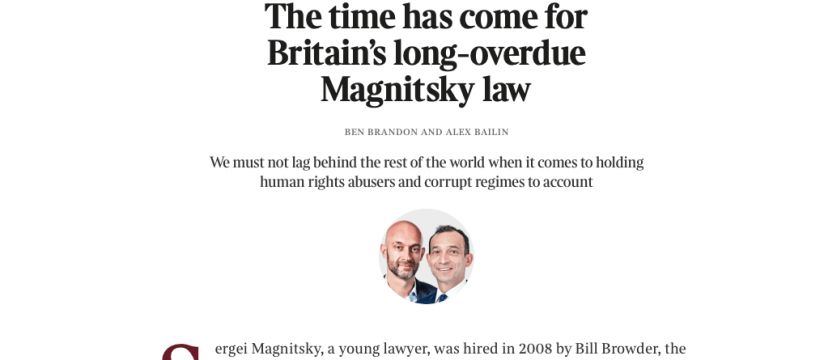
Screen shot of the London Times op ed.
The Times, October 24 2019
By Ben Brandon and Alex Bailin
We must not lag behind the rest of the world when it comes to holding human rights abusers and corrupt regimes to account.
Sergei Magnitsky, a young lawyer, was hired in 2008 by Bill Browder, the chief executive of Hermitage Capital, to investigate a tax fraud on his fund. Having diligently uncovered a large scale embezzlement by influential Russian officials, Mr Magnitsky was arrested and mistreated in prison in an attempt to pressure him into withdrawing his testimony.
He refused to retract and was beaten to death.
My Response
Dear Messrs Brandon and Bailin, I assume that as lawyers you think it’s a good idea to check out what people claim, since even clients lie. Therefore, please consider the evidence below, not what convicted fraudster William Browder apparently told you.
[1]
Lawyer: Magnitsky was an accountant. Browder acknowledges in his deposition in US federal court 2015 that Magnitsky didn’t have a law degree or go to law school. See him say it in a video clip. In his own interrogations, Magnitsky is identified as an auditor.[2]
Hired in 2008: Magnitsky worked for the accounting/law firm Firestone Duncan which Browder hired in 1997 to handle his company accounts and tax filings. The Russian court found that Magnitsky in the interests of Browder in 1997-2002 implemented an illegal tax evasion scheme using firms registered in Kalmykia and managed by Hermitage Capital. (See article) Browder claims he hired Magnitsky in 2007, so Brandon and Bailin get even that fabrication wrong.[3]
To investigate a tax fraud: See above. He was hired in 1997, ten years before the 2007 tax refund fraud. Magnitsky’s 2006 interrogation was about Browder’s company tax evasion. See his testimony and the cited article. And the fraud wasn’t on his fund, it was on the Russian Treasury. Fraudsters scammed the Russian Treasury by obtaining a $230mil tax refund based on fraudulent lawsuits.[4]
Uncovered embezzlement: The tax fraud, which is not properly described as an embezzlement as it was a fraud on the Russian Treasury, not on a company, was first reported by Rimma Starova in April 2008. The Russian newspaper Vedomosti and the New York Times reported it in July 2008. Magnitsky mentioned in testimony only in his October 2008 interrogation.[5]
Influential Russian officials: There are no Russian officials accused in any of the reports, by Starova, the newspapers or by Magnitsky. Read the documents.[6]
Mistreated: He suffered the same poor conditions as other inmates.[7]
pressure him into withdrawing his testimony: There is no evidence he was pressured to withdraw testimony. Or do you have any?[8]
Beaten to death: There is no evidence he was beaten to death. Or do you have any?The only on-site independent report, by the Moscow Public Oversight Commission, indicates terrible prison conditions and failure to provide needed medical care. The Physicians for Human Rights (Cambridge Mass) report, cites the POC report and is addressed to Browder, who gave PHR 44 documents to back up his claims. It reached the same conclusion.
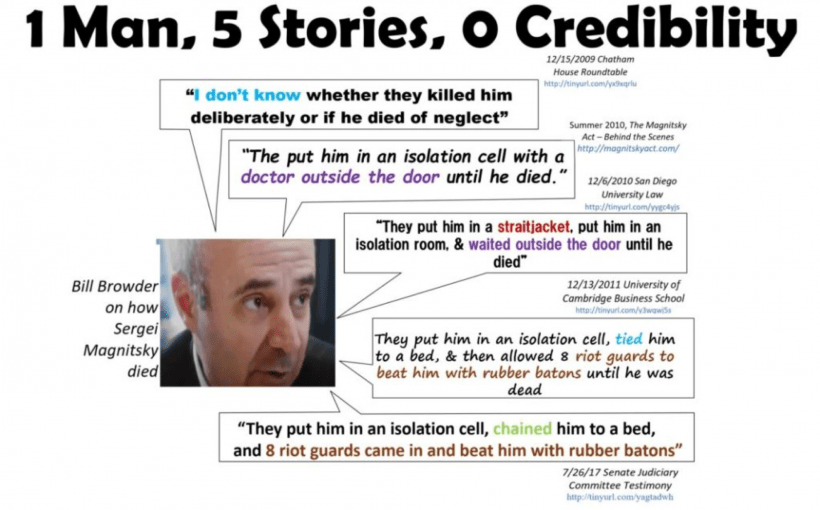
Browder’s initial statements about Magnitsky’s death, in 2009 and 2010, mention no beatings.
Check out his talk at Chatham House, in your home town. “I don’t know what they were thinking. I don’t know whether they killed him deliberately on the night of the 18th, or if he died of neglect.”
How Browder changed his stories about Magnitsky’s death. (Graphic by Michael Thau)
And the video of his address to the San Diego Law School the next year. “They put him into a straight-jacket, put him into an isolation room and waited outside the door for 1hr18 minutes until he died.”
He invented the beating death in 2011 when he decided to create and lobby for the Magnitsky Act in the U.S. Congress to stop Russian authorities from pursuing him for $100 million in evaded taxes and illicit stock buys.
Ironically, though he uses the U.S. to build a wall against Russian tax collectors, he gave up his American citizenship in 1998 to avoid paying taxes. He is listed by CBS News as a “tax expatriate.”
If you are serious lawyers and investigators, you will examine the evidence and respond. (And change your story.)
The rest of the op ed is to support unspecified steps to hold to account those who benefit from human rights abuses and corruption. No mention of the persecutors of Julian Assange or the beneficiaries of the U.K.’s worldwide system of tax havens. The real purpose appears to be to repeat the Browder hoax in the lede.
I sent copies of the article to Brandon and Bailin. No response.
I also sent a complaint to IPSO the British Independent Press Standards Organization.
It calls itself “the independent regulator of most of the UK’s newspapers and magazines.” It says: We hold newspapers and magazines to account for their actions, protect individual rights, uphold high standards of journalism and help to maintain freedom of expression for the press.
Clauses breached
1 Accuracy
This op ed article is based on egregiously fake facts. See this story and the links for the evidence. I have sent it to the authors. They should retract the story. https://www.thekomisarscoop.com/2019/10/london-times-runs-fake-browder-story-by-acolytes-ben-brandon-alex-bailin/
Lucy Komisar is an investigative reporter who writes about financial corruption and won a Gerald Loeb award, the most important prize in financial journalism, for breaking the story about how Ponzi schemer Allen Stanford got the Florida Banking Dept to allow him to move money offshore with no regulation. Her stories about William Browder focus on tax evasion. Find out more on The Komisar Scoop and on Twitter, @lucykomisar.
Robert McNamara’s Infamous “Project 100,000” and the Vietnam War
A Premeditated Crime against Humanity
By Larry Romanoff | Global Research | October 30, 2019
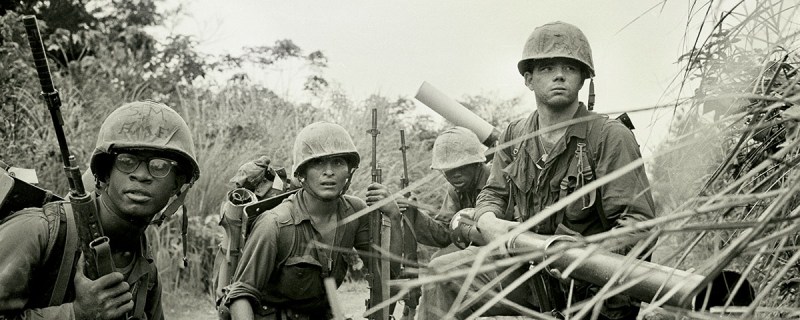
In the very long list of shocking and abominable atrocities committed by the US, there is one that stands out as especially obscene for the appalling and hypocritical inhumanity of US Government leaders. This was “Project 100,000”, a US military program enacted by then Secretary of Defense Robert McNamara to recruit 100,000 new soldiers per year during a time of great public opposition to the Vietnam war, and which was promoted as part of President Johnson’s ‘War on Poverty’. In McNamara’s own words, it was “a program to salvage the poverty-scarred youth of our society”, to give them two years of military service, then insert them into “a lifetime of productive activity in American civilian society”.
He further stated,
“Poverty in America pockmarks its victims inwardly. If unchecked and unreversed, that inner ghetto of the poverty-scarred personality of these men can fester into explosive frustrations of bitterness and violence. Chronic failures in school throughout their childhood, they are destined to a downward spiral of defeat and decay … If nothing were done to give them a strong sense of their own worth and potential, they, their wives and their children would almost inevitably be the unproductive recipients of some form of the dole ten years from now. Hundreds of thousands of men can be salvaged from the blight of poverty, and the Defense Department – with no detriment whatever to its primary role – is particularly well equipped to salvage them.” (1) (2)
That sounds good, except that this program was initiated during a time when the US was realising extremely high casualties in Vietnam, had already admitted the war was “unwinnable”, with most suitable recruits either taking student deferments or evading the draft by fleeing to Canada. McNamara’s solution was to run a sieve through the ghettos of America, an ingenious and diabolical solution to “rid the nation” of its surplus black and poor, in a program he may have hatched with the advice of Margaret Sanger, she of Planned Parenthood. In executing this program, McNamara lowered the standards to the point where these recruits were in the bottom quartile of intelligence and ability, a great many of them with an IQ of 60 or 65, and none above 80.
These new “soldiers” were functionally illiterate, able to read only at a Grade 3 level or lower. They were so severely (educationally) deficient that the military had to create little comic books to replace the training manuals, and many had to be taught even how to tie the laces on their boots. As other authors have noted, these men often failed their much-simplified basic training several times, with most being repeatedly “recycled” until they finally reached a deplorable minimum standard of readiness. None had the mental ability to appreciate what was happening to them.
The program ran for five years and recruited in total about 500,000 mentally retarded young men and gave them a one-way ticket to Vietnam, these helpless young men dying at many times the rate of regular soldiers. Many researchers have claimed that an overwhelming majority of these men, especially blacks, received combat assignments, and “comprised an overwhelming majority of … battle deaths”, and were also generally posted to “what were considered dangerous military occupations”. These men were provided with special ‘dog tags’ that began with “US67…” so they could be quickly identified by other soldiers. By all accounts, the regular troops did not want to be associated with these men, certainly not in a battle situation, believing their lack of intelligence and training simply jeopardised the lives of all around them. Many have reported that when battlefield decisions were being made, given that these men were unable to learn anything much more complicated than pulling a trigger, they were just sent to their deaths, “ending up on the Vietnam Memorial Wall at an alarming rate much higher than the average”. One young Vietnam veteran reported that a common order issued to these young men ‘salvaged from the blight of poverty’ was to “Go over there and see if there’s a sniper in that tree”.
US casualty figures mushroomed after the introduction of this program, the victims of which were simply cannon-fodder and, for this and other reasons, I remain convinced there is a high probability American deaths in Vietnam were grossly under-reported and that a great many of these nearly 500,000 simply never returned and whose records no longer exist. It is not only possible, but probable, that American deaths in Vietnam were in fact ten times the stated 50,000. Several organisations in the US have attempted to produce accurate Vietnam casualty statistics, but with little apparent success.
As one such organisation states,
“The Vietnam War presents multiple challenges to historians due to official discrepancies with draft numbers, contention over official number of soldiers deployed, and a general lack of transparency from the US government during the war leading to possible misinformation in historical records.”
In other words, the official sources of basic statistics as to the actual number of men recruited, the number sent to Vietnam and the number who died there, are often missing, sometimes contradictory, and sometimes wildly inaccurate, and the US military exercises only obstruction to those interested in remedying the situation. Moreover, without an Internet or mobile phones, and no social networking capability, the parents of these men would have no way of knowing the huge number of casualties from within their group.
On May 30, 2002, Salon Magazine published an article by Myra MacPherson on the HBO movie “Path to War” in which she discusses Hollywood’s attempt to “humanise” McNamara “while entirely overlooking … one of his most heinous acts” and ignoring his “arrogance and duplicity”. She notes that the HBO movie omits “some of the most shameful brainstorms of the Vietnam War’s masterminds – including a little-known recruitment program that turned the mentally and physically deficient into cannon fodder.”
She details how military recruiters “swept through urban ghettos and Southern rural back roads”, offering hundreds of thousands of the retarded poor – with IQs as low as the 60s – “a one-way ticket to Vietnam”, and that “McNamara’s Moron Corps, as they were pathetically nicknamed by other soldiers, entered combat in disproportionate numbers”, noting that they received combat assignments at 250% of the rate of general servicemen. MacPherson tells us that few today are aware of what she calls “this particularly shameful chapter” of American history, and that her stories of this episode were “generally met with disbelief”. This entire project had been so well buried by the government that almost no one was aware of its existence and few could believe it would be possible for the American government to perpetrate such an obvious genocidal travesty against its own population, especially after the military had already admitted the war “could not be won”.
In a 2006 article in the New York Times (3), this Project was dismissed as “a failed experiment” that was “of little benefit to the men it was created to help”, but my research leads me to conclude that, contrary to being a failed experiment, this program was a “success”, a truly ingenious and criminal method of applying eugenics to eliminate poverty (especially black poverty) and idiocy in America by using the mentally-deficient as cannon fodder in a trumped-up war, far from the first time a nation’s surplus poor discovered themselves in similar conditions. In recognition of his success, McNamara was rewarded by being given the post of President of the World Bank.
Notes
(1) McNamara’s Folly: Lowering the Standards to Fill the Ranks
(3) Don’t Dumb Down the Army – The New York Times, February 17, 2006
Lavrov: US’ ‘Deal of Century’ Example of Swapping International Law for Norms Suitable for US
Sputnik – November 1, 2019
MOSCOW – The so-called deal of the century on the Israeli-Palestinian conflict settlement that Washington says it is preparing is an example of how the international law is changed for rules that the United States finds convenient, Russian Foreign Minister Sergey Lavrov said.
“Instead of implementing these [UNSC] resolutions, the United States promises everyone to present some ‘deal of the century,’ which, as you have already understood, will not envision the creation of a full-fledged Palestinian state. This is an example of how international law represented by UNSC resolutions is swapped for rules that the United States has invented and which it finds convenient”, Lavrov said in an interview on TV on Friday.
The administration of US President Donald Trump has for years said it would announce its plan for Israeli-Palestinian peace. In July, it released what was characterized as an economic component of the plan — an infrastructure and investment project to support Palestinians.
However, the Palestinian authorities have rejected Washington’s involvement in the settlement of their conflict with Israelis after Trump recognized Jerusalem as the capital of Israel and moved the US embassy from Tel Aviv to the Holy City despite the condemnation of the Muslim world and the UN recommendations to refrain from establishing diplomatic missions in the city until its legal status is settled.
The UN Security Council has issued multiple resolutions on the Israeli-Palestinian settlement. For years, the Arab world remains committed to the Arab Peace Initiative, originally agreed upon at the Beirut Summit back in 2002. The plan has been formed on the basis of the UNSC Resolution of 194.
Police Defend Use of Taser, Chokehold & Excessive Force Against Man Who Complied During Arrest
The Rutherford Institute | November 1, 2019
MUSKOGEE, Okla. — Oklahoma police have asked a federal court to support their claim that citizens who comply with police during an arrest do not have a clearly established right to be free from police brutality. The police’s justification of the use of excessive force, even in the absence of provocation, were made in a motion by City of Muskogee police seeking the dismissal of a lawsuit filed by attorneys for The Rutherford Institute on behalf of Jeriel Edwards, an African-American man who, despite complying police orders during an arrest, was subjected to excessive force and brutality, including being thrown to the ground, tasered, and placed in a chokehold that rendered him unconscious and required his hospitalization for three days. The police officers’ motion seeks immunity from The Rutherford Institute’s Fourth Amendment lawsuit. In light of the fact that the beating Edwards was subjected to by police was clearly unreasonable and excessive, Institute attorneys have urged the court to reject the government’s justifications and claim of immunity.
Affiliate attorney Andrea Worden is assisting in the defense of Edwards’ Fourth Amendment rights.
“If you ask police what Americans should do to stay alive during encounters with law enforcement, they will tell you to comply, cooperate, obey, not resist, not argue, not make threatening gestures or statements, avoid sudden movements, and submit to a search of their person and belongings,” said constitutional attorney John W. Whitehead, president of The Rutherford Institute and author of Battlefield America: The War on the American People. “The problem is what to do when compliance is not enough. How can you maintain the illusion of freedom when daily, Americans are being shot, stripped, searched, choked, beaten and tasered by police for little more than daring to frown, smile, question, challenge an order or merely exist?”
On October 25, 2016, Jeriel Edwards was sitting in his car in the parking lot of a Muskogee Wendy’s restaurant when he was approached by a City of Muskogee police officer who ordered Edwards to put the car in park and provide his identification. Body and dashboard camera video of the encounter shows that the officer made the request even though he already knew Edwards’ identity. The officer then ordered Edwards to get out of the vehicle and remove his hands from his pockets. Edwards complied with all the officer’s orders. At this time, a second Muskogee police officer arrived at the scene. As Edwards exited the vehicle, he was ordered to face the vehicle and place his hands behind his back. At this point one of the officers grabbed Edwards’ right arm while the other officer shoved him into the corner of the car door, followed by the officers aggressively grabbing Edwards’ upper body and pushing his head into the corner of the car door as they attempted to place his hands behind his back. One officer then told Edwards to get to the ground, but before he could do so, the officers slammed him to the pavement. As the officers pushed Edwards’ head and neck to the ground, they also placed a knee on his body to pin him to the ground. Edwards repeatedly asked why the officers were abusing him, but got no answer. Instead, the first officer fired a taser at Edwards as he lay on the ground. A third officer arrived on the scene and made two striking motions at Edwards, the impact of which can be heard on the body camera video. A fourth officer arrived at the scene and put Edwards in a chokehold. As the four officers dragged Edwards to the ground, another joined the fray and held Edwards down by digging his knee into his body. Edwards lost consciousness en route to the hospital, where he was admitted to the ICU.
Documents:
State Department Accuses ‘Russian Trolls’ of Meddling in Chile Protests
Sputnik – November 1, 2019
The US State Department claims it has seen evidence of Russian attempts to “influence” the recent unrest in Chile.
The South American country has been rocked by massive anti-government protests for over three weeks now, with demonstrations and violence leading to a temporary curfew, soldiers in the streets and the cancellation of the Asia-Pacific Economic Cooperation (APEC) summit, expected to have taken place in Santiago in mid-November.
Speaking to reporters in Washington on Thursday, a senior State Department official told reporters that Russia was trying to ‘take advantage’ of the unrest in the country “and skewing it through the use and abuse of social media trolling and seeking –rather than allowing the citizens of Chile to have their own debate about how their country and the courses their country should take… to exacerbate divisions, foment conflict, and all around act as a spoiler to responsible democratic debate.”
The official pointed to alleged “Russian activity supporting this negative course of the debate,” but did not elaborate on what this entailed.
Pressed on the claims, and whether the alleged Chile meddling also included efforts by Venezuela or Cuba, the official said they were “not a digital analytical wizard,” but that they “saw organisations such as [Latin American news agency] Telesur exacerbating those debates.”
The official did not expand on his claims of Russia’s alleged meddling, noting only that “in recent years we’ve seen an increase of Russian engagement in the Americas, in South America in particular – very little of it positive.”
Commenting on the claims on Friday, Russian Deputy Foreign Minister Sergei Ryabkov dismissed the State Department’s allegations outright.
“The US administration is using the difficult internal situation in Chile to continue its efforts to blacken our country’s foreign policy. This isn’t news,” Ryabkov said in a statement.
The official added that Russia “has never meddled, does not meddle and will not meddle in any electoral or other internal political processes in any country.”
Chilean officials did not comment on the State Department’s claims.
Arguably the best-known case of confirmed meddling in Chile’s internal affairs took place on September 11, 1973, when the CIA-backed Chilean armed forces led by General Augusto Pinochet overthrew the democratically elected government of Salvador Allende in a coup.
Violent protests erupted in Chile last month over authorities’ decision to increase subway fares. The protests have spread to violent clashes between protesters, police and the military, with over 2,400 people reported injured and 21 people killed, and over 5,400 others detained. Last week, over a million people marched in the streets, demanding the resignation of President Sebastian Pinera.
Five Years On, Saudi Attacks on Yemen’s Farmers Are Pushing the Whole Country into Famine
By Ahmed AbdulKareem | MintPress News | November 1, 2019
HODEIDA, YEMEN — The country of Yemen, known in the medieval period as “Green Yemen,” is one of the most extensively terraced areas of the world. There, Yemeni farmers transformed rugged mountain slopes into terraces and built dams like the Great Marib, a structure whose history spans long enough that it was mentioned in the Quran. During the medieval period, Yemen had one of the widest ranges of agricultural crops in all of the Middle East.
Farhan Mohammed is one of the richest farmers in Qama’el, a rural village in the region of Baqim in northwestern Yemen. He owns 50 hectares of land which he uses to cultivate corn, pomegranates, and apples. Now, Farhan is struggling to keep his farm afloat after Saudi airstrikes targeted his fields, burning his crops and rendering the soil so toxic that it’s no longer able to sustain life. Saudi Arabia’s now nearly five-year-old project in Yemen has decimated the incomes of Farhan and most other Yemeni farmers. Fuel is hard to come by thanks to a Saudi-led coalition blockade and the fuel that is available has become prohibitively expensive. Airstrikes targeting farm fields and orchards have rendered large swaths of Yemen’s arable land too toxic to use.
Almost immediately after March 2015, when the war began, the Saudi-led Coalition began targeting Yemen’s rural livelihood, bombing farms, food systems, markets, water treatment facilities, transportation infrastructure, and even agricultural extension offices. In urban areas, fishing boats and food processing and storage facilities were targeted.
Before the war began, over 70 percent of Yemen’s population lived in villages dispersed in the mountains and small towns with irregular, and at times torrential, summer rainfall. These rural residents relied on agriculture and animal husbandry and grew fruits and vegetables to feed their own families and to sell to markets. Yet that way of life has all but disappeared since the Saudi attacks began, undermining rural livelihoods, disrupting local food production, and forcing rural residents to flee to the city.
Now, Yemen’s nationwide level of household food insecurity hovers at over 70 percent. 50 percent of rural households and 20 percent of urban households are now food insecure. Almost one-third of Yemenis do not have enough food to satisfy basic nutritional needs. Underweight and stunted children have become a regular sight, especially amongst the holdouts in rural areas. Families that have fled to cities are often forced to beg or to pick through the trash for food scraps.
According to a recent report by the United Nations Development Program (UNDP), poverty in Yemen has jumped from 47 percent of the population in 2014 to a projected 75 percent by the end of 2019 because of the war. The report warned, “If fighting continues through 2022, Yemen will rank the poorest country in the world, with 79 percent of the population living under the poverty line and 65 percent classified as extremely poor.”
The intentional targeting of agriculture
The targeting of the Yemeni agriculture sector and rural livelihoods is not merely accidental collateral damage incurred while targeting military sites. Data from the country’s Ministry of Agriculture shows that in the period between March 2015 and March 2019, the Saudi-led Coalition launched at least 10,000 airstrikes that struck farms, 800 that struck local food markets, and about 450 airstrikes that hit silos and other food storage facilities in the country.
According to the Ministry, crop-area cultivation declined an average of 40 percent and crop yields by 45 percent in rural areas. Many farmers in these areas reported that they could no longer produce yields at pre-war levels due to the extensive damage to infrastructure, the high cost of diesel fuel and other agricultural inputs, a collapse in markets and the destruction of roads and storage facilities.
According to a field survey carried out by the Ministry of Agriculture in the period between March 2015 and March 2018, Saudi attacks completely destroyed 270 agricultural buildings and facilities, 43 agricultural associations, 9,017 traditional irrigation canals, 54 agricultural markets, and 45 export centers.
High precision U.S. bombs dropped by Saudi-led coalition warplanes destroyed at least 1,834 irrigation pumps, 109 artesian and surface wells, 1,170 modern irrigation networks, 33 solar irrigation units, 12 diggers, 750 pieces of agricultural equipment, 940,400 farms, 7,531 agricultural reserves, 30 productive nurseries, 182 poultry farms, and 359,944 beehives.
Yemen has no major rivers like the Euphrates in Iraq and Syria or the Nile River, which supplies water to farmers in a number of African countries. This leaves farmers reliant on irrigation canals that channel rain and floodwaters into weirs and bunds built by local communities that are vulnerable to Saudi attacks. Attacks that have already completely destroyed at least 45 water installations (dams, barriers, reservoirs) and partially destroyed at least 488, including the ancient Marib Dam.
Yemen’s fishing sector has not been spared either. By the end of May 2019, every fish off-loading port in Yemen had been targeted by Saudi attacks. At least 220 fishing boats have been destroyed, 222 fishermen have been killed and 40,000 fishermen lost their only source of income. According to Yemen’s Ministry of Fishing Wealth, this has affected the lives of more than two million people living in coastal cities and villages.
Data shows that Saudi Coalition forces have stopped at least 4,586 fishing boats from leaving port in the directorates of Midi, Hajjah, Dabab, Bab al-Mandab, and in the Mukha districts in the Taiz governorate. Thirty fishing industry companies have left the country and about fifty fish factories have closed, causing catastrophic damage to Yemen’s fishing industry. Even before the war, Yemen’s fishermen were amongst the poorest segments of society.
As the war nears its fifth year, the Saudi-led coalition has continued to target the livelihoods of Yemen’s food producers. The coalition has expanded its military offensive to include large areas of agricultural lands and valleys in the K16, Durahami, Al-Jah, A-Tahita, Al-Faza, Jabaliya, Al-Mughrous, Al-Khokha and Hays countrysides.
Yemen’s breadbasket withers
With family in tow, Haddi Ibrahim Koba fled his family home in Al-Shaab in northwestern Tihama months ago after Saudi airstrikes destroyed his farm. The Koba family now struggles to eke out an existence 60 km away in the populous Hajjah province. Once proudly self-sufficient, relying on animal husbandry and farming for their livelihood, they now depend on handouts from humanitarian organizations, the meager bodies of their children already show signs of malnutrition.
According to a study by the Sana’a University-based Water & Environment Centre (WEC) in collaboration with the Flood-Based Livelihoods Network issued in November 2017 to assess the impact of the current war on food security in Yemen, the war is already drastically aggravating Yemenis’ ability to earn a livelihood, rapidly deteriorating the availability of food and elevating the complexity of an already dire humanitarian crisis in the country.
The study, The War Impact on Food Security in the Tihama, (Tihama is a region of Yemen traditionally known to be the country’s breadbasket) showed how agriculture in Tihama, which sustains most of the country’s population, has been seriously disrupted by the war. This, the study’s authors say, is undermining the productivity and investment capacity of the entire country.
Wadi Zabid is one of Tihama’s main valleys located in the Houthi stronghold of Hodeida, the second-largest governorate in Yemen. It is the second-largest valley in Tihama, with an area of 4,639 square kilometers. Before the war, Wadi Zabid was a model of sustainable agriculture and food security, but as of June 2017, when the WEC study was released, 43 percent of the valley’s residents were going hungry every night. Land cultivation has decreased by 51 percent and crop yields per hectare have declined between up to 61 percent. The production of fruits and vegetables has been wiped out as has the livestock population. Today, conditions for farmers in Tihama are likely even more dire than they were when the study was released.
Tihama’s woes are not due to climate change or local mismanagement. Instead, they are a direct result of the destruction of irrigation and water infrastructure resulting from Saudi attacks on the valley’s diversion dams and irrigation systems. Water in the irrigation canals in the downstream villages of both of Tihama’s main valley’s has decreased by about 60 percent since the war began, according to the study.
That damage has also created a massive impact on upstream areas that rely heavily on floodwater irrigation and has damaged irrigation systems and diversion dams affecting up to 75 percent of Tihama’s households.
Creating a toxic legacy
The Saudi-led coalition’s blockade on Yemen’s ports, airports and borders has only exacerbated the suffering of the country’s farmers and rural residents. The coalition has prevented the export of their products, especially to wealthy Gulf countries which imported thousands of tons of pomegranates and vegetables from Yemen before the war began. Importing pesticides, agricultural fertilizers and fuel has also become difficult due to the frequent seizure of seafaring vessels by the coalition.
For 77 days, the coalition, led by Saudi Arabia and the United Arab Emirates, has continued to hold ships loaded with oil derivatives at sea, preventing them from entering the port of Hodeida. The four ships that were allowed in carried transport fuel, not the fuel needed to power generators on which farmers rely.
Like in Tahamah, the blockade and attacks on agricultural targets across Yemen have not only destroyed machinery and infrastructure, it has had acute ecological impacts that may take decades to reverse. The accumulation of sediment in flood channels due to damaged gates and automatic barriers has caused trees to begin to reclaim now-dormant stream beds and flood plains, hampering the arrival of much-needed floodwaters to agricultural fields.
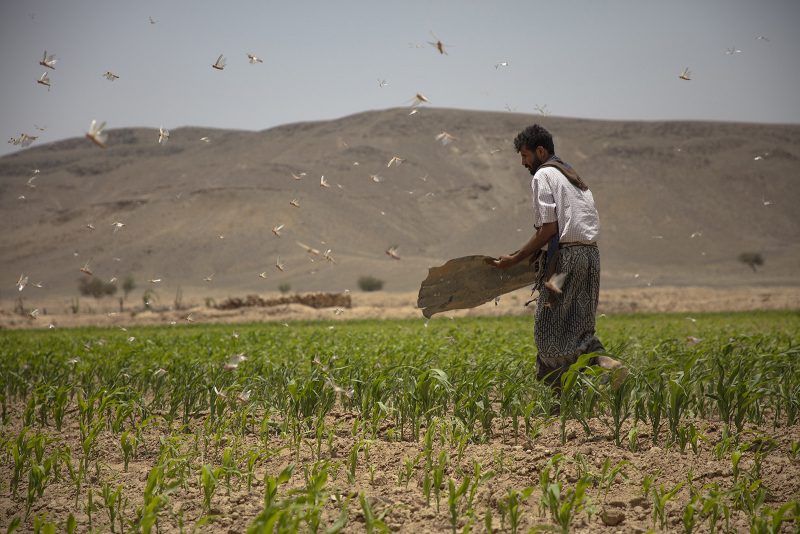
A Yemeni farmer tries to chase locusts off of his fields. Photo | UNFAO
Fertile soil, especially in the border areas in Saada and Hajjah, has become environmentally polluted due to the number of weapons dropped in more than half a million airstrikes. That pollution has not only affected the soil, experts fear it could genetically alter the pomegranates, grapes and coffee that were once staple crops in Yemen. Farmers and their families are at constant risk from unexploded ordnance, especially cluster bombs like the one that killed a young boy on his family farm in Hodeida last Thursday.
Agricultural and environmental experts that spoke to MintPress said that the effects of the Saudi coalition’s targeting of the agricultural sector will likely last for decades. The Director of Agricultural Extension in Yemen, Salah al-Mashreqi, said that more catastrophic effects will appear in the medium and long term, including genetic changes to pomegranates, for which Yemen is famous.
The deliberate targeting of food is prohibited by article 54 of the Geneva Conventions and the May 24, 2018, UN Security Council resolution 2417 on the protection of civilians in wartime, specifically reiterates this principle. Article 14 of the 1977 Protocol Additional to the Geneva Conventions clearly states that starvation as a means of combat is not allowed: ‘’It is prohibited to attack, destroy, remove, or render useless objects indispensable for the survival of the civilian population.” Yet the international community has done little to curb the Saudi-led coalitions use of starvation as a tactic of war in Yemen.
This, in large part, according to many Yemenis and legal scholars alike, is because Saudi Arabia enjoys the near-total diplomatic protection of the United States. Without that support, Saudi Arabia’s airstrikes, which rely on American contractors, targeting software, training, weapons, and technicians to target farmers that are concerned with little more than feeding themselves and their country, would not be possible.
Ahmed AbdulKareem is a Yemeni journalist. He covers the war in Yemen for MintPress News as well as local Yemeni media.
‘Thank God for Deep State’, ex-CIA boss says. Still think it’s a conspiracy theory?
By Nebojsa Malic | RT | November 1, 2019
In just a few short months, the US political establishment has gone from denying the existence of the ‘Deep State’ and calling it a conspiracy theory, to praising it as the bulwark of the Republic against President Donald Trump.
“Thank God for the ‘Deep State,’” declared former CIA director John E. McLaughlin at an event this week, describing the diplomats and intelligence officers testifying before the congressional impeachment inquiry as “people who are doing their duty or responding to a higher call.”
Lavishing praise on the ‘whistleblower’ intelligence officer whose complaint about Trump’s phone call launched the impeachment probe, McLaughlin said the intelligence community is “institutionally committed to objectivity and telling the truth.”
One would think this might be a bit rich, coming from the former deputy director of the CIA at the time of the infamous ‘Iraqi WMDs’ fiasco – and acting director for a time in 2004 – but McLaughlin’s comments were met with applause by the crowd at George Mason University’s Schar School of Policy and Government.
He wasn’t the only one to praise the Deep State either. Sitting right next to him was John Brennan, the CIA director under President Barack Obama, whose fingerprints are all over the so-called ‘Steele dossier’ and ‘Russiagate’, and who is now enjoying a rewarding career as a TV pundit accusing Trump of treason.
Brennan argued that the reason Trump “has a contentious relationship with the Deep State people… is because they tell the truth,” and praised the unelected intelligence and law enforcement officials for continuing to “do their work irrespective of what he’s going to do or say.”
Under normal circumstances, these admissions would be rather earth-shattering. It isn’t every day that former bosses of the intelligence apparatus basically admit that yes, they are meddling in the country’s politics, because they feel they have a “higher loyalty” – to borrow a phrase from ex-FBI boss James Comey, another member of this merry cabal – than to the chief executive elected by the American people.
Yet the response has been muted at best, with a silent shrug and the implicit “nothing to see here, move along” from the major outlets. That’s not particularly surprising, given the media’s role in the ‘Russiagate’ conspiracy. Why, just a couple weeks ago, the New York Times published an opinion piece praising the Deep State along the very same lines Brennan and McLaughlin would.
When Trump and his defenders talked about the Deep State during the ‘Russiagate’ hysteria, the very same outlets pooh-poohed them as insane, paranoid, and delusional. Now they say the Deep State is real, it’s always been real, and it’s acting in the best interests of the American Republic – and if you don’t believe it, you’re the one who’s insane, paranoid and delusional. Sense a pattern?
Whatever one may think of Trump, it beggars belief that the very people who cry the loudest about “our democracy” are elevating an unelected bureaucracy, spies and counter-spies as the arbiters of it. It almost makes you think the people responsible for pushing the ‘Russian meddling’ conspiracy theory may have done it as a smokescreen for their own (mis)deeds.
Oh, wait.
Questions Remain Over Alleged Death of Islamic State Leader
Strategic Culture Foundation | November 1, 2019
Russia’s Ministry of Defense this week said it had not seen any credible evidence that Abu Bakr al-Baghdadi, the leader of the Islamic State (IS) terror group, had been killed in northern Syria last weekend, allegedly in a daring US military operation.
US President Donald Trump boasted last Sunday that American Special Forces raided a base in Idlib Province, which purportedly led to al-Baghdadi’s death from a suicide explosion. The Pentagon said six other people were killed in the operation. In addition, two of al-Baghdadi’s children were killed when the IS leader blew himself up as American troops were closing in, according to Trump’s own dramatic telling of the event.
Curiously, Trump gave prominent thanks to Russia for its help in the logistics of carrying out the attack.
However, Russian MOD spokesman Major General Igor Konashenkov has subsequently stated that Russia was not involved in the raid, as Trump had claimed. He said that Russian flight data indicated that there were no US air strikes in the vicinity of the declared raid. The spokesman went further and remarked that there were doubts as to whether the assassination mission even took place in the way that Washington is publicly claiming.
Another anomaly in the official US account is that the base where al-Baghdadi was purportedly hiding out is in a location known to be a stronghold for another al-Qaeda affiliate that is a sworn enemy of their perceived rival jihadists belonging to IS. Why and how then was the IS leader able to maintain a base surrounded by enemy jihadists?
According to the New York Times, it is claimed that al-Baghdadi paid $67,000 to the rival terror group, Hurras al-Din, for protection. Somehow that sounds a dubious explanation.
A glaring omission in US media coverage of the alleged killing of al-Baghdadi is the historical background as to who he was and how his former so-called caliphate came into being straddling Iraq and Syria.
There is copious evidence that Iraqi-born al-Baghdadi was recruited by American intelligence while imprisoned during the US war on Iraq in the mid- to late-2000s. He was held in the notorious Abu Ghraib US-run torture prison, but subsequently was released by the Americans despite his known jihadist past. It was around 2012 that the Obama administration was covertly mobilizing and weaponizing jihadi assets to carry out its clandestine war for regime change against the Syrian government. It is believed that al-Baghdadi was a key CIA asset for the US dirty war in Syria, even though Washington was proclaiming its involvement in Syria was to “defeat IS” and other terror groups.
It is entirely plausible that US intelligence assets are “terminated” whenever it is politically convenient and when it is calculated that their usefulness has expired.
Trump and the mainstream US media depiction of a spectacular success in exterminating a feared terror chief is almost certainly a distortion of reality and events.
The way Trump in particular has crowed about the purported operation suggests he is seeking a boost to his re-election chances next year. The thuggish rhetoric of killing the IS leader “like a dog” smacks of Trump trying to project an image of a tough president.
More generally, the event has afforded US media to proclaim the virtue of American military power in apparently bringing a notorious renegade “to justice”.
The timing could not be more important. The nearly eight-year war in Syria has exposed the criminality of Washington and its NATO partners for fueling carnage. By contrast, the Syrian government and its Russian and Iranian allies have been vindicated in their long-held claims that a criminal US-backed aggression using terrorist proxies has been thwarted.
When Trump abandoned the Kurdish militants last month, the move was condemned for throwing Syria into further turmoil. It was Russia’s deft diplomacy which managed to contain the situation. At that point, Washington’s international credibility was scraping the barrel of duplicity and malign responsibility for conflict and chaos in Syria.
Hence, a sensational operation resembling “a movie” – as Trump put it – was a timely public relations remedy for Washington’s badly tarnished image. Ostensibly, “taking out” a terrorist leader gives the US the means to renew its propaganda narrative that it is “fighting against terrorism” rather than the reality of using terrorism for its regime-change wars and other imperialist objectives.
Was Abu Bakr al-Baghdadi killed last weekend? It is not the first time his “death” has been reported by US forces who have made similar claims in past years. There are too many questions and discrepancies to take Washington’s version of events as accurate. More plausibly, it was a carefully contrived propaganda stunt to burnish Washington’s disgraced image.
One thing for sure, however, is that the US will continue to use terror proxies and assets into the future in order to achieve its pernicious geopolitical aims. There are plenty more “al-Baghdadis” to be cultivated and orchestrated by Washington as it sows chaos and destruction in the Middle East and beyond for its selfish interests.
The “Deep State” Has Been Redefined as Career Bureaucrats Doing Their Patriotic Duty
By Edward J. Curtin | Behind the Curtain | October 31, 2019
It gets funny, this shallow analysis of the deep state that is currently big news. There’s something ghoulish about it, perfectly timed for Halloween and masked jokers. What was once ridiculed by the CIA and its attendant lackeys in the media as the paranoia of “conspiracy theorists” is now openly admitted in reverent tones of patriotic fervor. But with a twisted twist.
The corporate mass-media has recently discovered a “deep state” that they claim to be not some evil group of assassins who work for the super-rich owners of the country and murder their own president (JFK) and other unpatriotic dissidents (Malcom X, MLK, RK, among others) and undermine democracy home and abroad, but are now said to be just fine upstanding American citizens who work within the government bureaucracies and are patriotic believers in democracy intent on doing the right thing and keeping their jobs.
This redefinition has been in the works for a few years, and it shouldn’t be a surprise that this tricky treat was being prepared for our consumption a few years ago by The Council on Foreign Relations. In its September/October 2017 edition of its journal Foreign Affairs, Jon D. Michaels, in “Trump and the Deep State: The Government Strikes Back,” writes:
Furious at what they consider treachery by internal saboteurs, the president and his surrogates have responded by borrowing a bit of political science jargon, claiming to be victims of the “deep state,” a conspiracy of powerful, unelected bureaucrats secretly pursuing their own agenda. The concept of a deep state is valuable in its original context, the study of developing countries such as Egypt, Pakistan, and Turkey, where shadowy elites in the military and government ministries have been known to countermand or simply defy democratic directives. Yet it has little relevance to the United States, where governmental power structures are almost entirely transparent, egalitarian, and rule-bound.
The White House is correct to perceive widespread resistance inside the government to many of its endeavors. But the same way the administration’s media problems come not from “fake news” but simply from news, so its bureaucratic problems come not from an insidious, undemocratic “deep state” but simply from the state—the large, complex hive of people and procedures that constitute the U.S. federal government.
Notice how in these comical passages about U.S. government transparency and egalitarianism, Michaels slyly and falsely attributes to Trump the very definition – “unelected bureaucrats” – that in the next paragraph he claims to be the real deep state, which is just the state power structures. Pseudo-innocence conquers all here as there is no mention of the Democratic party, Russiagate, etc., and all the machinations led by the intelligence services and Democratic forces to oust Trump from the day he was elected. State power structures just move so quickly, as anyone knows who has studied the speed which bureaucracies operate. Ask Max Weber.
Drip by drip over the past few years, this “state bureaucracy” meme has been introduced by the mainstream media propagandists as they have gradually revealed that the government deep-staters are just doing their patriotic duty in trying openly to oust an elected president.
Many writers have commented on the recent New York Times article, Trump’s War on the ‘Deep State’ Turns Against Him asserting that the Times has finally admitted to the existence of the deep state, which is true as far as it goes, which is not too far. But in this game of deceptive revelations – going shallower to go deeper – what is missing is a focus on the linguistic mind control involved in the changed definition.
In a recent article by Robert W. Merry, whose intentions I am not questioning – New York Times Confirms: It’s Trump Versus the Deep State – originally published at The American Conservative and widely reprinted, the lead-in to the article proper reads: “Even the Gray Lady admits the president is up against a powerful bureaucracy that wants him sunk.” So the “powerful bureaucracy” redefinition, this immovable force of government bureaucrats, is slipped into public consciousness as what the deep state supposedly is. Gone are CIA conspirators and evil doers. In their place we find career civil servants doing their patriotic duty.
Then there is The New York Times’ columnist James Stewart who, appearing on the Today Show recently, where he was promoting his new book, told Savannah Guthrie that:
Well, you meet these characters in my book, and the fact is, in a sense, he’s right. There is a deep state… there is a bureaucracy in our country who has pledged to respect the Constitution, respect the rule of law. They do not work for the President. They work for the American people. And, as Comey told me in my book, ‘thank goodness for that,’ because they are protecting the Constitution and the people when individuals – we don’t have a monarch, we don’t have a dictator – they restrain them from crossing the boundaries of law. What Trump calls the deep state in the United States is protecting the American people and protecting the Constitution. It’s a positive thing in this sense.
So again we are told that the deep-state bureaucracy is defending the Constitution and protecting the American people, as James Comey told Stewart, “in my book, ‘thank goodness for that,’” as he put it so eloquently. These guys talk in books, of course, not person to person, but that is the level not just of English grammar and general stupidity, but of the brazen bullshit these guys are capable of.
This new and shallow deep state definition has buried the old meaning of the deep state as evil conspirators carrying out coup d’états, assassinations, and massive media propaganda campaigns at home and abroad, and who, by implication and direct declaration, never existed in the good old U.S.A. but only in countries such as Egypt, Turkey, and Pakistan where shadowy elites killed and deposed leaders and opponents in an endless series of coup d’états. No mention in Foreign Affairs, of course, of the American support for the ruthless leaders of these countries who have always been our dear allies when they obey our every order and serve as our servile proxies in murder and mayhem.
Even Edward Snowden, the courageous whistleblower in exile in Russia, in a recent interview with Joe Rogan, repeats this nonsense when he says the deep state is just “career government officials” who want to keep their jobs and who outlast presidents. From his own experience, he should know better. Much better.
Linguistic mind control is insidious like the slow drip of a water faucet. After a while you don’t hear it and just go about your business, even as your mind, like a rotting rubber washer, keeps disintegrating under propaganda’s endless reiterations.
To think that the deep state is government employees just doing their patriotic duty is plain idiocy and plainer propaganda.
Happy Halloween!
Assad casts doubt on ISIS leader’s death, draws parallels with Bin Laden’s killing
‘Americans will RESPAWN al-Baghdadi’

RT | October 31, 2019
Take any words from US politicians with a grain of salt, Syria’s Bashar Assad has urged, as he cast doubt on the story of the Islamic State leader being killed in US a raid, and compared it to the shady killing of Osama Bin Laden.
The widely publicized US special forces raid that allegedly killed Abu Bakr al-Baghdadi, the leader of the Islamic State (IS, formerly ISIS/ISIL) terrorist group, left more questions than answers and it should not be taken at the face value, the Syrian President cautioned, during a lengthy interview with state media on Thursday.
Damascus did not participate in the raid by any means, Assad stated, adding that he’d learned about the claim only through media reports. Adding imaginary participants into the operation is likely supposed to give it credibility, he added, while countries on such a list would likely be flattered to be a “part of a ‘great’ operation.”
“We do not need such credit. We are the ones fighting terrorism. We have no relations and have had no contact with any American institutions.”
Washington’s loud praise of its own actions, a picture of the ‘hero dog’ that took part in the raid and footage purportedly of the aerial strikes have not convinced Assad if it “actually took place or not.” Moreover, he thought the whole affair suspiciously resembled the 2011 killing of another notorious terrorist – Al Qaeda’s head Osama Bin Laden.
“Why were the remains of Baghdadi not shown? This is the same scenario that was followed with Bin Laden. If they are going to use different pretexts in order not to show the remains, let us recall how [former Iraqi] President Saddam Hussein was captured and how the whole operation was shown from A to Z; they showed pictures and video clips after they captured him.”
The killing of Saddam’s sons was also well-documented and widely publicized, Assad went on to add, suggesting that the Americans “hide everything” about both the killing of bin Laden and that of al-Baghdadi for a reason.
“This is part of the tricks played by the Americans. That is why we should not believe everything they say unless they come up with evidence. American politicians are actually guilty until proven innocent, not the other way around.”
All in all, it’s unlikely that death of the IS leader – if he really was killed – and even the ultimate destruction of the terrorist group would change anything, Assad said. The root of the problem – the Wahhabi ideology that is “more than two centuries old” would not disappear at once. The radical Islamist thought and al-Baghdadi were merely US tools all along, Assad claimed, adding that those tools could easily be re-purposed elsewhere.
“I believe the whole thing regarding this operation is a trick. Baghdadi will be recreated under a different name, a different individual, or ISIS in its entirety might be reproduced as needed under a different name but with the same thought and the same purpose. The director of the whole scenario is the same, the Americans.”
Featured Video

Ivermectin and iodine
or go to
Aletho News Archives – Video-Images
Book Review
UAE tortured, killed journalist for opposing Israel normalization
The Cradle | October 31, 2026
UAE security officers detained, tortured, and killed Emirati poet and news editor Habib al-Sayegh in August 2019, shortly after he published a column opposing UAE normalization with Israel, according to a newly published book.
“Princes and Thieves,” a book by investigative journalist Matthew Cole published on 25 October, alleges that UAE security officers raided Sayegh’s Abu Dhabi home shortly after the publication of the column, hooded him in front of his wife and took him to a detention facility where he was tortured to death.
His interrogators reportedly pulled out several of his teeth with pliers and beat him repeatedly with a sharp metal object.
On 11 August 2019, Sayegh criticized the UAE’s plan to normalize relations with Israel as part of the Abraham Accords in his weekly column for Khaleej newspaper. The column was titled “Israel Is Our Real Enemy and A Dangerous Project.”
Sayegh described Israel as “a real and natural enemy” while questioning “who authorized the normalizers to speak on behalf of everyone?”
Nine days after the column was published, Emirati state media announced his death, without stating a cause. … continue
Blog Roll
 Aletho News
- Ivermectin and iodine
- Congratulations climate skeptics — you are a ‘Hybrid weapon of war’ and a growing public health threat
- ‘The Arab Vote’: How Israeli Racism Has Ruined Their Elections
- Israel forces Palestinians in Gaza to choose between assassination alone or death with their families: Report
- US Approves Sale of 500 Patriot Missiles to Ukraine, Deliveries May Take Years
- German Imperialism: An Urgent Explainer
- Backed by AAP, West Virginia Proposal Would Allow Dental Hygienists to Give HPV Vaccine to 9-Year-Olds
- Poland Is the Symptom and Europe Is the Patient
- UAE security forces tortured, killed journalist for opposing Israel normalization: Report
- They Compared the Spice to the Drug. The Spice Won — Again. (Part 2)
- If Americans Knew
- An error has occurred; the feed is probably down. Try again later.
- No Tricks Zone
- Germany’s Green Energy Transition Becoming Increasingly Expensive…Another 6 Trillion Euros!
- Sudden Stratospheric Warming, Powerful El Niño Combination May Lead To Extreme Europe Cold, Energy Crisis!
- Two New Studies Find Thwaites Glacier Melt Cannot Be Driven By Human Activity Or A Warming Ocean
- E-Cars Reduce CO2 Emissions By Only 41% Compared To Internal Combustion Engine Vehicles
- Predictions Made By Renowned Climate Professor Over Past Decades Have Been Proven To Be Poor
- New Study Suggests Large Regions Of The Pacific Ocean Have Been Cooling For The Last 80 Years
- Germany’s Green Energy Debacle: High Energy Costs Force Kahla Porzellan to Close After 182 Years!
- New Study: 50 Years Of The Most Aggressive ‘Net Zero’ Policies Can Only Affect The Global Climate By 0.03°C
- US September “Heat” Was No Record…Many Records Set Decades Ago
- Latest European Green Energy Debacle; Portugal’s Largest Flagship Solar Park Insolvent!

