Liberal Interventionists and Neoconservatives Dominate US Foreign Policy
And the bad outcomes are predictable

BY PHILIP GIRALDI • UNZ REVIEW • MAY 10, 2022
Once upon a time United States foreign policy was based on actual national interests, but that was long ago and far away before the country was beguiled into a colonial war with Spain followed by a twentieth century that was chock-a-block full of any type and intensity of warfare that one might imagine, including the use of nuclear weapons. Some might consider that the United States has become a nation made by war, to include a presumption that all the war-making has been both just and necessary, since America is “exceptional” and by default “the leader of the Free World.” Witness what is taking place vis-à-vis Ukraine and Russia right now, pressing forward with a full-scale economic war against Moscow while arming one of the belligerents in support of no actual national interest, as if by habit. The propensity of American politicians to resort to arms to compensate for their other failures is such that among circles in Washington and the media there has long been a joke making the rounds observing that no matter who is nominated and elected president we always wind up with John McCain. But if one is seriously concerned about the tendency of the United States to view nearly every foreign problem as solvable if only one uses enough military force, the joke might be updated to suggest that we Americans now always wind up with the Kagans, the first family of neoconservative/neoliberal advocates for an aggressive, interventionist US foreign policy.
Victoria Nuland, the architect of the disaster in Ukraine and a Dick Cheney and Hillary Clinton protege, is married to Robert Kagan and now serving as number three in the State Department. Robert is the Stephen & Barbara Friedman Senior Fellow with the Project on International Order and Strategy in the Foreign Policy program at Brookings and is also a regular contributing columnist at The Washington Post. His brother is Fred, currently a resident scholar at the American Enterprise Institute, and Fred’s wife Kimberley is head of the aptly named Institute for the Study of War.
When Congress-critters want to justify a new war, they frequently cite judgements made by one of the various groups associated with the Kagans. Robert is a frequent contributor to the national media both in interviews and opinion pieces calling inevitably for harsh measures against countries like Russia and Iran while Fred uses his bully pulpit to argue in favor of a large increases in military spending to counter “future threats.” Fred and Robert are members of the Aspen Strategy Group. They and their father, Donald, were all signatories to the neocon Project for the New American Century manifesto, Rebuilding America’s Defenses (2000).
Characteristically, the Kagan brothers love war but expect someone else to do the fighting. They are both considerably overweight and could never pass a military entrance physical if they were so inclined, which, of course they are not. The Kagans have been closely tied to the Democratic Party on many social issues and would likely describe themselves as liberal interventionists as well as neocons, since in practice both labels mean the same thing in terms of an assertive foreign policy backed by force. Plus, their flexibility gives them access to the foreign policy establishments of both major parties, as also does their support of Israeli interests in the Middle East, to include outspoken support of the Iraq War and for a covert war against Iran.
The Kagans are labeled by many as conservative, but they are not reliably Republican. Donald Trump was much troubled during his 2016 and 2020 campaigns by so-called conservatives who rallied behind the #NeverTrump banner, presumably in opposition to his stated intention to end or at least diminish America’s role in wars in the Middle East and Asia. The Kagans were foremost among those pundits. Robert was one of the first neocons to get on the #NeverTrump band wagon back in 2016 when he endorsed Hillary Clinton for president and spoke at a Washington fundraiser for her, complaining about the “isolationist” tendency in the Republican Party exemplified by Trump. Many other notable neocons also declared themselves to be #NeverTrump, including Bill Kristol, Bret Stephens, Daniel Pipes, Reuel Gerecht, Max Boot and Jonah Goldberg.
To be sure, some high-profile neocons stuck with the Republicans, to include the highly controversial Elliott Abrams, who initially opposed Trump but later became the point man for dealing with both Venezuela and Iran, attracted by Trump’s hardline with both countries. Abrams’ conversion reportedly took place when he realized that the new president genuinely embraced unrelenting hostility towards Iran in particular as exemplified by his ending of the Joint Comprehensive Plan of Action (JCPOA) and the assassination of Iranian general Qassem Soleimani in Baghdad. John Bolton was also for a time a neocon in the White House fold, though he later became an enemy after being fired by the president and then wrote a book critical of Trump.
Even though the NeverTrumper neocons did not succeed in blocking Donald Trump in 2016, they maintained relevancy by slowly drifting back towards the Democratic Party, which is where they originated back in the 1970s in the office of the Senator from Boeing Henry “Scoop” Jackson. A number of them started their political careers there, to include leading neocon Richard Perle.
It would not be overstating the case to suggest that the neoconservative movement together with its liberal interventionist colleagues are dominating foreign policy thinking across the board in Congress and the White House. That development has been aided by a more aggressive shift among the Democrats themselves, with Russiagate and other “foreign interference” still to this day being blamed for the party’s failure in 2016 and for its dreary prospects in midterm elections later this year. Given that mutual intense hostility to Trump, the doors to previously shunned liberal media outlets have now opened wide to the stream of foreign policy “experts” who want to “restore a sense of the heroic” to US national security policy. Eliot A. Cohen and David Frum have been favored contributors to the Atlantic while Bret Stephens and Bari Weiss were together at the New York Times prior to Weiss’s resignation. Jennifer Rubin, who wrote in 2016 that “It is time for some moral straight talk: Trump is evil incarnate,” is a frequent columnist for The Washington Post while both she and William Kristol appear regularly on MSNBC. Russian-Jewish import hardliner Max Boot is a regular feature contributor at the Post.
The unifying principle that ties many of the mostly Jewish neocons together is, of course, unconditional defense of Israel and everything it does, which leads them to support a policy of American global military dominance which they presume will inter alia serve as a security umbrella for the Jewish state. In the post-9/11 world, the neocon media’s leading publication Bill Kristol’s The Weekly Standard virtually invented the concept of “Islamofascism” to justify endless war in the Middle East, a development that has killed millions of Muslims, destroyed at least three nations, and cost the US taxpayer more than $5 trillion. The Israel connection has also resulted in neocon political and media support for the currently highly aggressive and dangerous policy against Russia, due in part to its involvement in defense of Israeli target Syria. In Eastern Europe, neocon ideologues have aggressively exploited the largely illusory policy of “democracy promotion,” which, not coincidentally, has also been a major Democratic Party foreign policy objective, both coming together nicely to justify the current chaos in Ukraine.
The neocons and liberal interventionists are involved in a number of foundations, the most prominent of which is the Foundation for Defense of Democracies (FDD), that are largely funded by Jewish billionaires and defense contractors. FDD is headed by Canadian Mark Dubowitz and it is reported that the group takes direction coming from officials in the Israeli Embassy in Washington. Other major neocon incubators are the American Enterprise Institute, which currently is the home of Paul Wolfowitz, and the School of Advanced International Studies (SAIS) at John Hopkins University.
Many former Barack Obama White House senior officials who believe in liberal interventionism and democracy promotion while also hating Russia and Vladimir Putin have developed comfortable working relationships with the neocons. Foreign policy hawks including Antony Blinken, Wendy Sherman, Nicholas Burns, Susan Rice and Samantha Power are calling most of the shots given Biden’s senility but with neocon political and media support.
Unfortunately, nowhere in Biden’s foreign policy circle does one find anyone who is resistant to the idea of worldwide interventionism in support of claimed humanitarian objectives, even if it would lead to an actual shooting war with major competitor power Russia and also possibly China. In fact, Biden himself embraces a characteristically extremely bellicose view on a proper relationship with foreign nations “claiming that he is defending democracy against its enemies.” His language and authoritarian governing style leave no wiggle room for constructive dialogue with adversaries. The script being written by his Administration on how to deal with the rest of the world promises nothing but unending trouble and quite possibly sharp economic decline in the US for the foreseeable future.
Philip M. Giraldi, Ph.D., is Executive Director of the Council for the National Interest, a 501(c)3 tax deductible educational foundation (Federal ID Number #52-1739023) that seeks a more interests-based U.S. foreign policy in the Middle East. Website is councilforthenationalinterest.org, address is P.O. Box 2157, Purcellville VA 20134 and its email is inform@cnionline.org.
Sanctions hurt US more than Russia – poll
Samizdat | May 10, 2022
A poll published on Saturday found that 53% of Americans believe that sanctions on Moscow hurt the US more than Russia. Amid soaring gas prices and a rising cost of living, voters are losing confidence in US President Joe Biden’s leadership, and 43% say they’re “OK” with Ukraine losing its ongoing conflict with Russia.
With inflation at a 40-year peak and gas prices near record highs, the Democracy Institute/Express.co.uk poll revealed that Biden is polling negatively in all policy areas, with foreign policy the worst. Some 56% disapprove of his handling of foreign matters, compared to 40% approving. On Ukraine specifically, only 38% approve of his stewardship, while 52% disapprove.
The Biden administration has attempted to blame Russia and its president, Vladimir Putin, for the rising cost of living at home, with his officials repeatedly referring to “Putin’s price hike.” However, living costs were rising for months before Russia sent troops into Ukraine, and voters are pointing the finger at Biden for their economic woes.
Some 50% said they’d back Republicans in November’s midterm elections, compared with 42% saying they’d vote Democrat. In addition to more voters being “OK” than “not OK” with Ukraine losing the conflict with Russia (43%-41%), more Americans think it would be better for Biden to leave office than for Putin to step down, by 53% to 44%.
Biden has sanctioned the Russian banking and energy sectors, and his administration has sent nearly $4 billion worth of weapons to Ukraine, with Defense Secretary Lloyd Austin promising last month to “move heaven and earth” to finance Kiev’s fighting. The US president has also asked Congress to approve another $33 billion aid package for Ukraine – of which $20 billion would be earmarked for military aid – and on Monday signed the Lend-Lease Act of 2022, allowing Washington to send unlimited quantities of arms to Kiev.
In the eyes of the Kremlin, this deluge of weapons plus the US and NATO’s intelligence-sharing arrangements with Kiev mean that the West is “essentially going to war with Russia through a proxy.”
American voters, however, are not as earnest as the Biden administration in fuelling this war. According to the latest poll, they consider Russia the fourth biggest threat to the US at 16%, behind North Korea (18%), Iran (20%), and China (40%).
“Americans were very pro sanctions at first, [but] they are not as keen on the sanctions as they were,” Democracy Institute Director Patrick Basham told Express. “Biden made these predictions at the outset – the ruble would be rubble, we were going to crash the Russian economy, people will rise up, Putin will be out, the Russians will run away from Ukraine … [but] none of those things have happened.”
This difference between expectation and reality has made people cynical, he claimed, comparing the apparent loss of trust to public disillusionment with coronavirus policies throughout the West.
“The problem [now] is that at least half of the country in America thinks they were hoodwinked over a lot of the Covid stuff, so they are even more cynical about government and media than they were two years ago,” he said.
Brazil rejected US oil request
Samizdat | May 10, 2022
The US asked Brazil in March to increase its crude oil output to curb soaring prices amid international sanctions against Russia, but Brazil refused, Reuters reported on Tuesday.
US government officials approached Brazil’s state-run oil company Petrobras, the outlet quoted its sources as saying, as crude prices started to rise against the backdrop of Russia’s military operation in Ukraine and the ensuing international sanctions.
The officials came away empty-handed, however, as Petrobras said that output levels were determined by business strategy rather than diplomacy and also that a significant short-term production boost would not be logistically possible, Reuters says.
Brazil is the world’s 11th largest oil exporter, with most of its crude going to China, the US, and India, according to the Observatory of Economic Complexity (OEC).
Also in March, the US approached Venezuela, which has the world’s largest proven oil reserves, offering to ease some of the sanctions on the country in exchange for increased oil exports to the US. However, Washington later backtracked on the issue.
Washington banned the import of Russian oil in early March, with US Energy Secretary Jennifer Granholm saying that the country was on “war footing,” and calling on domestic producers to boost output. Last year, the US got 8% of its total petroleum imports from Russia, according to the US Energy Information Administration, with other major suppliers being Canada, Mexico, and Saudi Arabia.
FDA Chief Claims “Misinformation” is Leading Cause of Death in the United States
By Paul Joseph Watson | Summit News | May 9, 2022
During an appearance on CNN, FDA chief Dr. Robert Califf asserted that the leading cause of death in the United States is online “misinformation.”
Yes, really.
Califf spoke about his remarks during an interview with CNN’s Pamela Brown, which were originally made at a health conference in Texas last month when he said online misinformation was “now our leading cause of death.”
After admitting that there was “no way to quantify this,” before mentioning heart disease and cancer (actual killers), Califf went on to bolster the claim anyway.
Claiming that there has been “an erosion of life expectancy,” Califf went on to say that Americans were living an average of 5 years shorter than people in other high income countries.
Califf said that anti-virals and vaccinations meant “almost no one in this country should be dying from COVID,” before going on to explain that there was also a “reduction in life expectancy from common diseases like heart disease.”
“But somehow … the reliable, truthful messages are not getting across,” he said, adding, “And it’s being washed down by a lot of misinformation, which is leading people to make bad choices that are unfortunate for their health.”
The FDA chief did not explain how ‘online misinformation’ was causing more deaths from heart disease, but went ahead and made the claim anyway without being challenged by the host.
As we have exhaustively highlighted, “online misinformation” is indistinguishable from information the regime doesn’t like.
As we previously noted, the woman picked to head up the Department of Homeland Security’s ‘Ministry of Truth’ said free speech makes her “shudder” while also promoting the lie that the Hunter Biden laptop story was Russian disinformation.
Nina Jankowicz also ludicrously cited Christopher Steele as an expert on disinformation. Steele was the author of the infamous Clinton campaign-funded Trump ‘peegate’ dossier’ that turned out to be an actual product of disinformation.
The contrived moral panic over “misinformation” has become more pronounced following Elon Musk’s purchase of Twitter, with CNN guests recently complaining about how it might impact their monopoly on controlling “the channels of communications.”
Assad renews Syria’s bonds with Iran
BY M. K. BHADRAKUMAR | INDIAN PUNCHLINE | MAY 9, 2022
The unannounced arrival of the Syrian President Bashar al-Assad to Tehran on Sunday makes yet another wrinkle to the geopolitics of West Asia. In a short trip of a few hours, Assad had meetings with Iran’s Supreme Leader Ali Khamenei and President Ebrahim Raeisi and returned to Damascus.
This is only the second trip by Assad to Iran in the past 11 years since the conflict erupted in Syria. The last occasion was in 2019, when he came accompanied by the charismatic commander of the IRGC’s elite Quds Force late Qassem Soleimani to mark Syria’s “victory” in the conflict. Much water has flowed down down the Euphrates and the Tigris since then.
There is some speculation that Russia may redeploy its forces in Syria. The Israeli intelligence website DebkaFile reported cryptically on Friday that “Russian units deployed to Syria are assembling at the air bases of Hmeimim, Qamishli, Deir e-Zor and T4, ready for some to transfer to the Ukraine warfront. DEBKAfile’s military sources report that the Russians are handing over key bases to Iran’s Revolutionary Guards and Hizballah.”
Prima facie, this is kite-flying, so to speak. There is no independent word from Moscow. Iran will be certainly in the loop on any big Russian troop withdrawal from Syria. The Turkish air space is closed to Russian [military] planes since April and on February 28 Ankara had restricted the passage of Russian warships through the Bosporus and Dardanelles Straits (unless they are returning to their bases in the Black Sea.)
Analysts have interpreted the Turkish decisions as “anti-Russian” but they come under the ambit of Montreux Convention (1936) and on closer look, may even work to Moscow’s advantage since the door is also closed to any NATO naval build-up in the Black Sea. Russian papers have pointed out that Moscow has been using the air corridor via Iran and Iraq to supply its troops in Syria.
Indeed, Turkey is doing a delicate trapeze act vis-a-vis Russia and Ukraine, being a Black Sea power with overlapping security concerns, while also a NATO power. Turkey has deftly created space to manoeuvre since NATO is technically not at war with Russia, and since Turkey is not a EU member country, it isn’t obliged to sanction Russia, either.
Turkish leadership has actively nurtured contacts with the Kremlin, and the economic partnership continues, including over the construction of the massive $20 billion Akkuyu Nuclear Power Plant (comprising four 1,200 MW VVER units), which is expected to meet ten percent of Turkey’s electricity demand when it is completed in 2025.
Again, Russian carrier Aeroflot has just resumed flights to Turkey in anticipation of the tourist season. Believe it or not, Turkey has found an ingenuous formula to allow Russian tourists to travel to Turkey bypassing the suspension of Visa and Mastercard by making it possible to access their funds through Russia’s homegrown payments system called Mir! Some 4.7 million Russian tourists visited Turkey last year, accounting for 19% of the total tourist arrivals, fetching an annual income exceeding $10 billion.
When it comes to Russian-Iranian relations too, the picture is broadly similar to India’s — neither supporting Russia nor opposing it while refusing to censure Russian intervention and counselling ceasefire and dialogue as the only solution.
According to Iranian media reports, Russia’s Deputy Prime Minister Alexander Novak is due to visit Iran shortly in connection with the session of the Iran-Russia Joint Economic Committee. The discussions are expected to focus on “strengthening financial cooperation and resolving transit problems” between the two countries as well as cooperating in the fields of oil and gas and promoting trade and tourism. Tehran knows that such camaraderie with Moscow is contrary to the spirit of Western sanctions.
Moscow has every intention to remain actively involved in Syria. Special Russian Presidential Representative for the Middle East and Deputy Foreign Minister Mikhail Bogdanov disclosed to Tass last week that Russia is working on scheduling the next international meeting on Syria in the Astana format for the end of May in Nur-Sultan, Kazakhstan. Does that look like Russia washing its hands off Syria? To quote Bogdanov, “We already discussed this with partners Iran and Turkey as the guarantors of the Astana process plus with the Syrian government and opposition delegations.”
The official Syrian news agency Sana described Assad’s trip to Tehran as a “working visit.” It quoted Assad as stressing to Khamenei about “the importance of continuing cooperation in order not to allow America to rebuild the international terrorist system that it used to harm the countries of the world,” adding that the US “is weaker than ever.”
There are four main takeaways from Assad’s talks with the Iranian leadership. First, Assad made it clear in no uncertain terms that no matter Syria’s normalisation with the UAE (or other Arab countries involved in the conflict), he continues to attribute the highest importance to Syria’s alliance with Iran. Assad underscored that Syria is ready for broader coordination with Iran in security, political and economic fields.
Second, Damascus needs Tehran’s help for finally freeing Syria from foreign occupation. Raisi told Assad, “The whole of the Syrian land must be liberated from foreign occupiers. This occupation should not be subject to the passage of time, and the occupying forces and their mercenaries should be expelled.” Sana cited Khamenei as stressing that Iran will “continue to support Syria to complete its victory over terrorism and liberate the rest of the country’s lands.”
Third, the two countries have a consensus on the effectiveness and vibrancy of the resistance front. Assad acknowledged that the weakening of the US’ influence in West Asia and the end of Israel’s military supremacy regionally is a direct outcome of the strategic relations between Iran and Syria, “which must continue with strength.”
Interestingly, Khamenei recalled that Soleimani had “a special liking towards Syria and literally sacrificed his life” for that country and viewed the issue of Syria as a “sacred duty and obligation”. Khamenei reminded Assad poignantly, “This bond is vital for both countries and we should not let it weaken. On the contrary, we should strengthen it as much as possible.” Raisi called Assad “one of the figures of the Resistance Front” like his father Hafez al-Assad.
Fourth, Assad sought and obtained assurances from the highest level of Iranian leadership that Iran will help Syria overcome its difficulties. This is particularly crucial at a juncture when regional politics is in flux and Russia is preoccupied in Ukraine.
A resuscitation of the US-led regime change project in Syria is not to be expected and Washington no longer wields commanding influence over its Persian Gulf allies or Turkey to get them to act as its surrogates. But Assad’s challenge is that Syria is getting relegated to the back burner as new hotspots and topical issues draw the region’s attention — such as JCPOA, Yemen, Iran-Saudi normalisation, OPEC+, etc.
Although the conflict has ended, Syria still remains under foreign occupation and its economy is in ruins. A frozen conflict may legitimise the status quo. Meanwhile, Israel is waiting in the wings. Assad’s visit to Tehran signals that Iran remains the mainstay of Syria’s future strategy to avoid such a dismal fate. Iran’s Foreign Minister Hossein Amir Abdollahian affirmed on Monday that Assad’s visit was held in an atmosphere of “fraternity and friendship,” and it opens a new chapter in the strategic ties.
Insights On Progressive Thinking From The Climate Action Council Public Hearing
By Francis Menton | Manhattan Contrarian | May 6, 2022
My previous post on Tuesday contained some highlights from the May 3 public hearing of New York’s Climate Action Council. The CAC is the body that is charged with devising a “Scoping Plan” to inform all us New Yorkers how we will achieve “zero carbon” electricity by 2030 and a “zero carbon” economy by 2050. I attended the hearing for about two and a half hours, during which about 60 people spoke.
Reflecting on the hearing a few days later, I think there are a few more highlights that would interest the readers, and will give some more insights into the nature of progressive thinking.
As stated in my prior post, of the 60 or so speakers, all but myself and four others were vigorous supporters of the critical necessity of achieving the stated zero carbon goals by the given dates as an urgent matter of saving our planet and our children. This was so despite what appeared to me to be manifestly huge issues of physical feasibility and cost that are almost certain to cause these grand “net zero” energy schemes to fail. The CAC’s draft “Scoping Plan,” as it currently exists for public comment, does not consider these feasibility or cost issues in any remotely adequate fashion, if at all. That fact did not appear to bother the overwhelming majority of the speakers.
So what are the things that do drive the thinking of these other 55 or so speakers, who apparently represent the large majority of New York City’s citizenry? The previous post mentioned fear as a common theme — fear that use of fossil fuels by us New Yorkers will bring on storms, floods and other disasters to threaten our lives and livelihoods. But what I failed to mention was another emotion that was even more prevalent in the comments — anger.
Anger at what, you might ask? Good question. I admit that this doesn’t make any sense, but here it is. The anger is directed at the fossil fuel producers and distributors who the commenters, with near unanimity, seemed to believe were hell-bent on destroying the planet. A substantial majority of the 60 or so comments that I listened to expressed this anger in one form or another, and it was an implicit undercurrent in most of the rest.
But, you might say, all of these people are in fact the users of the fossil fuels. Essentially all of them use electricity, which in New York currently comes about 60% from fossil fuels. The large majority of them drive cars, of which some 99% in New York use gasoline. Most of them heat their homes with natural gas, and cook with natural gas. Aren’t they themselves the ones who are responsible for the problem, if there is a problem? They use fossil-fuel-burning cars and furnaces and stoves because those vehicles and appliances are cheaper and/or work better than the alternatives. And yet, somehow these people have convinced themselves that they have no responsibility at all, and the use of gasoline and natural gas by them and others is a fault of evil producers and utilities.
On this theme, two commenters in particular stand out in my mind. First was a youngish (probably in her 30s) woman from Brooklyn who described herself as having a toddler in the apartment. After relating her fears for the toddler’s future in a world of changing climate, she got to the crux of her personal testimony, which was much more about anger than fear. The gas company was putting a dangerous substance into her stove, which when burned to cook gave off toxic substances and fumes that were putting the toddler’s health at risk. Her intense rage was palpable. She urged the CAC in the strongest terms to impose legal prohibitions that would prevent this kind of conduct going forward.
Put aside for the moment that this woman apparently had no idea that there is nothing toxic about the combustion products of natural gas, which are CO2 and water. But even more bizarre was that she apparently hadn’t figured out that if she is concerned about this subject, however irrationally, she can just go out and buy an electric stove tomorrow. And why hadn’t she done that? She didn’t say. The only reasons I can think of are that natural gas stoves work better than electric ones and are cheaper. Those are perfectly good reasons. But I wouldn’t recommend that you try to argue with this woman about why she has a gas stove. She is completely convinced that it has been foisted upon her by the evil gas companies who are intent on destroying the health of her toddler, let alone the planet. I doubt that any amount of logic or reason could talk her out of that belief.
And then there was the case of an equally irrational 60-something man, who said he was from Cedarhurst, Long Island. For those unfamiliar, Cedarhurst is a very wealthy suburb of large homes just outside the New York City limits. You may have seen Cedarhurst out the window of an airplane approaching JFK airport on a flight back from Europe. The guy in question styled his testimony as a confessional. He candidly admitted to his extreme climate guilt. But he claimed that he was unable to do anything about his large carbon footprint right now because the state had failed to compel the suppliers to provide him with zero emissions alternatives. He didn’t give us any details of what fuel he currently uses to heat his home, or to cook, but chose to focus on his driving. He stated that he wanted to buy an electric car, and was ready to do it, but was prevented from doing it. How was he prevented? Because there were no electric vehicle charging stations in his town! Needless to say, he was angry about that, and demanded that the state step up to order somebody to provide the charging stations, and provide funding to be sure that the charging stations got built.
Huh? Why didn’t this guy just get his own charging station at his own house? He didn’t mention that, so we are left to speculate. Again, the only thing I can think of is that he doesn’t want to spend his own money on this. Better to gin up some anger and demand that somebody else pay for it.
The thinking is that not only perfect fairness and justice, but also perfect climate, are easily within our reach if only our leaders summon the political will to order the evil people and companies to do the right thing, and perhaps provide some funding from the infinite free pile of government money. I guess, if you believe that, you are right to be angry that the leaders haven’t yet issued the necessary orders to get the job done. What’s wrong with them?
It’s Time We Get Answers About the FBI’s Involvement In the OKC Bombing
By John Kline | The Libertarian Institute | April 27, 2022
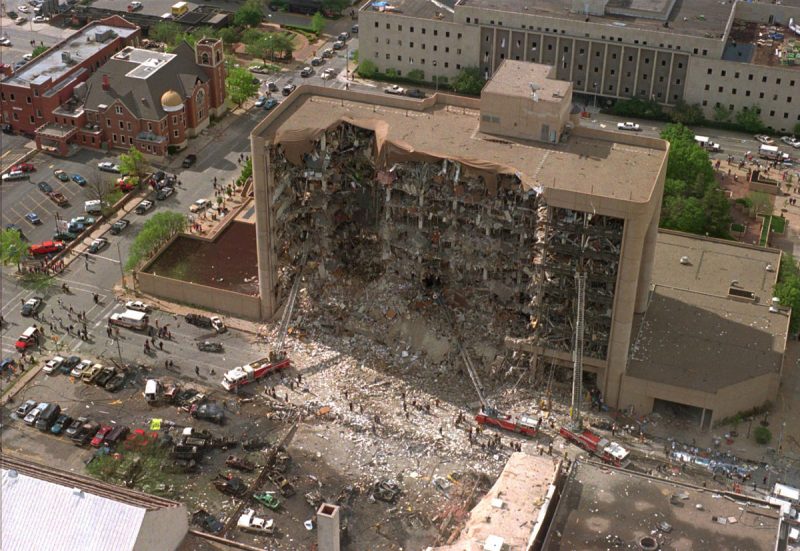
This past week marked the 27th anniversary of the Oklahoma City bombing. As the worst terrorist act committed on U.S. soil at the time, we all know the reported facts of the horrific event well: a 27-year-old Desert Storm-vet, Timothy McVeigh, acting with minimal help from Terry Nichols and Michael Fortier, detonated a 7,000-pound fertilizer bomb from a parked Ryder truck outside the federal Alfred P. Murrah building, killing 168 people, 19 of them children.
Two years later, in 1997, McVeigh was convicted of “Using a weapon of mass destruction resulting in death,” among other federal charges. For a time, he was held on the same cell block as the Unabomber and WTC-bomber Ramzi Yousef (who tried to convert him to Islam), before being put to death by lethal injection in 2001.
There is much we still don’t know about the case, however. Thanks to years of heroic work by people like Salt Lake City-based attorney Jesse Trentadue, writer and researcher J.M. Berger, and independent investigative reporter Wendy S. Painting, the American public is slowly learning more and more key (and disturbing) facts about the case. Facts involving the FBI’s possible incitement of McVeigh and the subsequent cover-up of these facts by Newsweek magazine.
FBI incitement is more topical than ever, of course. Reports of the FBI being involved in Michigan governor Gretchen Whitmer’s kidnapping plot and of FBI agents and assets being involved in the January 6th events has collapsed whatever level of trust the public had with federal law enforcement, not to mention the mainstream media whose related coverage rarely digs deeper than the government’s official line.
What other crimes have been committed or conspiracies planned, the public wonders, where the initial momentum was actually created the FBI? How much have FBI infiltrators pushed constitutionally protected “heated talk” into the unlawful planning and execution of deadly crimes? To what extent has the FBI been, as the saying goes, arsonists posing as firefighters? These are especially important questions when it comes to the OKC bombing.
Operation PATCON
As most know, the FBI and other law enforcement agencies have conducted surveillance and infiltration operations against right-wing groups for decades. Chief among them being the “Patriotic Conspiracy” or “PATCON” operation. Despite its official ending in late 1993 (although some say it was carried forward in some form), PATCON only became public in 2007 thanks to a public records request.
Partly citing internal FBI documents, Painting in her explosive 2016 book about PATCON and McVeigh, describes how the former’s secret operatives and paid informers “were given license to engage in provocateur activities and instructed to make known their willingness to commit violence and advocate for the violent overthrow of the U.S. government.”1 She quotes one informer who went public about the operation, John Matthews, saying he realized that although initially told “the objective was to infiltrate and monitor,” he would later come to understand that its real objective was to “to infiltrate and incite.”2 This, says Matthews, included providing “the ideas, detailed instructions, and even live C4 explosives and automatic weapons to targeted individuals as a way of entrapping them into terrorist plots, so the FBI could capitalize on foiled and actualized plots.”3 According to Trentadue, through PATCON, the FBI was actually trying to sow a full-on rebellion.
While the FBI has indeed infiltrated hard-left and Islamic groups in the past, the extent and complete failure of the FBI’s overreach when it comes to right-wing groups (which diversely included pro-gun, ultra-libertarian, survivalist, and white racist or advocacy groups) makes this area especially alarming. For instance, there was just one minor conviction over stolen military night-vision goggles that was ever made through PATCON, and it relied on army, not FBI, intelligence. As Oklahoma City journalist J.D. Cash said about PATCON and certain precursor programs of the 1980s, “there isn’t a neo-Nazi or racist group in the country that isn’t operationally controlled by the FBI.” This seems to concur with what a former young Aryan Nation-member told Painting for her book4:
It was well known that at any Aryan Nation event, in a crowd of 300 people, there’d be at least 30 undercover federal agents in attendance to monitor us, and another third of the crowd were informants… It was rampant, just like cops at a Grateful Dead show trying to sell people LSD.
One of those assets was Vietnam War veteran John Matthews. Up until 1986, the government had been supporting U.S. civilian groups conducting operations in Nicaragua for anti-communist contra forces; a cause which Matthews chose to serve. When such efforts turned into a political scandal, however, the government broke-off ties with these groups and refused to help its members. This included people like Matthews’ fellow soldier Tom Posey who would later be indicted on weapons-smuggling charges.5 While he beat the rap, Posey felt cheated and shifted his efforts to anti-U.S. government organizing. When he revealed plans to break into a federal armory, however, Matthews contacted the FBI, establishing a relationship with law enforcement that led him to infiltrate over 20 militia, libertarian, gun-rights, and racist groups over a 20-year period.
Matthews, who has long been suffering from an Agent-Orange-related cancer, is key to what understanding we have about PATCON’s connection to the OKC bombing. In the early nineties, Matthews was assigned to attend a PATCON-infiltrated, militia-training camp in Texas. While there, he met Timothy McVeigh. After the bombing and when McVeigh was arrested, Matthews immediately recognized him and called his FBI handler, Don Jarrett, to tell him this was the same man he saw at the Texas training camp. Jarrett assured Matthews they knew this already and told him to “forget about it.”
In interviews with Painting, Matthews says he was disturbed by this for a few reasons, a major one being, she paraphrases, that “if they were watching McVeigh and friends back then, they had likely continued watching them throughout the bombing plot.”6 “I felt Don knew more about this,” he said elsewhere.
What other items he knew may have been what came out later in Trentadue’s public records suit against the FBI. Dozens of witnesses to the bombing had apparently reported to police and the FBI they had seen someone in the passenger side of McVeigh’s truck while parked outside the Murrah building. Other witnesses reported seeing McVeigh with several people at his motel the night before, including someone sitting at some point behind the wheel of the truck—And Nichols himself (who was in Kansas when the bombing took place) told journalists in 2007 that FBI provocateurs had lent their support to McVeigh’s plans.7
Also disturbingly, using a fertilizer truck to blow up a federal building had been an idea Matthews had actually heard a few times before, including from suspected FBI infiltrators. For instance, he had heard it raised by two militia members he met who later became part of a busted plot to rob a bank, but who never got arrested, let alone jailed for it.
All of this would seem to point to the OKC bombing being something like 2010’s Operation Fast and Furious, in which the FBI intentionally put guns into the hands of criminals, but failed to close the loop leading to a border agent being killed by a Mexican cartel. Was OKC a similar ‘gunwalking case gone awry’? Only one, far, far deadlier? Someone who McVeigh contacted two weeks before the bombing, Andy Strassmeir, later told a journalist it is possible the FBI was “going to arrest McVeigh at the site with the bomb in hand, but he didn’t come at the right time.” “[M]aybe he changed the time”, he said, “you never know with people who are so unreliable.”8
Newsweek’s Complicity
In 2011, wishing to tell his story before he died, Matthews was put in touch with former Associated Press-writer and then-editor of Newsweek, John Solomon. At the time, Newsweek was still foremost in the U.S. media field, coming in second in circulation only to Time magazine. It was an important and respected news source. Over months, Solomon and article-author Ross Schneiderman worked with Matthews and other sources, including former FBI officials, to confirm everything he told them about the murky workings of PATCON, including the unanswered questions about its operatives’ possible involvement in the OKC bombing.
Enter Newsweek managing editor, Tina Brown. Above the heads of Solomon and Schneiderman, Brown (who left in 2013 and has been blamed for the periodical’s collapse) took what may have been a Pulitzer-worthy piece of journalism and cut away virtually all detail that could directly or indirectly impugn the government for the fallout of its PATCON operations. In the process, she reduced the original 7,000-word draft (found here) down to a mere 4,000 words (found here). As the since-defunct Examiner detailed at the time, all of the aforementioned suspicions Matthews aired about the FBI’s hand in the OKC bombing were cut.
Brown’s puzzling decision had real consequences for Matthews. As Painting recounts in her book, the dying Matthews had taken a lot of risk by coming forward. He was now Newsweek’s cover story, but for reasons that had been omitted. Now, he was still a target but “for no good reason and he regretted coming forward.”9
More broadly, by keeping such information away from the public, Brown was confirming the existence of a state-media axis in America. While examples of such direct state-interventions into our otherwise free media system are rare (although certainly plentiful enough), media analysts like Noam Chomsky have long posited that, yes, news outlets do profit off the circulation of their stories and are thus incentivized to objectively report on events potentially embarrassing to the powerful elite. But, the big media houses still need government access and wish to maintain good relations with major power centers; hence, their occasional compliance with direct government demands—One might add the promise of future political jobs as an incentive for compliance or, in cases such as this where right-wing groups were clearly being mistreated, plain old liberal media bias (consider, for instance, the fairly wide–reporting on the FBI’s infiltration of Islamic extremist groups).
It seems without a doubt that the FBI did get to Brown. At the time Matthews approached Newsweek, Attorney General Eric Holder’s Operation Fast and Furious-debacle was still in the news. How could the Obama Administration handle yet another and far bigger scandal involving the FBI helping dangerous people do harm against innocent Americans?
More Alarming Questions about FBI Conduct
Elsewhere, the FBI has demonstrated a serious interest in keeping any questions about the OKC bombing firmly under wraps. When Matthews was slated to testify in Trentadue’s 2014 public records case over the release of Murrah building surveillance footage, his fear of retaliation led to the judge allowing him to testify at a secret location by video—Trentadue thought what Matthews had witnessed while a PATCON operative would help provide a motive for what had become the FBI’s ongoing, unlawful refusal to provide the footage under public records law.
And despite the judge’s precautions, Matthews’s testimony still never took place. At the last minute, Matthews was supposedly threatened with having his VA medical benefits cut off and told to “stand down” by Jarrett and another FBI agent, Adam Quirk. Such a rank case of witness tampering, in fact, led to the judge ordering the FBI to reveal what exactly they had communicated to Matthews; an investigation that has been strangely ongoing since 2015.
At the heart of Trentadue’s marathon public records case certainly has the FBI worried. Someone who did manage to testify early on in the case was an Oklahoma police officer and first responder to the OKC bombing. He told the court he witnessed the FBI actually stop the beginning of the recovery process while victims were still under piles of rubble in order to remove a surveillance camera from the Murrah building. Some believe the camera would have recorded anyone else besides McVeigh who left the truck after it was parked and, in fact, did so.
Finally, there’s the questions about the FBI’s conduct vis-à-vis Trentadue himself. Why Trentadue got involved with the OKC case is because six weeks after the bombing, his brother Kenneth, another war vet, was taken into custody after a traffic incident triggered a parole violation relating to a minor event from years previous. Soon after, he was found hanging in a cell of a federal detention center.
Photos released to Trentadue following a subsequent lawsuit against the federal Bureau of Prisons, however, showed his brother’s throat having been cut and his body covered in bruises—authorities had apparently tried to cover his wounds with make-up before releasing it to Kenneth’s family. The theory behind his death is, having shared a close resemblance with someone called Richard Guthrie, a white supremacist who the FBI thought had information about the OKC bombing, Kenneth was mistaken as Guthrie and taken in by the FBI for interrogation. McVeigh himself called and advised Trentadue of this, telling him he heard that the FBI had indeed mistaken Kenneth for Guthrie and that his death was the result of a botched interrogation session.
Adding to suspicions, the DOJ formed a special team to handle media inquiries and the Trentadue family’s immediate requests for information. It apparently obstructed and delayed the Trentadue’s right to know what happened to Kenneth in every way it could, even when it came to releasing his corpse. Who happened to be the head of this operation (dubbed internally as “the Trentadue Mission”)?10 Then-Deputy Attorney General, Eric Holder.
Finally, there are the other related and mysterious deaths. After Guthrie himself was arrested, he told the LA Times he had “a couple grand juries to talk to” about what really happened with the OKC bombing, and was also later found hanging in his cell.11
And later in 1999, a supposed inmate and witness to Kenneth’s murder, Alden Gillis Baker, threatened to come forward about what he saw. He too was later found hanging in his cell.12
Conclusion
The details surrounding the OKC bombing show it to have all the elements of a “perfect,” post-war American tragedy: Vietnam vets disrespected by the liberal-media class and tossed aside by a government they loyally served; an unhinged federal bureaucracy using its sprawling resources to violate the civil rights of poor and ignored Americans; and, a state-liberal media-axis willing to cover up for government when the “cause” was right.
And consider the following. Even if we ignore the aforementioned evidence about the FBI’s hand in the OKC bombing, remember that the twin motivations for McVeigh’s crimes were Waco and Ruby Ridge—McVeigh chose April 19 as his bombing date because it was the same day as the Waco massacre two years previous. Matthews has actually expressed the view that both massacres had PATCON fingerprints all over them. That’s certainly the case with Ruby Ridge. There, a federal agent/infiltrator pushed former Green Beret Randy Weaver into selling him an illegal sawed-off shotgun. This led to his attempted arrest and an eventual standoff, which then led to the shooting deaths of his 14-year-son by federal marshals and his unarmed wife (baby in hand) by an FBI sniper.
In public and in private correspondence, McVeigh tore into the federal government over these events, expressing fear of a state that was at war with its own citizens. Without federal law enforcement acting so heinously in these events, it’s likely McVeigh would not have carried out the crime that he did.
Further, these rank FBI abuses ironically pushed “right-wing terror groups” to become the threat we were warned about all along. As the original Newsweek article rightly said about Ruby Ridge, the FBI’s conduct “quickly galvanized the radical right like never before” with talks between “various white supremacists, Neo-Nazis and anti-government groups… about joining forces… quickly turn[ing] to action.”
And as Painting writes, even more absurd perhaps, Ruby Ridge was used by federal law enforcement as a justification for increased PATCON resources and investigatory powers.13
So, we have FBI abuses leading to organized rage and resistance, which is then given even more momentum by FBI infiltration and incitement. And with the help of a media sphere that refuses to do its job, all of this works to amp up yet more fear, anxiety and division among the public. It’s a spinning wheel which loyal, patriotic Americans never asked for and certainly want off of.
While we should certainly hope these allegations can be explained away, it’s high-time the OKC victims and the American people generally get the transparency they deserve about what really happened that fateful day.
American progressives join the War Party
Some leftist commentators can barely conceal their enthusiasm for American involvement in the Ukraine war
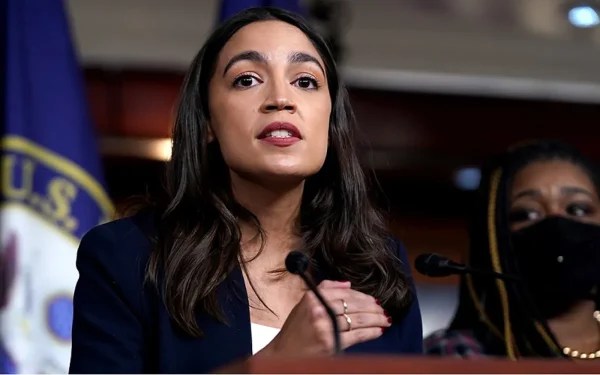
US representative Alexandra Ocasia-Cortez is among the Democratic Party members to vote in favor of a Republican sponsored Ukraine war bill
By James W Carden | Asia Times | May 6, 2022
Russia’s war on Ukraine has, among many other things, highlighted a consequential, indeed historic, shift taking place in American politics with regard to foreign policy.
A recent vote in the House of Representatives helps tell the tale. On April 28, Congress voted by an overwhelming majority of 417-10 to pass Republican Senator John Cornyn’s bill that would revive Lend Lease and apply it to Ukraine.
As is well known, Lend Lease was the brainchild of Franklin D Roosevelt as a way to get around the series of Neutrality Acts passed by Congress in the 1930s, in order to help supply the British war effort against Nazi Germany.
One might be forgiven for wondering if such legislation is really necessary today; after all, according to numbers released by the State Department, the US has provided more than $6.4 billion in “security assistance” to Ukraine since 2014. And last week President Joe Biden put forward a request for another $20.4 billion in “additional security and military assistance” as part of a $33 billion aid package to Ukraine.
So what was the actual point of reviving Lend Lease? Well, it was in part, as is the case with many things that happen on Capitol Hill, performative: a way to signal to US arms manufacturers that constitute much of the political donor class that the money spigot will remain wide open for the foreseeable future.
But the Cornyn bill also tells us that the center of gravity of the anti-war movement is shifting away from its traditional home on the progressive left.
In the century since the US embarked on its journey to global hegemony with the Spanish-American War of choice in 1898, it was most often progressive Democrats who rallied under the banner of peace.
Jeanette Rankin of Montana, the first woman elected to Congress, was one of 50 dissenting votes against American entering the First World War. Progressive magazines such as The Nation were a thorn in the side of proud American imperialists like Henry Cabot Lodge, Brooks Adams and Theodore Roosevelt.
The historian Barbara Tuchman noted that Roosevelt in particular “confused the desire for peace with physical cowardice.” Roosevelt took delight in targeting papers and magazines like the Evening Post and The Nation, which he wrote, “in all of whom there exists absolute physical dread of danger and hardship and who therefore tend to hysterical denunciation and fear of war.”
The Vietnam era marked perhaps the high point of progressive dissent against the American war machine. The anti-war movement was certainly well represented (especially by today’s standards) in the US Senate, where J William Fulbright, William Proxmire, Wayne Morse, Robert F Kennedy, George McGovern, Eugene McCarthy and Frank Church opposed president Lyndon B Johnson’s war.
Perhaps the most recent example of exemplary progressive bravery on Capitol Hill is that of Representative Barbara Lee, who cast the sole vote in the House against granting the George W Bush administration practically unrestricted power to wage war (via the Authorization for the Use of Military Force, or AUMF) in the wake of the attacks of September 11, 2001.
Now, it seems we have entered a new era.
The House’s overwhelming passage of the Cornyn bill will in effect cement Washington’s status as a co-belligerent in a war against a nuclear-armed and increasingly unpredictable Russia.
A look at the roll-call vote in the House shows that only 10 members voted against Cornyn’s bill, all of whom were Republicans.
Not a single Democratic progressive voted against the legislation. All the leaders of the progressive left in Congress, including Ro Khanna (D-CA), Jamie Raskin (D-MD) and Pramila Jaypal (D-MI), voted for Lend Lease – as did every member of the so-called “Squad,” including Alexandria Ocasio-Cortez (D-NY), Ayanna Pressley (D-MA), Ilhan Omar (D-MN), Jamaal Bowman (D-NY), Rashida Tlaib (D-MI), and Cori Bush (D-MO).
But perhaps most important of all was the vote cast by Representative Barbara Lee.
Not only did Lee vote for the Cornyn bill, she accompanied Speaker Nancy Pelosi and the House’s leading Russia hawk Adam Schiff on a trip to Kiev last weekend, where they paid homage to the Ukrainian president and promised US support “until victory is won.”
Lee’s vote takes on additional significance since she chairs the House Appropriations Subcommittee on State and Foreign Operations, which oversees foreign-aid programs such as those funneling billions of taxpayer dollars to Ukraine.
Still worse, progressive activists, journalists and thought leaders have likewise joined the American War Party. A longtime progressive hero and anti-poverty activist, the Reverend Dr William J Barber II, recently released a statement that attempted to leverage the tragedy of the war to drum up support for his grassroots campaign of poor people’s marches.
In a fundraising letter, Barber writes that “Russia’s assault on Ukraine has produced scenes that demand action from people who want to hold on to our humanity.”
“If Russia’s atrocities in Ukraine demand action,” said Barber, “then so too does the failure of the US Senate to pass Build Back Better’s provisions for affordable housing, green jobs, living wages for care workers, and a child tax credit that will immediately lift 4 million children out of poverty.”
After reading the statement, a Chicago-based labor activist wrote to me in disgust. “This [expletive] happens all the time in the left-wing non-profit industrial complex,” he wrote. “They have a really, really bad sense of history, and specious moral claims and comparisons like these are made all the time – usually done to raise money.”
The darling of the progressive foreign policy community, Bernie Sanders’ foreign-policy adviser Matt Duss, recently defended the policy that arguably brought us to this point, NATO expansion.
Brooklyn lefties were once so besotted by Duss that he landed on the cover of the The Nation magazine. His recent comments will no doubt keep him high in their esteem because, with few exceptions, progressive writers and activists have abandoned their commitment to peace: We are all Ukrainians now, or so we are told.
Some progressive commentators can barely conceal their enthusiasm for American involvement. Here is the chickenhawk founding editor of the progressive magazine American Prospect, Robert Kuttner:
“It is appalling that the West keeps lionizing Zelensky, giving him standing ovations after he addresses national parliaments, but denying him what he needs to save his country.
“What does he need? He needs warplanes.
“Sooner or later, NATO will have to give Ukraine planes powerful enough to annihilate Russia’s invading armies. It might as well be sooner.”
Quincy Institute non-resident fellow Joe Cirincione, a longtime nuclear-arms-control expert, has, like Kuttner, embraced his inner chickenhawk. He recently praised the US and North Atlantic Treaty Organization for supplying more arms to Ukraine, and hence prolonging the war in blithe disregard of the possible consequences, including Russia resorting to the use of tactical nuclear weapons, writing:
“Supplying Ukraine with artillery that can out-range Russian artillery can be a dramatic shift in the war. It may save cities now threatened by brutal Russian bombardment. Smart move by US/NATO.”
In the end, the unanimous Democratic support for the Ukrainian Lend Lease bill and the calls for more and more weapons by leading progressives shows they have abandoned their traditional and long-held opposition to American wars of choice.
What a shame.
James W Carden is a former adviser to the US-Russia Bilateral Presidential Commission at the US Department of State. His articles and essays have appeared in a wide variety of publications including The Nation, The American Conservative, Responsible Statecraft, The Spectator, UnHerd, The National Interest, Quartz, the Los Angeles Times and American Affairs.
Pfizer and FDA reveal Paxlovid fails clinical trial, as FDA tries to evade its responsibility
FDA emphasizes the drug is not approved, not even for COVID
By Meryl Nass, MD | May 2, 2022
Suddenly Pfizer’s website and the FDA want to emphasize all the problems with Paxlovid. So in the case of this drug, these two co-conspirators apparently think that disclosures will save them from something.
Just look at this language! Compare to the lack of disclosure of adverse effects long known to be due to the COVID vaccines. Have you EVER heard FDA refer to the vaccines for children as unapproved?
U.S. FDA Emergency Use Authorization Statement
PAXLOVID has not been approved, but has been authorized for emergency use by FDA under an EUA, for the treatment of mild-to-moderate COVID-19 in adults and pediatric patients (12 years of age and older weighing at least 40 kg) with positive results of direct SARS CoV-2 viral testing, and who are at high-risk for progression to severe COVID-19, including hospitalization or death.
The emergency use of PAXLOVID is only authorized for the duration of the declaration that circumstances exist justifying the authorization of the emergency use of drugs and biological products during the COVID-19 pandemic under Section 564(b)(1) of the Act, 21 U.S.C. § 360bbb-3(b)(1), unless the declaration is terminated or authorization revoked sooner.
AUTHORIZED USE
The U.S. Food and Drug Administration (FDA) has issued an Emergency Use Authorization (EUA) for the emergency use of the unapproved product PAXLOVID for the treatment of mild-to-moderate coronavirus disease 2019 (COVID-19) in adults and pediatric patients (12 years of age and older weighing at least 40 kg) with positive results of direct severe acute respiratory syndrome coronavirus 2 (SARS-CoV-2) viral testing, and who are at high risk for progression to severe COVID-19, including hospitalization or death.
LIMITATIONS OF AUTHORIZED USE
• PAXLOVID is not authorized for initiation of treatment in patients requiring hospitalization due to severe or critical COVID-19
• PAXLOVID is not authorized for use as pre-exposure or post-exposure prophylaxis for prevention of COVID-19
• PAXLOVID is not authorized for use for longer than 5 consecutive daysPAXLOVID may only be prescribed for an individual patient by physicians, advanced practice registered nurses, and physician assistants that are licensed or authorized under state law to prescribe drugs in the therapeutic class to which PAXLOVID belongs (i.e., anti-infectives).
PAXLOVID is not approved for any use, including for use for the treatment of COVID-19.
PAXLOVID is authorized only for the duration of the declaration that circumstances exist justifying the authorization of the emergency use of PAXLOVID under 564(b)(1) of the Food Drug and Cosmetic Act unless the authorization is terminated or revoked sooner.
IMPORTANT SAFETY INFORMATION … continue
Featured Video

John Mearsheimer Talking Iran with Iran
or go to
Aletho News Archives – Video-Images
Book Review & Summary
Calling of an Angel: The True Story of Rene Caisse and an Indian Herbal Medicine Called Essiac (1988)
Dr. Gary L. Glum – 30 Q&As – Book Review & Summary
Lies are Unbekoming | October 17, 2026
On June 10, 1975, Dr. Chester Stock, a vice president at Memorial Sloan-Kettering Institute for Cancer Research, wrote to a Canadian nurse named Rene Caisse: “Enclosed are test data in two experiments indicating some regressions in sarcoma 180 of mice treated with Essiac.” The sentence sat in a letter from one of the world’s largest private cancer research centers, concerning an herbal tea an elderly English woman had learned from an Ojibwa medicine man at a northern Ontario mining camp in the 1890s. The tests were terminated the following year after Sloan-Kettering admitted, in sworn affidavit three years later, that they had prepared the injectable solution improperly from the dried material supplied — freezing and thawing the herb rather than boiling it as Rene had instructed. By the time Calling of an Angel was published in 1988, Rene Caisse had been dead for a decade, having treated thousands of cancer patients across fifty-six years in her Bracebridge, Ontario kitchen, never charging a fee, and refusing every offer — from Memorial Sloan-Kettering, the National Cancer Institute, Merck, Parke Davis, and private corporations dangling contracts up to $1 million — to release her formula before the medical establishment admitted her remedy had merit. … continue
Blog Roll
 Aletho News
- Vice President J.D. Vance’s Deceptive ‘Antiwar’ Campaign Speech
- Iran: Palestinians’ rights must not be compromised in Gaza’s future; US, Israel to blame for Hormuz situation
- Ongoing tales of Syrian chemical weapons
- Moscow blasts UN for ignoring torture of Russian POWs
- Millions of Books Could Have Been Destroyed in Lebanon During Israeli Bombings
- Moscow warns of ‘hunt for Russians’
- Calling of an Angel: The True Story of Rene Caisse and an Indian Herbal Medicine Called Essiac (1988)
- South Korean Assistance to the U.S. in the War with Iran: Between Allied Duty and National Interests
- Pharma- and Gates-Funded GAVI Seeks to Assure Parents
- John Mearsheimer Talking Iran with Iran
- If Americans Knew
- Israeli soldiers debunk Israel’s talking points
- In West Bank, Israeli settlers are totally out of control – Daily Update
- NPR investigation finds evidence of widespread fraud at mall kiosks tied to Israeli skincare brand
- Tucker Carlson exposes Israeli Lies about the Oct 7th attack, Charlie Kirk, and the U.S.
- Israel has detained thousands of Palestinian children since Oct 7th – over half spent time in solitary, many uncharged
- Israeli Analysis: Is Netanyahu Planning an ‘October Surprise’ Attack Before Israel’s Election?
- Israeli settlers brutally attack Palestinians and Washington Post female photographer, 65
- Words Have Changed, Occupation Continues: The Reality of the Gaza Ceasefire
- Gaza’s child amputees are growing faster than their prosthetics allow
- Israel keeps Palestinians struggling just to survive–Daily Update
- No Tricks Zone
- New Study Suggests Large Regions Of The Pacific Ocean Have Been Cooling For The Last 80 Years
- Germany’s Green Energy Debacle: High Energy Costs Force Kahla Porzellan to Close After 182 Years!
- New Study: 50 Years Of The Most Aggressive ‘Net Zero’ Policies Can Only Affect The Global Climate By 0.03°C
- US September “Heat” Was No Record…Many Records Set Decades Ago
- Latest European Green Energy Debacle; Portugal’s Largest Flagship Solar Park Insolvent!
- Green Energy Debacle: German Expert Professor Fritz Vahrenholt Warns Of Severe Economic And Social Consequences
- Two More Paleo Reconstructions Affirm Meters-Higher Sea Levels Across Ireland, Brazil 7000-6000 Years Ago
- New Study: Earth And Venus Surface Warmth Largely Explained By Convection And Lapse Rate, Not CO2 Or Radiation
- 2025 Nature Paper Claiming Worsening Global Drought Gets RETRACTED …Heavily Flawed
- New Study: ‘Global Drought Shows No Detectable Recent Acceleration Under Climate Warming’


