Three more studies show negative vaccine efficacy. When will health authorities face up to what the data is telling us?
By Will Jones | The Daily Sceptic | December 28, 2021
The last two weeks have brought three new studies finding negative efficacy for two vaccine doses, meaning the vaccinated are more likely to be infected than the unvaccinated. These are study findings, not raw data, so have been adjusted for various biases and confounders, making it harder to dismiss them as anomalous or skewed.
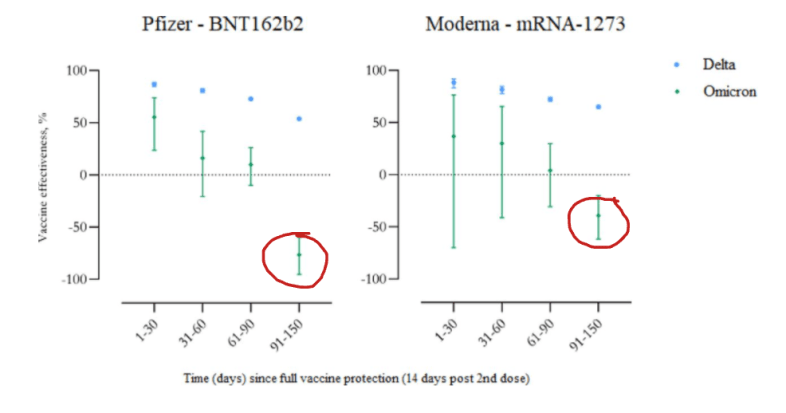
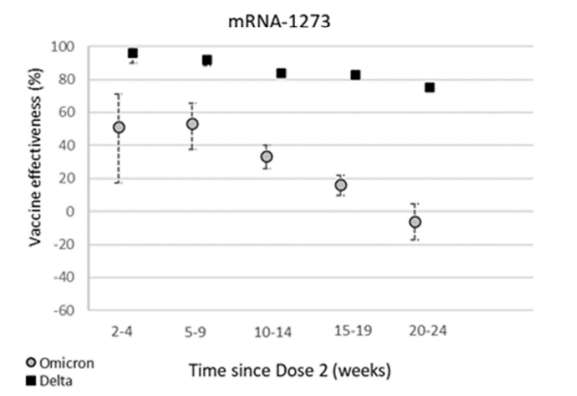
The first is a pre-print study from Denmark, published on December 23rd, which looked at nearly all PCR-positive SARS-CoV-2 infections in Denmark from November 20th to December 12th and investigated them to see if they were likely to be the Omicron variant. By comparing the vaccination status of those infected, the researchers found a vaccine effectiveness against the Omicron variant of minus-76.5% for Pfizer and minus-39.3% for Moderna three months after double vaccination (see chart above), meaning the double-vaccinated were considerably more likely to be infected than the unvaccinated. They found the vaccine effectiveness against Omicron was significantly lower than against Delta, with Pfizer vaccine effectiveness at 53.8% and Moderna at 65% against Delta after three months. They reported that a third dose of Pfizer got vaccine effectiveness against Omicron back up to 54.6%, at least for a month. The full results are in the table below.
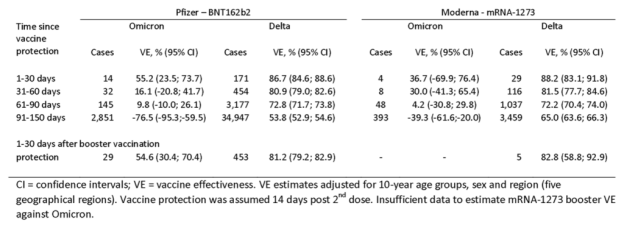
Hansen et al
The latest vaccine effectiveness study from the UKHSA confirms these results. Against Omicron, the UKHSA reports zero or negative vaccine effectiveness from a double-dose of all three vaccines (AstraZeneca, Pfizer and Moderna) after five months. The third dose takes it up again, but only into the 40-60% range, and dropping fast.
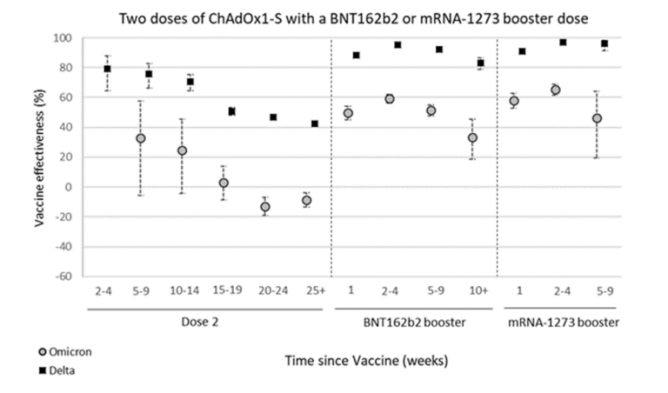
AstraZeneca
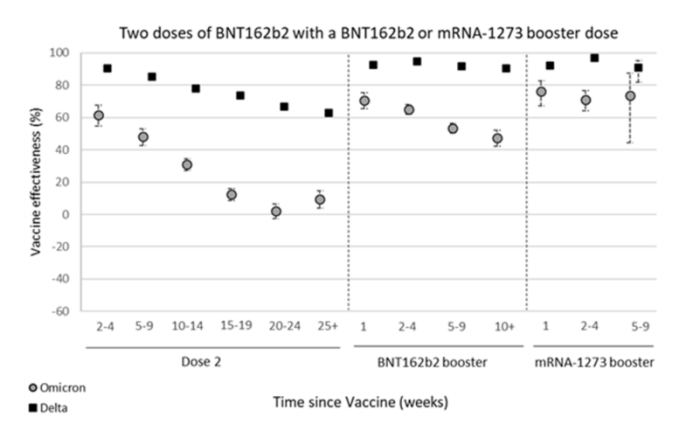
Pfizer
Moderna
A new study in Eurosurveillance from Norway also backs up the observation of negative vaccine effectiveness against Omicron, with a higher proportion of those who tested positive in the particular outbreak in the study being double-vaccinated than those who did not test positive (98% versus 93%).
Some studies had already found negative vaccine effectiveness against Delta, in line with the unadjusted figures from the UKHSA, though many people had dismissed these results as anomalous or biased. With Omicron, the reports of negative efficacy are becoming impossible to ignore, with even the UKHSA publishing graphs showing it after three months on two doses. At some point, health authorities are going to need to grapple with what the data is showing on this and stop pretending it isn’t there.
Why Have Our Points Landed After All?
By Dr. David McGrogan | The Daily Sceptic | December 29, 2021
I can’t be alone in noticing that the public mood has quite radically shifted. There are still, I am sure, plenty of people who are scared, and still plenty of people who think that restrictions ‘work’ and should continue to be used. But in conversations with dozens of friends, family members and colleagues over the past month or so, I have noticed a particular phrase coming up over and over again, with slight variations: “We have to learn to live with it now.” There is a benign resignation (“We’re all going to catch it eventually so we might as well get on with it”) where once there was anxiety. It is profoundly irritating, of course, to have to grit one’s teeth and resist pointing out that some of us were of the view that we had to learn to live with the virus in February 2020. But it is also heartening – there will, after all, be more joy in heaven over one sinner who repents than over ninety-nine just persons who need no repentance. I could of course be wrong – God knows I’ve consistently underestimated the capacity of the population to stoically go along with the mainstream narrative from the very beginning of the Covid era. But I hope I don’t jinx things to say that I think it is now politically impossible for the government to do much in the way of strict lockdowns.
What explains this? The reasons are not, I think, very complicated. First, a critical mass of people are not scared anymore. They’ve had three jabs, they know omicron causes mostly mild symptoms, and many of them have actually had Covid and discovered it’s not the end of the world. Fear was a powerful motivating factor in support for lockdowns; now it’s on the retreat. Second, war weariness has set in. Young people especially are just sick of all of this, and want to live their lives. On shopping excursions on December the 27th and 28th I was surprised at just how many people in the bustling shops were not wearing masks. I’d say in the region of 30% at least, and among young people the proportion was even higher. They’ve simply had enough. And third, there is a real feeling abroad these days that the SAGE modellers are just a glorified boy crying wolf – we’ve been told too many times now that we’re on the brink of catastrophe and found out that we’re faced with nothing of the sort. Their warnings are no longer taken very seriously.
What is perhaps a little galling about all of this to lockdown sceptics is that these reasons are all emotional, not rational. It’s not that anybody has been persuaded by our wonderful knockdown arguments. It’s that a different narrative – “the virus is never going away, so let’s just get on with our lives” – has set in.
This ought not to be very surprising. It is almost exactly a year ago that I wrote a post on Lockdown Sceptics, making the claim that the most important reason why we sceptics were being ignored (or pilloried) was that the points that we were making simply did not accord with a particular ‘moral truth’. There was a prevailing social narrative which said, in essence, that lockdowns stop people dying. Our arguments, in going against this moral truth, were by definition immoral in the eyes of the vast majority of our compatriots, and highly unlikely to win popular support as a result. In other words, it doesn’t matter how well-reasoned one’s critique is, if what one is critiquing is perceived almost universally as being The Right Thing To Do.
This is in fact in keeping with what psychologists tell us about the way human reason works. We don’t generally look dispassionately at the evidence and then make up our minds what to believe. Rather, we believe something to begin with, and then we go out and look for evidence to support it. In March 2020 people were scared, and wanted to hide from the nasty virus, and went and found a great deal of data that explained why they were right to do so. Fast forward to January 2022: people are sick of thinking about Covid and want to get back to normal, and it would not be at all surprising if all of a sudden they suddenly begin to find a lot of evidence to justify them doing so. Reason follows emotion – not the other way round. It is ultimately how people feel that dictates everything that follows.
Since it’s mostly just about feelings, does this mean that the efforts of Toby, Lord Sumption, Peter Hitchens, Neil Oliver, Brendan O’Neill and the like have had no effect at all? Would the madness all have ended in the fullness of time anyway?
I’m not so sure. Milton Friedman once said that he thought his basic function was to “develop alternatives to existing policies, to keep them alive and available until the politically impossible becomes the politically inevitable.” In other words, yes, public opinion is led by emotion, but this makes it fickle. It can shift, and shift quickly. The trick is to make sure that, when this happens, it is your ideas that are the ones “lying around” (to use Milton’s phrase) for them to seize up.
People in other words, will increasingly start to feel that this lockdown nonsense has to stop. As they do, they will start to look for evidence and arguments to support that view. Thanks to the efforts of Toby and those like him, they will find a huge wealth of this in the public domain. Lockdown sceptics, in other words, probably haven’t been very persuasive or influential when it comes to the broad swathe of the population. But that hasn’t been the point. We’ve been keeping the alternative view alive, so that when eventually public opinion shifts, it is our ideas that they will pick up, and which will increasingly therefore begin to drive the agenda.
David McGrogan is a Professor at Northumbria Law School.
NY State Dept. of Health Still Can’t Provide Any Proof that Vaccinated Children are Healthier than Unvaccinated
Informed Consent Action Network | December 29, 2021
Last month, yet another letter had to be sent to the Commissioner of the New York State Department of Health (NYSDOH) and the New York State Education Department (NYSED) calling out their failure to provide any proof to dispute extremely important and revealing data reflecting that unvaccinated children have far better health outcomes than vaccinated children.
Soon after that letter was sent, a new Acting Commissioner of NYSDOH was appointed and so a letter was also sent to Dr. Mary Bassett, welcoming her to her new role and asking that she provide proof disputing these findings.
As explained to Dr. Bassett through the historical correspondence detailing the issue, on May 21, 2021, the attorneys that regularly represent ICAN sent a demand letter on behalf of a group comprising all the families of unvaccinated children in four contiguous school districts in New York. The demand explained that there is an abundance of evidence to support that unvaccinated children have better health outcomes than vaccinated children and shared the following results for the children in the four school districts:
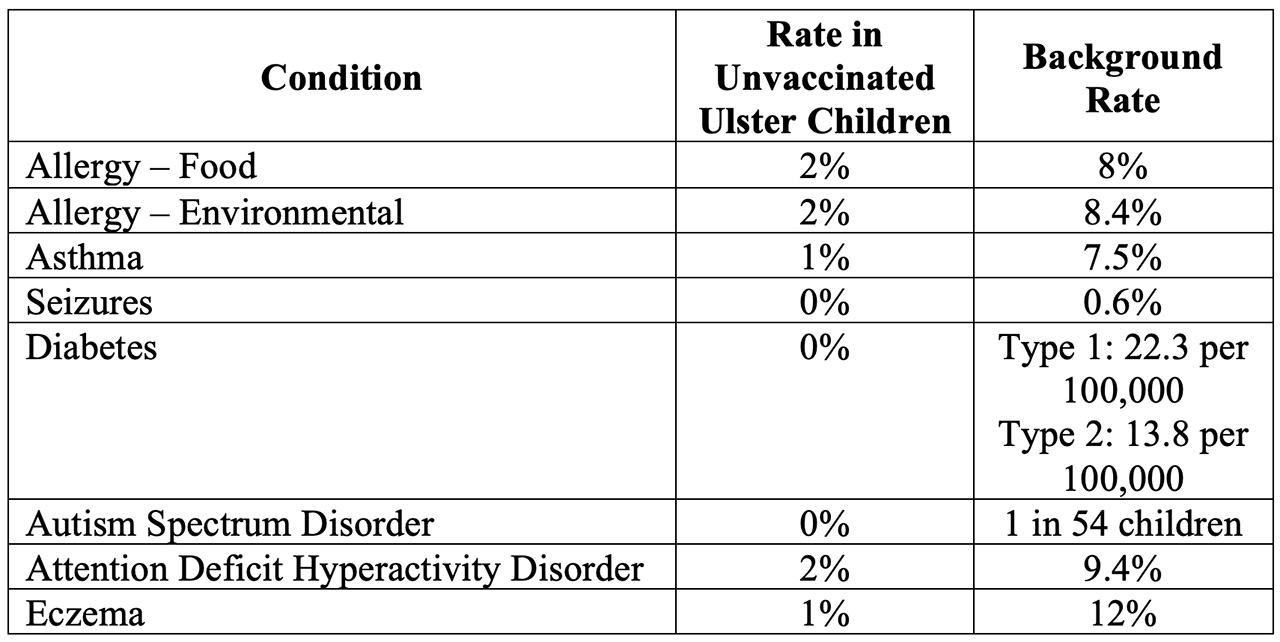
Although not shocking to ICAN, these results should elicit a reaction from and a response by public health authorities and an education department which mandates vaccines. Instead, NYSED chose to completely ignore these findings and sent an inadequate, half-page response almost a full month later.
On August 11, 2021, a response letter was sent to NYSDOH pointing out the glaring omission from the NYSDOH’s response of even a shred of evidence to support that the growing rate and list of chronic diseases and disabilities affecting children are not caused by vaccination. NYSDOH was therefore warned that, absent receipt of this proof, the attorneys have been directed to commence an action challenging the school immunization requirements for kindergarten through the twelfth grade. Still no proof has been provided by the NYSDOH.
One must continue to wonder whether there is any data that could be submitted to these public health agencies that will change their unwavering belief in and allegiance to vaccines. And aren’t they troubled by the fact that they cannot produce any evidence to support their claims? Let’s see if the new Acting Commissioner provides any better response than her predecessor.
Twitter Suspends mRNA Inventor Dr. Robert Malone

By Tyler Durden | Zero Hedge | December 29, 2021
After months of providing valuable Covid-19 information that runs counter to the official narrative, Twitter has finally banned Dr. Robert Malone, inventor of mRNA technology.
Malone, who will appear on the Joe Rogan show Thursday according to associate Ed Dowd (one of four contributors to the Malone doctrine), had more than 520,000 followers. He has been an outspoken critic of both mRNA vaccines, as well as the abysmal failures of policymakers worldwide in responding to the pandemic.
He was not warned or provided an opportunity to delete any offending tweets – instead he was “just suspended,” Dowd continued.
Here’s Malone’s last tweet – sharing an article which claims that the Pfizer Covid-19 vaccine does ‘more harm than good.’
Malone can still be followed via his substack page.
How to manipulate a research study
Top tips on ensuring vaccine success (and for other treatment failure)
Health Adisory and Recovery Team | December 29, 2021
There are ways to ensure any trial will give you the results you want. Here are the top six methods used to manipulate covid research results.
1. Carry out the study when cases are falling
A favourite trick that has been used repeatedly throughout the pandemic.
Vaccination is a process that takes time. At the beginning of the study all participants are enrolled as unvaccinated. People move into the vaccinated cohort over time. The result is that the unvaccinated are exposed at periods of higher prevalence and for a longer time. The vaccinated are only exposed from a period later on and further down the curve. The vaccinated will therefore be less likely to catch covid and the vaccine can be made to look like it worked.
The ONS recently deployed this trick to claim a 32 fold lower mortality among the vaccinated. It was extreme data manipulation whereby they included the majority of deaths in winter prior to vaccination instead of starting from spring when a fairer comparison could have been made. The Office for Statistics Regulation has upheld a complaint about the ONS’s manipulation of data in this case.
2. Don’t include meaningful outcome measures like death
The vaccine trials have not demonstrated prevention of death.
Death from covid was too uncommon for the trials to be able to show an effect. Among 44,000 participants in the Pfizer trial, for example, there were a total of
29 deaths before the placebo group were themselves vaccinated. 15 of these were in the vaccinated including one of the three covid deaths. There were only 20 severe covid cases reported in the Pfizer submission to the FDA for Emergency Use Authorisation, including those that did not need hospital care.
Instead of using outcomes which are hard to distort, like death, the outcomes used were based on test results.
3. Only measure outcomes for part of the time after vaccination
Vaccinated people are at increased risk of covid infection in the first two weeks after vaccination. After the first two weeks the susceptible will have acquired natural immunity. By ignoring the first two weeks, a distorted picture of the overall impact of vaccinations can be presented. If all the vaccines are doing is causing the susceptible to have their infections earlier then the whole period from the date of vaccination needs to be included in assessing any benefit.
4. Use modelled data
The most reliable scientific papers ensure that the population being studied is representative of the population as a whole. Sometimes that is hard to achieve and adjustments need to be made afterwards to account for any differences e.g. the sample may be younger than the population as a whole. These adjustments are a reasonable thing to do to correct for small problems in the sample.
However, if the sample is so different to the general population that massive adjustments need to be made then effectively the study is no longer based on real world evidence. Instead it has become yet another prediction based on modelled data.
For example, this CDC study claimed, contrary to all other evidence, that people with a prior infection were 5 times more likely to become infected than those who had been double vaccinated. The actual results from the study showed a 70% higher rate but their adjustments made this into 500%. There were other serious flaws in the study which makes even the 70% claim highly dubious.
5. Ignore a crucial subgroup
If the findings are equivocal in most of the population then modelling might be enough to get the result you want. However, if there is a subgroup which has clearly contrary results then they can be left out entirely. When trying to calculate the impact of vaccination on transmission in winter the most obvious group to study would have been the heavily vaccinated care home residents. PHE omitted this group from their paper with no reason given. The consequence was that the overall household transmission rate was much higher in the real world (see figure 1) than in the study. Using published data on mean national transmission rates each week the expected rates in the study would have been 12.4% in the unvaccinated (who were overrepresented when transmission rates were highest) and 11.7% in the vaccinated cohorts. However, the study reported a rate of only 10.1% in the unvaccinated and only 6% in the vaccinated. The population excluded from the PHE study clearly contributed to the much higher real world transmission rates for both the unvaccinated and the vaccinated.
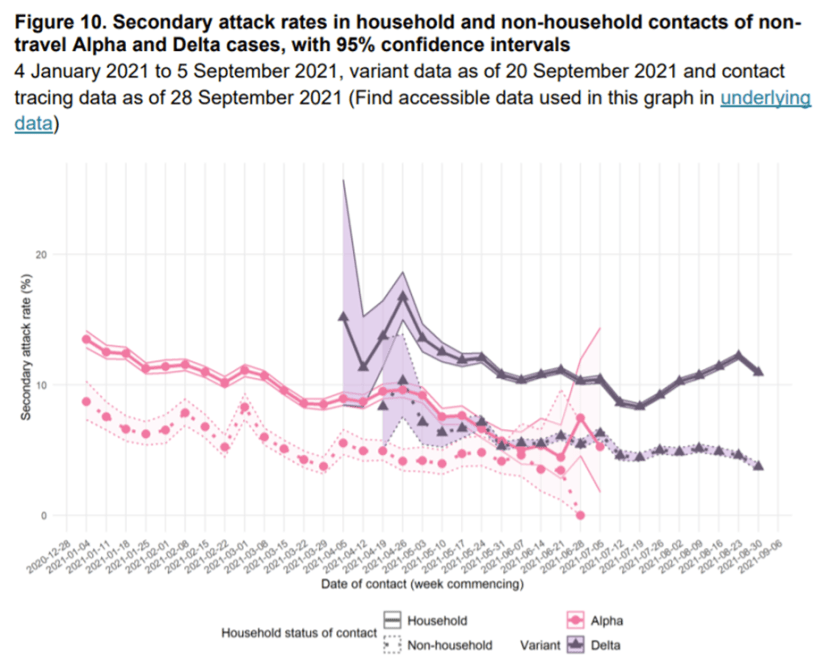
Figure 1: Real world transmission rates as measured by the proportion of contacts that become infected, the secondary attack rate.
6. Use the wrong dose of the drug
A drug can be discredited in a trial where the protocol is deliberately designed to give a drug at an inappropriate time or dose. For example, the RECOVERY trial was said to show that hydroxychloroquine treatment was not helpful in covid. The trial design used a dose of hydroxychloroquine that was in the toxic range and may well have been responsible for the deaths of participants in the treatment arm of the trial. Hydroxychloroquine doses over 1500mg are associated with cardiovascular and neurological harms that can be potentially fatal. The trial used a dose of 2000mg in the first 18 hours and 400mg every 12 hours thereafter.
Conclusion
Scientists are human and are under pressure to produce results in their papers as that increases the chances of publication which is needed for career progression and securing funding for research. There are numerous ways in which data can be altered to tell a story and many of them have been put to use during the pandemic. Dramatic results have become headline grabbing news but often the truth was far more mundane. If a result sounds too good to be true, don’t believe it.
ICAN Sues CDC to Stop Hiding V-Safe Data from the Public
Informed Consent Action Network | December 29, 2021
The FDA and CDC have now made crystal clear that their promise of transparency with regard to COVID-19 vaccines was hogwash. As everyone now knows, the FDA has asked a federal judge to give it at least 75 years to produce the pre-authorization/licensure safety data. And we now know with certainty, federal health authorities similarly want to hide the post-authorization/licensure safety data.
The FDA and CDC have admitted their existing safety monitoring program, VAERS, was incapable of determining causation and therefore unreliable. The CDC has therefore deployed a new safety monitoring system for COVID-19 vaccines called v-safe, and now claims that these “vaccines are being administered under the most intensive vaccine safety monitoring effort in U.S. history.”
V-safe is a smartphone app that allows vaccine recipients to “tell CDC about any side effects after getting the COVID-19 vaccine.” The purpose of the app “is to rapidly characterize the safety profile of COVID-19 vaccines when given outside a clinical trial setting.” Data submitted to v-safe is “collected, managed, and housed on a secure server by Oracle,” a private computer technology company. Although the CDC has “access to the individualized survey data,” Oracle can only access “aggregate deidentified data for reporting.” Meaning, based on the CDC’s own documentation, the data submitted to v-safe is already available in deidentified form (with no personal health information) and could be immediately released to the public.
ICAN, through its attorneys, therefore asked in three FOIA requests that the CDC produce the deidentified data from the v-safe program in the same form in which Oracle can currently access it. The agency acknowledged that “v-safe data contains approximately 119 million medical entries” but denied producing that data because the “information in the app is not de-identified.” The CDC had apparently not read its own documentation regarding v-safe. But ICAN’s attorneys had and so they administratively appealed this decision and, at the same time, to leave no doubt what was being requested, submitted another request to the CDC that sought all data deidentified after it was submitted to the v-safe app (in other words, in the form that the agency made known that Oracle has the data). Incredibly, the CDC administratively closed this request stating it was duplicative of the original request.
Meaning, the first request was denied by the CDC because the CDC claimed it requested data that was deidentified when entered into the app, but then the CDC closed the second request (which was identical to the first request except for making clear it was seeking data deidentified at any point – before or after it was entered into the app) by claiming the second request was duplicative of the first request! The CDC is plainly playing games. It clearly does not want the v-safe data released.
The public should have immediate access to all v-safe data in deidentified form. Despite the fact that this deidentified data already exists, that it is already in the hands of a private company, and that the CDC has never objected to its production, the CDC has so far failed to produce it to ICAN or to the American public – the same people being mandated to take this liability-free product. But don’t worry, ICAN will not rest until this data is made public and so today has commenced a lawsuit against the CDC and HHS demanding that a court compel them to release this data.
You can read this lawsuit here.
NZ Doctors Receive ‘Perverse’ Monetary Incentives to Vaccinate, ‘Hush Money’ Paid to Victims’ Families
By Amy Mek | RAIR Foundation | December 21, 2021
Veteran New Zealand doctor René de Monchy’s career came to an abrupt halt after refusing to be vaccinated. Wanting to remain “vaccine-free,” the physician of over 48 years was fired, banned from his hospital, and not allowed to say goodbye to his patients.
The general practitioner and psychiatrist is shining a spotlight on the Globalist forces using Covid to help them seize control of New Zealand. The brave doctor questioned why doctors and patients receive monetary “vaccine” incentives. Furthermore, Dr. Monchy believes the actual number of people who have died from the vaccines is not reported, and relatives of those killed from the injection are receiving “hush money.”
Critical From The Begining
From their inception, Dr. Monchy was very critical of the “experimental, never-before-used mRNA vaccines.” The Doctor disagreed with the vaccine’s “lack of a control group and long-term outcomes,” reports the Doctors Collective. Even more so, the Doctor is outraged that the injection is being promoted to children and pregnant women,
… what closed the door for me was when the vaccines were also given to children, who are absolutely not at risk with corona infection. In addition, the mRNA vaccines were also promoted for pregnant women, which is completely contrary to any medical and scientific tradition of carefully weighing the pros and cons. The immune system, especially of a child, is a delicate interplay. It is like a symphony orchestra with several sections; the winds, strings, and percussion, all of which must fill in at just the right time. By administering vaccines whose effects are still largely unknown, you are going to disrupt this interplay. We have every reason to be cautious.
 “Peverse”Monetary Incentives
Since the arrival of the gene-therapy injections, New Zealand has pushed to have 90% of its population receive two injections. In December, the country successfully reached its milestone. To achieve its 90% “vaccination” goal, Dr. Monchy explained that every citizen who received the injection was bribed with a voucher of 20 NZD (12 euros). At the same time, doctors have been given 359 NZD (216 euros) per vaccine.
Just five weeks ago, New Zealand had a so-called “vaxxathon,” a kind of festive campaign, with the sole purpose of giving as many people as possible a shot. Dr. Monchy reported that one health center made 175,000 NZD (105,000 euros) during that vaxxathon. “There is a perverse incentive for doctors to participate in this kind of campaign,” stated the Doctor.
No Vaccine Exemption
Vaccine exceptions were initially allowed in New Zealand, but were soon withdrawn by the government. The only exception now is if someone has suffered anaphylactic shock or a pulmonary embolism after the injection, explains the doctor. “I have had patients who suffered a stroke or Guillaume Barré after the first injection. But what do you think? No exception was given for a second vaccination.”
Similarly, in Australia, Senator Gerard Rennick condemned his government for forcing citizens to take a second shot if they suffered an adverse event from the first.
Chance Of Fine Or Jail
Those who don’t get pricked are demonized as anti-vaxxers and increasingly socially excluded. Since November 18, an unvaccinated person is no longer allowed to work in health care, education, or air and sea transport. Following the introduction of the Corona Pass on December 3, the unvaccinated are no longer welcome in hospitality, sports, cultural events, and non-essential stores. Those who fail to comply risk a fine of NZD 12,000 (€7210) or six months in prison. We have become a segregated society, explains Dr. Monchy.
Because the Doctor works in healthcare, he was also required to get vaccinated. On the day the deadline passed, the manager called him in her office. She asked if he had been vaccinated. He replied, “no.” Immediately his computer account and swipe card were blocked. He was unable to say goodbye to patients and colleagues. He received a restraining order from the hospital, “like a hooligan receiving a stadium ban,” stated Dr. Monchy.
One of the doctor’s closest colleagues told him that there is no talk about the people forced to leave the hospital. The doctor’s co-workers are afraid of losing their livelihoods. The rumor is that doctor’s medical licenses will be revoked, which has already happened to three colleagues.
The doctor is sporadically working under the radar. He sees patients through teleconsultations. His only hope is to continue doing the work he loves.
Posthumous PCR Positive
At the onset of the corona crisis in early 2020, the doctors were initially shocked by the extreme outlook we were presented with, states Dr.Monchy. However, it soon became apparent that the mortality rate was much lower than predicted; in New Zealand, exactly 46 people have died from Covid-19 from January 2020 to date, according to official statistics. Anyone who dies within 28 days of a positive PCR test is counted as a corona death, regardless of other circumstances. Recently, the police in New Zealand shot and killed a criminal. Posthumously, the PCR test turned out to be positive. As a result, he, too, went down in the books as a corona death explains the Doctor.
Leaders Do Not Care About People’s Health
Standard ways of improving health are not encouraged, such as diet, exercise, and fresh air, but rather suppressed. Moreover, any dissent by doctors is being dealt with harshly, either in the media or through the Medical Councils (professional organizations), states Dr. Monchy. “At some point, it dawned on me: this is not so much about health, but more about politics, money, power, and social manipulation.”
Globalists Have Seized Control Of New Zealand
New Zealand is a testing ground for international organizations wanting to roll out systems worldwide, explains Dr. Monchy. For example, credit cards and PIN payment (EFTPOS) were first introduced in New Zealand. In addition, the country is remote and easy to manage, as the population is generally accommodating.
The Doctor slammed the country’s globalist Prime Minister Jacinda Ardern,
She is intelligent, but also shrewd woman, who has mastered political maneuvering to her fingertips. After the attack in Christchurch, she was able to count on much goodwill among the population. Ardern has a degree in communications which you can see, she knows how to play to the masses. What has also helped her is that the press was completely in her hands, and still is by the way.
Jacinda Ardern is closely connected with World Economic Forum (WEF) and was its selected Young Global Leader. RAIR Foundation USA recently reported on her and the Young Global Leaders school, which was established and managed by Klaus Schwab of the WEF. Arden, like many of the school’s famous for Covid dictator attendees are exploiting the pandemic with the aim of crashing national economies and introducing a global digital currency.
Arden’s Labour party has an absolute majority in parliament. The Doctor explains that this allows Arden’s party to publish laws on Thursday, and her government will quickly and quietly push them through on Monday. The leader operates at a pace that the public is supposed to struggle to keep up with.
The Prime Minister has already said that there will be no end to vaccines. The latest Covid-19 law is far-reaching: the Minister of Health can declare a location an emergency area, after which agencies have the right to enter a home, test the people present, and provide mandatory “treatment.” All court cases brought against this type of measure, up to the Supreme Court, have been lost.
“It would be a mistake to think that this system is unique to New Zealand or that only here will it be so extreme.” I think the system is only being perfected here before it is introduced in other places, explains the Doctor.
Powerful international organizations, such as the WEF are out to bring about an overall social transformation. A new plan is launched almost every week in our area, such as a general smoking ban. So much is unknown, but what the Doctor feels sure about is, “so much power should never be in the hands of a government.”
“It is fascinating but creepy to see how a small group of people around Jacinda Ardern have taken control of this country,” states the Doctor. He questions why a majority of the population goes along with this?
Why do we allow ourselves to be split into “good citizens” and the “anti-vaxxers” or “outcasts”? I have noticed that it is precisely the more intellectual people who fall for it. That includes, unfortunately, many fellow physicians, when you cannot possibly maintain that this regime of vaccines and measures is good for public health. I think the scale of the deception certainly has something to do with it. It is simply too big to grasp. The moment you see through it, you lose much of what you have assumed to be valid up to that point. Intellectuals have more invested in the system; they, therefore, have more to lose. Perhaps our greatest fear is that we will lose our minds. To give up confidence in this corona system is maddening; many people do not yet dare to do so.
Sums Of Hush Money
According to official figures, 117 deaths have been reported as “possibly associated” with the Pfizer vaccine, of which only one case has been assessed as “probable.” The rest are still under investigation, or the deaths were dismissed as “not related to the vaccine.”
These are entirely different figures reaching us through the unofficial route, explains the doctor. We have collected 220 cases via next of kin in which the vaccine is most likely the cause of death. For example, a healthy 50-year-old man or a 15-year-old youth died a day after their shot. He reports that “there are indications that relatives are being offered sums of hush money.”
History Repeating Itself
The doctor grew up in the Netherlands and was conceived around the liberation. His father was active in the underground, helping Allied pilots to escape. But, of course, this was dangerous, so his family lived in a certain tension.
During his childhood, the war was never far away. He grew up playing in the bomb craters in the street. His family regularly discussed the war in their home; it was not taboo. Dr. Monchy’s father described how the occupying forces gradually tightened the thumbscrews: “identification requirements, more and more restrictions, then excluding entire groups.” Exactly as is happening now in New Zealand and elsewhere worldwide, explained the doctor. Unfortunately, it is the known way to take control, as history has repeatedly shown.
Hope For New Zealand
The doctor has not lost hope and praised activist organizations like Voices for Freedom for doing fantastic work in New Zealand. Demonstrations are held in many cities almost every week and attract hundreds or even thousands of people. The Globalists can only suppress human beings for so long stressed the doctor,
You have to remember that our “opponents” see us as interchangeable, as expendable units. For everyone the same vaccine. For all the world the same QR system. There is no place for our sense of self in their human vision. But this clashes with the uniqueness of the human being. You can suppress the sense of self for a while, but not for very long. Once people have rediscovered themselves, they start to see the seriousness of the current situation and the turnaround comes.
In April 2021, doctors, dentists, pharmacists and veterinarians set up an organization, New Zealand Doctors Speaking Out with Science. Their group objected to pharma companies actions and the harsh consequences they faced for voicing their concerns,
Our group formed around an open letter to the New Zealand government that expressed our concerns with the Pfizer Comirnaty Covid-19 injection, as well as the implication from our regulatory bodies that we would be considered incompetent in our duties if we provided fully informed consent about this procedure.
The organization is growing quickly as hundreds of doctors, nurses, and other paramedics have been fired for being vaccine-free – they deliberately do not call them “unvaccinated.” When the first side effects of the gene therapy injections appeared, people noticed that their complaints were brushed aside, as was the personal experience of nurses in hospitals. Their organization tries its best to help these brave individuals.
Seeking Connection
Many colleagues Dr. Monchy speaks to express open doubts about the harsh corona policy in private. They wonder whether the measures still have to do with public health. The doctor is glad that they are expressing their doubts and seeking a connection with other medics. “For myself, I will remain true to my principles. I stand for individual freedom and responsibility, for ‘Respect for Life.’ No one can judge me on that.”
Why is Japan crushing COVID?
By Steve Kirsch | December 28, 2021
I cannot recall a time in American history where the medical boards would go after you for prescribing an approved drug off-label for a condition that is supported by over 60 positive studies and multiple peer-reviewed systematic reviews and meta-analyses which is the highest level of evidence-based medicine. Can you?
Is there a cost-benefit analysis somewhere that I missed showing that ivermectin causes harm?
If the cost-benefit analysis is clearly negative, how could those positive meta-analyses have been published?
Why is the FDA to be on the warpath against ivermectin? Check out this article: TrialSiteNews entitled “Feds Coming After Doctors & Pharmacies that Market Ivermectin as Effective & Safe for COVID-19.”
Perhaps they don’t want you to take it because if people found out it works, the pandemic would be over? Wow. That would be really evil.
Let’s look at a country that is allowed to use ivermectin: Japan
Here’s an article describing how Japan is using ivermectin to combat COVID. Here’s an excerpt:
Ivermectin was discarded unceremoniously till now, but Japan has demonstrated that the drug can be used as a more effective cure and a permanent substitute for the Coronavirus vaccines produced by big pharmaceutical companies. […]
The Pandemic in Japan was going out of control, yet the Japanese government was smart enough to look beyond vaccines in its COVID-19 containment efforts.
In September, Japan deployed Ivermectin and legalising the use of the anti-parasitic drug has helped people recover from COVID-19 with more durable and long-lasting immunity. Caseloads have come down rapidly without the need for booster vaccination doses. In Tokyo, there were around 6,000 cases in the middle of August, but the number has now dropped down to below one hundred.
Japan is now overcoming the Coronavirus, with the number of COVID tests dropping from 25% in the fag end of August to just 1% mid-October.
Ivermectin use is thus helping Japan permanently beat the COVID-19 Pandemic. If and when vaccine efficacy wanes, Japan will have a choice- using an anti-parasitic medicine as a permanent cure to ensure speedy recovery of infected patients with durable immunity. Japan has thus crushed Big Pharma with a small move- deploying the use of Ivermectin.
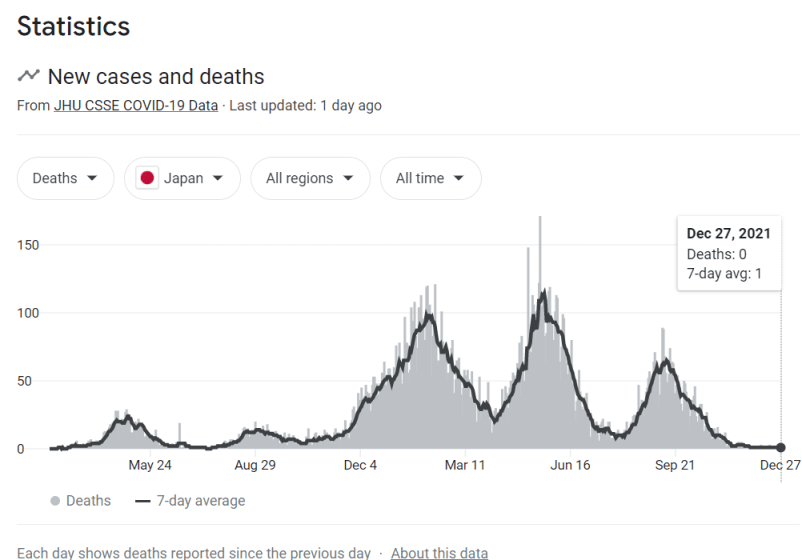
Let’s look at death rates in Japan vs. the US. See a difference? On a per capita basis, Japan is beating the US by a factor of 17. As soon as Japan rolled out ivermectin, their death rates dropped rapidly to 0.
I wonder if it could be caused by the ivermectin? What do you think?

Biggest pandemic lie: PCR tests accurately detect cases and deaths
By Joel S Hirschhorn | December 28, 2021
As of this Friday, December 31 the ubiquitous and infamous PCR test used universally by the public health and medical establishments is gone, according to a CDC declaration issued last July.
To all of the propaganda victims of the pandemic collusion mafia, now is the time (belatedly) to face facts. A huge fraction of all the fear-producing data in COVID cases, hospitalizations and deaths are sheer crap. From the very beginning in early 2020 there were experts who said that the PCR test should not have been so used universally as a way to detect and document COVID infection and disease.
You may have noticed that there has been no coverage of this rather important act by CDC in the leftist mainstream media. Why not? Because now they have to admit that massive false positive results from PCR tests have produced totally unreliable data. These PCR tests had the capability of calling the common flu or cold COVID. And so much of the time they were run at very high cycles to create false positives.
FDA has other approved tests for COVID that will be used.
The larger point after two pandemic years is that the public should better appreciate just how easy it has been for public health, medical and public policy establishments to totally lie about virtually all aspects of the pandemic.
It started with PCR testing and continues to this day with COVID vaccines. If you were stupid enough to trust testing, then you probably remain stupid enough to trust everything said about vaccines and boosters as ways to curb the pandemic. And add on masking, lockdowns and school closings to the BIG LIES endlessly promoted by Big Media, Big Government and Big Pharma.
And now keep believing, if you remain gullible, that omicron is a huge health threat.
Starting with my book Pandemic Blunder I have worked endlessly to be a truth-teller. But it is not easy to combat the disinformation and lies from all the powerful forces determined to instill fear so that governments can coerce and control the public.
Though I prefer to focus on COVID deaths, there are reasons why these data are also problematic. So many have died with COVID but not from COVID.
Hospitals have utterly failed to effectively prevent COVID related deaths, now over 830,000 and that will surely reach 1 million by the end of March. Why? Because severely ill, late-stage COVID patients in ICUs are not being saved by current hospital protocols. Those patients got to that point because the government prevented wide use of generic medicines for early home treatment and even now for late-stage COVID.
Everywhere I look I see widespread dishonesty, incompetence and corruption. These have produced widespread suffering in all aspects of lives. Time for the revolution. If you have enough critical thinking capability to see all the many lies from the powerful, especially the evil Fauci.
What really happened at Simpsonwood and why it matters today
By Steve Kirsch | December 27, 2021
If you read my story about RFK Jr. and how he became an anti-vaxxer, it mentions the Simpsonwood transcripts.
There is a book, “Evidence of harm” that talks about what happened there in detail. Some people think the author wasn’t sure who was telling the truth. That’s not true. The book author takes an objective viewpoint, leaving it to the reader to determine who was telling the truth. If your brain is working, it’s easy to figure out.
Basically, Simpsonwood was a meeting where the CDC was scrambling to figure out how to cover up the “signal” caused by thimerosal in vaccines.
Here is the original Verstraeten study which shows the connection with autism. RR=7.6 is huge. It means mercury causes autism.
Here is a transcript of the Simpsonwood meeting which was held to figure out what to do about the paper.
It’s a long read, so this excerpt gives you the highlights in a much shorter amount of time. The key thing was the study by Verstraeten. Version #3 was presented at that meeting.
This web page describes each version of the Verstraeten study. Search for “A “SIGNAL” DISAPPEARS ACROSS FIVE GENERATIONS OF STUDY.” In that section they’ll talk about a signal that “won’t go away.” They basically massaged the numbers to make the association “go away” so they wouldn’t have to admit making a mistake which would be a PR disaster.
In short, the CDC was more interested in covering their ass (making the signal go away) than protecting kids.
That was all 20 years ago. Why is this relevant today?
Because it shows the agency was corrupt 20 years ago and they haven’t changed. Today, they can ignore all the deaths in VAERS saying “there is no causality.” Bullshit. This is why they don’t debate any of us.
In 2002, the doctors knew that the mercury in thimerosal disappeared from the blood quickly. But it wasn’t until later (in a study by Burbacher in April 2005) that it was discovered where all the mercury went to: your brain. Paul Offit and RFK Jr. knew this.
Yet, fifteen years later the CDC is still lying to the public about the same issue.
Here’s the lie on the CDC website today:

Sure, it’s true that Thimerosal doesn’t stay in your blood a long time; but it’s not true that it doesn’t stay in your body a long time. In fact, it stays in your brain for the rest of your life (unless you use some special methods to remove it over time using chelation). They are not admitting established facts even today. They are still hiding that it stays in your body forever.
Was the Brubaker study wrong about the mercury going into your brain? Nope. It’s been confirmed 21 times. Here’s the most recent review showing that the mercury in thimerosal goes into your brain, confirming what we knew 15 years ago: 22 studies showing ethyl- and methylmercury cross the blood-brain barrier using the same LAT system:
In total, these studies indicate that ethylmercury-containing compounds and Thimerosal readily cross the BBB, convert, for the most part, to highly toxic inorganic mercury-containing compounds, which significantly and persistently bind to tissues in the brain, even in the absence of concurrent detectable blood mercury levels.
So the CDC is clearly lying to the public 15 years later about what happened back then, even after the science is completely settled.
And of course, Wikipedia doesn’t acknowledge this either (see the Disproven autism hypothesis).
So the lesson here is this:
- They covered up the dangers of thimerosal back in 2000… the five generations of the Verstraeten study shows that.
- But more importantly, and more clearly, they are still covering up the dangers of thimerosal today, claiming it leaves your body when they know it doesn’t. It is obvious to anyone doing a literature search.
So, do you think they are levelling us now about the safety of the COVID vaccines?
Answer: Of course not.
Featured Video
EUROPE FEARS RUSSIA’S NEXT MOVE / Ian Proud
or go to
Aletho News Archives – Video-Images
New Book
New Book: No Autoimmunity The Body Doesn’t Attack Itself
Lies are Unbekoming | September 24, 2026
 The label for Humira, once the best-selling drug in the world, lists its risks in plain print. One of them, in the label’s own words, is new “autoimmune” disease.
A drug prescribed for a condition labelled autoimmune carries a warning that it can cause a condition labelled autoimmune. That contradiction sits in every box, on a folded paper almost nobody reads.
My new book starts there.
No Autoimmunity: The Body Doesn’t Attack Itself
For seventy years, “your body is attacking itself, and we don’t know why” has ended the conversation for people diagnosed with multiple sclerosis, lupus, rheumatoid arthritis, Hashimoto’s, Type 1 diabetes, Crohn’s and psoriasis. More than eighty conditions now carry the autoimmune label. The diagnosis comes with a prescription for life. It almost never comes with a question about cause.
This book asks the question and answers it from the framework’s own records: its drug labels, its journals, its regulatory filings, and its own experiments. … continue
Blog Roll
 Aletho News
- Debunked: Trump’s egregious UNGA claims on war against Iran crumble under scrutiny
- Europe was part of the infrastructure of US aggression against Iran: Deputy FM
- New evidence on the Bucha Massacre
- Italy and France debunk reports CIA issued ‘Russian drone threat’ warning
- How Russia is Rewiring the Global South
- Britain’s elites want you ready to die for a war they keep imagining
- Inside Ukraine’s propaganda operation targeting Americans
- Hackers From US, France, Singapore Tried to Disrupt Russian Elections – Internet Provider
- New Book: No Autoimmunity The Body Doesn’t Attack Itself
- EUROPE FEARS RUSSIA’S NEXT MOVE / Ian Proud
- If Americans Knew
- Gaza winter nears as 162,000 tents become unusable, raising fears of humanitarian crisis
- Netanyahu says, “It’s the opposite of genocide”; UN says Gaza economy is world’s ‘most severe crisis on record’ – Daily Update
- Israel’s US-Backed Assault on Gaza Has Created the ‘World’s Most Severe Economic Crisis on Record’: UN
- ‘Protecting U.S. Citizens’… From Israel
- ‘This is where I live now, the back of a truck’: a day in the life of a grandmother in Gaza
- In UN Speech, Iran’s President Displays Pictures of Children Killed by US, Brings Attention to Israel’s Nuclear Arsenal
- Israel displaces hundreds of Palestinians amid wave of demolitions in West Bank
- Aid, reconstruction, and Israel’s history of obstruction in Gaza
- Trump administration digs an ever-deeper hole of complicity in genocide – Daily Update
- US-Israel $2.8 Billion Arms Deal, 40,000-Bomb Supply Faces New Gaza Complicity Accusations
- No Tricks Zone
- New Study: Earth And Venus Surface Warmth Largely Explained By Convection And Lapse Rate, Not CO2 Or Radiation
- 2025 Nature Paper Claiming Worsening Global Drought Gets RETRACTED …Heavily Flawed
- New Study: ‘Global Drought Shows No Detectable Recent Acceleration Under Climate Warming’
- Economic Masterminds: German Socialists Suggest Taxing Productivity Gains Stemming From Using AI
- The South China Sea Has Not Been Cooperating With The Climate Change Narrative
- Energy Crisis: Germany Enters Heating Season With Historically Low Gas Reserve Fill Levels
- New Study: The Antarctic Ice Sheet Gained Mass From 2020-2024 Due To Staggering Snow And Ice Accumulation
- Study: Ocean Heating Rates From Thousands Of Years Ago ‘Dwarf’ Modern Ocean Heating Rates
- Climate Extremists Target, Attack Large-Scale Power Grid Infrastructure In Germany!
- New Study: Antarctic Ice Melt Has Contributed Less Than 1 Centimeter To Sea Level Rise In The Last 30 Years

