Iran announces plan to link electricity grid with Qatar, transfer up to 1,000 MW of power
The Cradle | June 17, 2026
Iran is planning to connect its electricity grid with Qatar and announced on 16 June that work on the matter is in its “final stage,” reviving a years-old agreement with the Gulf state in the aftermath of the brutal US-Israeli war against the Islamic Republic.
Iranian Energy Minister Abbas Aliabadi said on Tuesday that “the connection between Iran and Qatar will begin soon.”
He added that “studies are in the final stage, and we are beginning the implementation phase.”
Aliabadi also said Tehran was “studying” power grid connection with other Gulf countries, according to Tasnim News Agency.
The minister affirmed that this would happen “in the near future.” The deal will involve a transfer of up to 1,000 megawatts (MW) of electricity.
Talks on the matter had been taking place between Tehran and Doha in December 2023.
The two countries had previously signed an electricity memorandum of understanding (MoU) under the late Iranian president Ebrahim Raisi’s government.
The new announcement comes several days after Qatar denied a Washington Post report that said the Gulf state cut a “secret” deal with Iran to avoid further retaliatory strikes.
“Any suggestion that operational decisions relating to energy production were – or have ever been – made in coordination with Iran, for Iran’s benefit, or to influence the course of the conflict is entirely unfounded,” Qatar’s International Media Office said on 12 June.
The Washington Post had cited western and regional officials as saying that Qatar approached Iran at the start of the war, following Tehran’s major strike on the key Ras Laffan energy facility.
“Seeking to protect its economic crown jewel, Qatar approached Tehran … to present a mutually beneficial arrangement: Iran would refrain from hitting Ras Laffan, and Qatar would halt gas production unilaterally – a move that would send energy prices soaring and put economic pressure on the US and Israel to shorten the war,” the sources said.
After the Iranian strike on Ras Laffan, Doha said the attack caused $20 billion in losses and wiped out 17 percent of the Gulf state’s gas export capacity.
Iran largely refrained from attacking the country in the days that followed, although some drone attacks and explosions were reported.
Tehran said during the war that many attacks on the Gulf were actually Israeli “false-flags” aimed at inflaming tensions.
Political commentator Tucker Carlson also reported in early March that Qatar and Saudi Arabia detained Mossad agents who were planning bombings, implying that the foiled attacks were designed to be pinned on Iran.
Tehran’s announcement on the electricity agreement with Qatar coincided with a Bloomberg report that said Qatar is planning to rapidly increase liquefied natural gas (LNG) production once the Strait of Hormuz reopens, aiming to restore up to 80 percent of its export volume within two months.
Pax Iranica? The end of uncontested U.S. military hegemony
By Raphael Machado | Strategic Culture Foundation | June 17, 2026
Anyone would be skeptical about the sustainability of the “peace” taking shape in the Middle East from the Memorandum of Understanding to be signed between Iran and the United States in a few days. It is plausible that it may not even be signed. And even if it is signed, considering that it involves a gradual, phased unfolding of a peace process that would last at least two months, it is hard to believe that everything will go as intended by the parties and the Pakistani mediators.
Nevertheless, in the terms that this “peace” is presented and which have been accepted by the U.S., we are facing an overwhelming victory for Iran. Even if the diplomatic process is derailed, nothing will change the fact that the U.S. accepted peace with Iran on terms unilaterally favorable to the Persians, leaving Tehran in a much stronger position than before the war began.
First of all, the U.S. failure should be seen as obvious and rests on a very simple assessment: Washington failed to achieve any strategic objective in the conflict with Iran: the “regime” was not overthrown, the nuclear program was not destroyed, military capabilities were not eliminated, support for the Axis of Resistance was not liquidated, and finally, it was not possible to reopen the Strait of Hormuz by force.
The U.S. committed the most basic error of any conflict: misjudging the balance of power. And in this, naturally, the U.S. was led into error by Israel and its allies within the U.S.. From the start, reports indicate that the Pentagon opposed military action against Iran, for good reasons.
Even considering the tactical and operational dimensions, the U.S. was unable to impose itself as intended. The U.S. failed to achieve air superiority over Iran and resorted to launching missiles from outside Iranian airspace. Most times the U.S. penetrated Iranian airspace, they encountered anti-aircraft systems capable of shooting down even F35s. The U.S. also could not take advantage of its regional military bases, which were harassed and operationally neutralized by barrages of missiles and drones, complicating U.S. logistics and forcing them to use increasingly distant bases. Iran also managed to force U.S. aircraft carriers to keep their distance, with one returning to port for maintenance. Furthermore, the U.S. demonstrated that it is not yet ready to face a war in which drones play a central tactical role. But perhaps the most significant embarrassment was the fact that Iran forced the U.S. to confront its own industrial shortcomings—the U.S. expended large quantities of Tomahawks, Patriots, and other types of offensive and defensive missiles, which are produced at a trickle. The fact that U.S. missile stocks plummeted rapidly without any objective being achieved was certainly decisive for U.S. reluctance to restart the conflict.
There was also the poorly explained situation involving the destruction of several aircraft and helicopters in an alleged attempt to rescue a downed pilot (a pilot who was simply never seen again and was not even reliably identified). The fact that the ceasefire came just days after this alleged rescue operation suggests that the story is very poorly told and that perhaps that was a failed special forces operation to seize Iran’s enriched uranium.
That is precisely why reducing the issue to “control of the Strait of Hormuz” is nothing short of amateurish, since control over the Strait itself was only possible because Iran surprised the U.S. tactically through its ability to present challenges for which the U.S. had no answers and to deny the U.S. certain important military advantages on that terrain.
Naturally, control of the Strait of Hormuz had a significant impact on the conflict, making it more complex and a global issue. Carrying out attacks against Arab Gulf countries rather than just U.S. and Israeli targets followed the same logic of demonstrating power and turning the conflict into a broader, more complex problem. This stance alone forced Qatar to concede and seek a separate peace and rapprochement with Iran.
Now, if pointing out the U.S.’s inability to achieve its objectives, as well as its tactical difficulties, is not enough to demonstrate its defeat by Iran, then the imbalance of the Memorandum of Understanding, which represents a draft peace treaty, is certainly sufficient proof.
The Memorandum is scheduled to unfold in three phases. The first immediate result is the end of military actions on all fronts and the end of the U.S. naval blockade. The situation in Lebanon is already extremely uncertain due to the “Joker factor” that is Israel. But the end of the naval blockade, which is already a reality, has left the Strait of Hormuz under Iranian control, and even if Iran does not charge a “toll,” it is already charging a “service fee” to authorize ship transit.
The next phase, lasting 30 days and beginning after the Memorandum is signed, involves a U.S. promise not to increase its military presence around the Persian Gulf, the return of $12 billion in frozen assets to Iran, the immediate removal of sanctions on Iranian oil, gas, and petrochemical exports, confirmation of joint management of the Strait of Hormuz by Iran and Oman, and a U.S. promise to pressure Israel to withdraw from Lebanon. In return for all this, Iran promises not to seek to develop or acquire nuclear weapons.
And in the final phase, expected to last at least 60 days, the return of the remaining $12 billion in frozen assets, the granting of $300 billion for the reconstruction of Iran (equivalent to reparations), and the beginning of the process of removing all remaining sanctions. In return, Iran promises to agree to discuss its uranium enrichment.
In short, Iran’s obligations under this Memorandum are minimal, while the commitments undertaken by the U.S. are disproportionate. Why take on all these commitments and accept all these conditions if the U.S. “won“—as Trump says—and could “destroy Iran at any moment”?
The reality is that between an international oil crisis, low missile stockpiles, the resilience of the Iranian population, and difficulty dealing with hypersonic missiles and drones, the U.S. suddenly found itself in a potential quagmire capable of causing infinitely greater harm than any conceivable benefit. Perhaps finally aware of the mistake of starting this conflict, with very low popularity, hosting a World Cup, and worried about a myriad of internal and external crises, Trump seems eager to get rid of the “Iranian issue.”
What is proven here is that although the U.S. remains a military superpower, it is possible to defeat them under certain specific conditions and with sufficient preparation. We are not saying here that any country could defeat the U.S. in a war, but that regional powers of a certain scale, immunized against color revolutions and with years of military preparation and investment in technologies capable of negating the potential of the U.S. Navy and its air superiority, can defeat them in a defensive war.
Having recently gone through the “unipolar moment” of uncontested U.S. superiority in the post-Cold War era, whose highest expression was the rapid destruction of Saddam Hussein’s regime, clearly the world is no longer the same, which in itself is proof that we are in a phase of geopolitical transition toward multipolarity.
Weakened in the Middle East, Iran is left in control of the Strait of Hormuz. Its ability to simultaneously confront all the Arab Gulf countries has been proven, and Israel’s inability to defeat Iran without U.S. help has been as well. This opens up for the Middle East the possibility of a regional pax Iranica, though much water will yet flow under this bridge.
Israel, however, remains a problem. Driven by a messianic ideology and accustomed to being treated with privileges derived from the influence of its diaspora, Israel does not appear willing to respect the terms of the Memorandum, nor to give up trying to establish a Greater Israel by force of arms. It is the Israeli factor that makes it difficult to fully realize a peace agreement between Iran and the U.S..
UN: Israel continues to violate Lebanon airspace in defiance of Iran-US MoU
Press TV – June 16, 2026
The United Nations has reported ongoing Israeli military offensives in southern Lebanon, including projectile launches and repeated violations of airspace, though it recorded a decrease in overall violence following a memorandum of understanding between Iran and the United States.
UN spokesperson Stephane Dujarric said during a news conference on Monday that the UN Interim Force in Lebanon (UNIFIL) had “observed a decrease in violence and exchanges of fire” from midnight until 4 p.m. local time.
UNIFIL also documented “133 trajectories of projectiles and 2 airstrikes” conducted by Israeli forces, while noting “no trajectories from Hezbollah or non-state actors.”
Dujarric further explained that peacekeepers had recorded 25 violations of Lebanese airspace by Israeli forces, with a cumulative overflight duration of “approximately 40 hours.”
“Prior to the announcement of the agreement yesterday between the US and Iran, our UNIFIL peacekeepers noted 135 violations of Lebanese airspace by the [Israeli military], with a total overflight time exceeding 222 hours,” he stated, adding that the peacekeeping mission had recorded a total of “1,374 trajectories of projectiles over the weekend, with 1,328 attributed” to Israeli forces.
Regarding the humanitarian situation, Dujarric highlighted the prevailing uncertainty on the ground, stating, ”Some families have reportedly begun to return to their homes or are evaluating the conditions in communities in parts of southern Lebanon, particularly in Nabatieh.”
“However, no large-scale returns have occurred thus far,” he added.
On Monday evening, Iran’s Supreme National Security Council announced that the memorandum of understanding (MoU) reached between Tehran and Washington earlier in the day will bring an end to warfare on all fronts, including in Lebanon.
The SNSC secretariat also announced that the MoU is scheduled to be officially signed on Friday, June 19.
Despite the agreement, the Israeli army conducted demolitions and shelling in several towns in southern Lebanon on Monday. Reports indicated that displaced residents were returning to some southern villages, while local municipalities advised caution and urged residents to postpone their returns.
Since March 2, Israel has been conducting an extensive military offensive in Lebanon, killing 3,783 individuals and injuring 11,699 others, as reported by the Lebanese Health Ministry. Additionally, over one million people have been forced to flee their homes.
Israel maintains its occupation of certain regions in southern Lebanon, with some areas being held for decades and others since the onset of the 2023-2024 war. Israeli troops have also penetrated more than 10 kilometers into Lebanese land.
Araghchi: Israeli occupation of Lebanese land a violation of MoU
Al Mayadeen | June 16, 2026
In a televised statement, Iranian Foreign Minister Abbas Araghchi affirmed that, from Iran’s perspective, the two parties to the Memorandum of Understanding are the United States and “Israel” on one side, and Iran and Hezbollah on the other.
He also said, contrary to Trump’s overnight statement, that the MoU would be signed on Friday.
Speaking at the opening of a meeting with ambassadors, chargés d’affaires, and heads of foreign and international missions in Tehran on Tuesday, Araghchi stressed that the end of the war in Lebanon is an inseparable part of the complete end of the war, noting that ending the war on Lebanon also includes ending the occupation of Lebanese territory.
Araghchi said that, from now on, any military attack by “Israel” on Lebanon, as well as the continuation of the occupation of Lebanese territories, will be considered a violation of the MoU.
According to Araghchi, the heads of the two delegations from the US and Iran will first sign the memorandum of understanding on Friday before the inaugural round of formal negotiations begins.
Tehran, he said, aims to build on the understandings reached and translate them into a tangible economic opening.
Implementation mechanism amid deep-seated mistrust
The Iranian foreign minister also said that the negotiation agenda and the mechanism for implementing the anticipated understandings will be formulated in light of the prevailing lack of trust in the United States stemming from previous experiences marked by breaches of commitments and failures to uphold obligations.
“Naturally, we do not squander any opportunity in foreign policy, but at the same time, we do not pin our hopes on any opportunity,” Araghchi said, underscoring Tehran’s cautious and pragmatic approach to the forthcoming negotiations.
Meanwhile, US President Donald Trump claimed overnight Monday that a memorandum of understanding with Iran has been signed and that the Strait of Hormuz will be completely reopened by Friday, speaking to reporters upon his arrival in Evian, France, ahead of the G7 summit.
The formal signing ceremony is scheduled for Friday in Geneva, with Vance confirmed to attend.
Hezbollah fighters confront intruding Israeli forces in southern Lebanon
Press TV – June 16, 2026
Fighters from the Lebanese Hezbollah resistance movement have confronted an Israeli military convoy as it was attempting to infiltrate into southern Lebanon despite an Iran-US agreement that includes complete cessation of Israeli assaults on Lebanon.
Hezbollah said in a statement on Monday that its fighters, employing rockets and drones, obstructed an Israeli unit comprising an excavator and two Merkava tanks that was moving forward near the town of Kfar Tebnit, close to the southern city of Nabatieh.
In a subsequent statement later in the day, Hezbollah said, “The enemy army has reorganized its forces in the vicinity of the crossing area by deploying an armored contingent consisting of five Merkava tanks and four vehicles.”
“The combatants of the Islamic Resistance have targeted them with rocket barrages and artillery shells, and clashes are continuing.”
It came after an Israeli drone struck a vehicle in the same region, killing its driver. The air raid marked the first fatal strike since the announcement of the agreement.
Hebrew-language media outlets, meanwhile, reported “a serious security incident” for Israeli soldiers positioned in southern Lebanon.
The outlets added that Israeli rescue helicopters are trying to transport the injured troopers to hospitals in the northern part of the occupied territories.
There were no immediate reports about the number of casualties that the Israeli army suffered as a result of the incident.
Israeli media outlets also reported that a soldier fighting in southern Lebanon committed suicide last night due to mental distress from military offensives.
This comes as the Israeli military is witnessing a continuous and alarming rise in soldier suicides, a trend linked to widespread post-traumatic stress disorder (PTSD) stemming from Israel’s prolonged and repeated aggressions on multiple fronts.
According to figures published by the Haaretz daily newspaper, at least six active-duty soldiers and three non-active reservists died by suicide in April alone.
Earlier this year, the newspaper recorded 22 soldier suicides in 2025, a 15-year high.
A new poll by Israel’s public broadcaster KAN shows that a majority of Israeli settlers believe that the Zionist regime has failed to secure victory in any war since October 2023.
Lebanon Accuses Israel Of Violating The Chemical Weapons Convention By Spraying Toxic Herbicide Over Farmland
By Justin K.P. | The Dissident | June 15, 2026
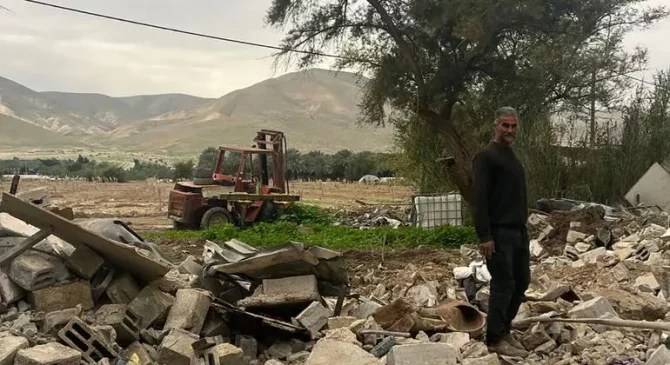
Lebanon has officially accused Israel – in a complaint filed with the U.N. Security Council- of violating the Convention on the Prohibition of Chemical Weapons for using aircraft to spray glyphosate, a “toxic herbicide with serious consequences for health, soil, and crops” over farmland in Southern Lebanon, as part of its broader ethnic cleansing plan.
Lebanon said that “the Convention on the Prohibition of Chemical Weapons prohibits the use of herbicides as a means of warfare”.
It noted that “Chemical analyses and laboratory tests conducted on soil samples taken from Aita al-Shaab (Bint Jbeil district), Ras Naqoura and Dhaira (Sour district) ‘confirmed the use of glyphosate at high concentrations reaching 22,750 micrograms per gram, a level far higher than the concentrations usually found in agricultural soils after farmers’ direct use of this product, which generally range between 0.5 and 2 micrograms per gram at most’”.
For context, Lebanon’s agriculture minister, Nizar Hani, revealed in February that “Laboratory tests have identified the chemical sprayed by Israeli aircraft in southern Lebanon as glyphosate, a widely used herbicide that can destroy vegetation when applied intensively,” adding that “the substance was used at abnormally high concentrations along the border with Israel”.
Nizar Hani noted that, “glyphosate, like other herbicides, eliminates vegetation when used at such high levels, directly affecting soil and water and causing negative repercussions for human health” and “the substance is classified as having carcinogenic effects and poses serious risks, particularly to agriculture and plant ecosystems” adding, “the incident was consistent with known practices along the border, where such substances are used to create vegetation-free zones, effectively resulting in systematic desertification.”
The Guardian reported that glyphosate was “in 2015 classified by the World Health Organization as ‘probably carcinogenic to humans’.”
In January, Israel similarly sprayed glyphosate over farmland in the southern Quneitra province in Syria and soon after, “A second incident occurred two days later, during which the visible release of substances led to outcries from Syrian farmers in occupied areas near Quneitra, southwest of Damascus and along the border with Israel.”
Israel, through spraying this carcinogenic herbicide, is attempting to kill off the farms and crops needed to sustain life in areas of Syria and Lebanon targeted for Israeli annexation in the Greater Israel Project.
‘Jewish lobby’ deceived Putin – Lukashenko
RT | June 15, 2026
Russian President Vladimir Putin was deceived into withdrawing troops from near Kiev in 2022 by forces claiming to represent Vladimir Zelensky’s willingness to seek peace, Belarusian President Alexander Lukashenko has said.
Speaking in an interview with Al Arabiya, Lukashenko said the conflict could have ended quickly in its early stages, when Moscow’s forces were near the Ukrainian capital.
“At the time, not only I, but everyone in the world understood that the war would end quickly with a Russian victory. This was primarily because the Russians were in Kiev,” the Belarusian leader said, according to BelTA.
However, Lukashenko claimed that “certain politicians and forces” then asked Putin to stop, pull troops back from Kiev, and conclude a peace agreement. “Before that withdrawal, everyone understood that Ukraine’s days were numbered.”
The Belarusian president argued that Moscow had been acting on what appeared to be a genuine opportunity to reach a settlement, adding: “Judge for yourselves who was right and who was wrong in this matter.”
“Once again, probably, these forces deceived him. It was the Vatican. And, surprisingly, the Jewish lobby, the Israelis,” Lukashenko said. “They said on behalf of Zelensky: that’s it, we are moving toward peace, we agree. And others as well.”
It was not immediately clear what exactly Lukashenko meant by the “Jewish lobby.” In the early days of the conflict, then-Israeli Prime Minister Naftali Bennett acted as a mediator between Moscow and Kiev, meeting Putin in Moscow and holding multiple phone calls with Zelensky. Media reports at the time claimed that Bennett had urged Zelensky to accept Moscow’s terms.
Lukashenko also did not elaborate on the Vatican’s alleged role. In March 2022, however, Pope Francis and Russian Orthodox Patriarch Kirill held a video call in which they stressed the “exceptional importance” of the negotiation process.
Moscow and Kiev held several rounds of peace talks in Istanbul in March 2022. Putin said in June 2023 that Ukrainian negotiators had initialed a draft treaty on permanent neutrality and security guarantees, but that Kiev later abandoned the deal after Russian troops pulled back from areas near the Ukrainian capital.
Moscow has argued that Ukraine walked away from the agreement under Western pressure, including from then-British Prime Minister Boris Johnson, who reportedly urged Kiev not to sign any deal with Moscow and to “continue fighting.”
Kiev has disputed Moscow’s account of the failed talks, even though its former chief negotiator, David Arakhamia, has acknowledged Johnson’s role. Ukraine has since formally applied to join NATO and abandoned discussions of neutrality.
The UK Joins the Pirates
By Craig Murray | June 15, 2026
I was genuinely surprised by the Starmer regime’s refusal to state that the Israeli boarding of the Global Sumud flotilla on the High Seas was illegal. I did not realise it was because the UK was planning to undertake similar illegal seizure itself.
The Gaza Flotilla seizure was illegal: while for obvious reasons freedom of navigation had been the undisputed basis of UK maritime policy for centuries. The UK is a set of islands whose population is dependent on food imports to stay alive. Freedom of navigation is a core strategic interest of the UK. The relevant provisions of the UN Convention on the Law of the Sea were very heavily UK driven, including on passage through straits.
Abandoning the primacy of freedom of navigation is absolutely a radical policy departure for the UK, driven like so many other changes to traditional British legal positions by the Starmer regime’s extreme support for Israel.
It is not generally understood how profound a change this is. Even the Tory government of David Cameron, with William Hague as Foreign Secretary, had opposed the Israeli naval blockade of Gaza and particularly Israeli seizure of vessels on the High Seas. William Hague stated in 2010 to the House of Commons of the boarding of the Mavi Marmara:
We are seriously concerned about the seizure of British nationals in international waters,
This is a long term British legal position now directly repudiated by Starmer, Lammy and Cooper.
I had not realised that not only was the UK now supporting the campaigns of illegal blockade and seizure of vessels being openly pursued by Israel and by Trump, but Starmer was actually intending to abandon freedom of navigation and join the Trump/Netanyahu doctrine.
That is what the UK has now done by its seizure of the Smyrtos as it had passed through the Straits of Dover en route to Sikka in India.
The Dover Strait is a strait. The clue is in the name. The UK has absolutely no right to close it to Russian shipping. This is in Article 39 of the UN Convention of the Law of the Sea:
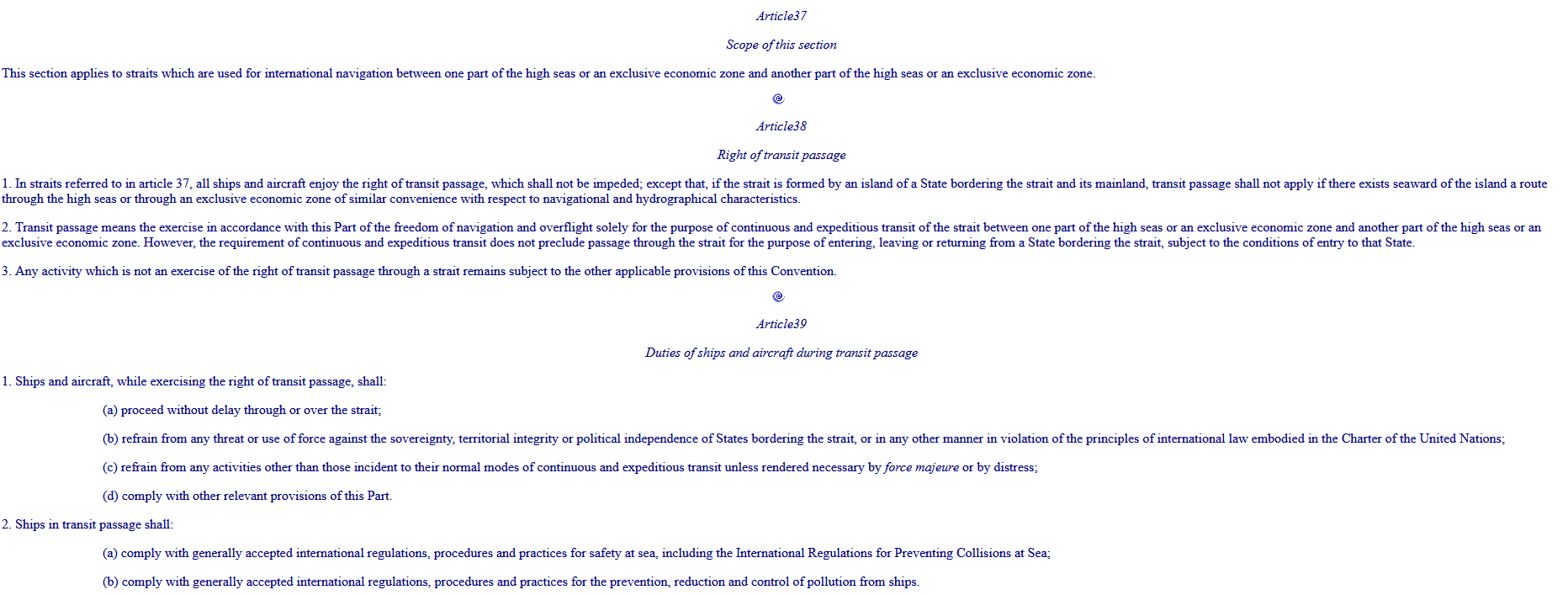
Transit of international straits “shall not be impeded” is pretty plain. This is the applicable legal regime for both the Strait of Dover and the Strait of Hormuz. Obviously in time of war different considerations apply, and commercial shipping of belligerent states – and to and from belligerent states – becomes a legitimate target. Iran is fully justified in also treating states permitting attacks launched from their territory as belligerent states.
If hostilities end this Article 39 regime that should apply again in the Strait of Hormuz.
It is worth a footnote to say that Iran had, until the recent illegal aggression by Israel and the United States, always strictly observed the international law on straits even though Iran did not sign the Convention and actually had entered a formal reservation on passage through straits. Even during the war, Iran had attempted, in extremely difficult circumstances, to establish a system for passage of genuinely neutral vessels.
It is astonishing that at this moment, when navigation of the Strait of Hormuz is arguably the single most live question in all of international politics, the UK has decided to abandon the principle of free transit through straits.
It takes hypocrisy to an entire new level, it truly beggars belief, that the day after closing the Dover Strait to Russian shipping, Starmer issued a joint statement with Germany, France and Italy insisting on “Freedom of Navigation” in the strait of Hormuz.
Even if you don’t care about international law and believe that Trumpian realpolitik is better, to act against freedom of navigation now would seem an unwise decision. The UK is now copying actions like the United States naval blockades of Cuba and Venezuela, and the Israeli genocidal blockade of Gaza. These are gross violations of the Law of the Sea.
UK Government minister Lisa Nandy was on television news last night as the government pumped out militaristic propaganda. The Royal Navy’s action in boarding and capturing an entirely unarmed and peaceful merchant vessel was portrayed as an act of Nelsonian brilliance. Nandy justified the seizure on the grounds that Russia’s oil sales pay for its war with Ukraine, and that the UK was enforcing sanctions against Russia.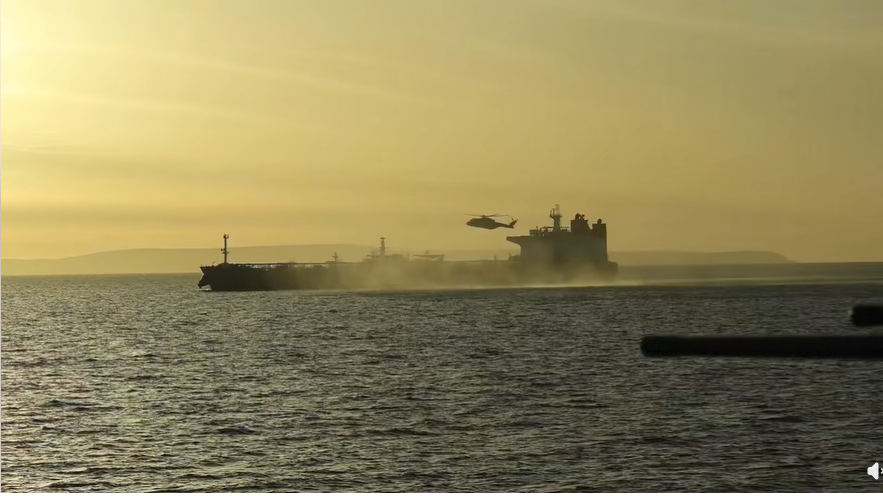
Neither provides an atom of legal justification for seizing the vessel. The UK is not at war with Russia. Ukraine is, and the Ukrainian navy would have been entitled to seize the vessel. For reasons of cheap popularity and to increase the massive amounts of public money swirling around the corruption honeypot of military spending, UK ministers seem determined to move us to the brink of war with Russia. But we are still not at war, and the UK accordingly has no right to seize peaceful and innocent Russian bound, owned or flagged commercial vessels.
The UK is legally entitled to put whatever sanctions it wishes on Russia. But it can only enforce those within its legitimate jurisdiction. A foreign vessel, even when engaged in innocent passage or transit passage through a UK strait or other territorial waters, is not under UK jurisdiction. The Smyrtos was in fact in international waters south of the UK when seized.
In fact this attempt to enforce western sanctions in areas where western powers have no jurisdiction is a classical example of the current aggressive resurgence of imperialism, where the “rules based order”, meaning rules imposed by the imperialists, replaces international law.
Nandy also stated that the Smyrtos was a member of the “Russian shadow fleet”. This is a term that the Starmer regime and their client mainstream and corporate media have relied upon repeatedly to demonise the Russian owned or directed merchant fleet.
Russia sells oil to countries like India and China perfectly lawfully. That this oil is carried in ships bearing flags other than Russian is perfectly normal.
Nil or close to nil of those ships carrying hydrocarbons to and from the UK are UK registered and flagged.
It has been a sad truth of international shipping for many decades that commercial vessels bear flags of convenience, and that jurisdictions compete to offer the very lowest standards of crew salary and welfare regulations, officer and crew training, vehicle condition and maritime safety and inspection regimes.
Most of the registries of well-known international flag of convenience states such as Panama, Liberia and the Marshall Islands, do not really exist in the sense of being government departments of those countries, as they should be. They are private companies with almost no real world footprint, which pay a fee to the government to operate the registry, and collect the fees from the shipowners registering. The register is just names in a laptop – and very often that laptop is in London.
UK colonies often have substantial such fake registries. The UK is a strong opponent of the International Transport Workers Federation, which has struggled against this system to improve mariners’ rights.
The system evolved for wealthy shipowners to avoid all maritime safety, environmental and welfare regulation, and the UK and other western countries which pander to the needs of the ultra wealthy have always been complicit. The incredible hypocrisy of western states pointing fingers at Russia for running “Flags of convenience” is breathtaking.
The West has spent decades building and profiting from the global flags of convenience system. Russia is simply using the same system that Western companies created and still dominate.
Incidentally the MOD’s own propaganda footage, shown by all UK mainstream media yesterday, proves that the Smyrtos is a modern, clean, well-equipped and comfortable vessel and all the propaganda about ancient rustbucket is completely untrue.
I have finally managed to pin down the alleged legal basis of the seizure of the Smyrtos, and it is that the vessel was stateless and thus subject to boarding under Article 110 of the UN Convention of the Law of the Sea.
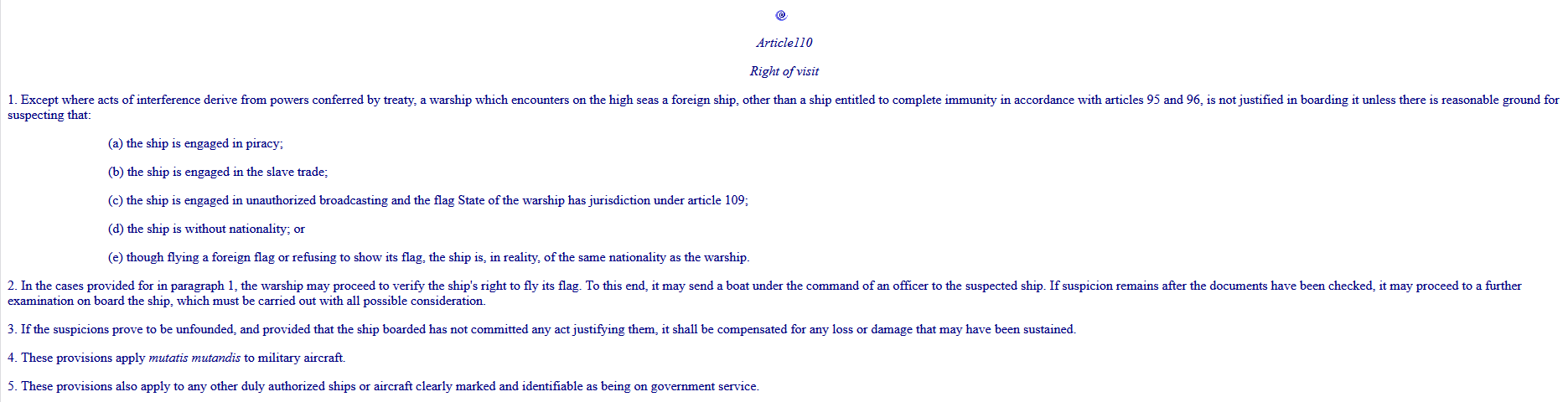
The UK is claiming that the Smyrtos fell foul of Article 110.1 (d) that it was “without nationality”.
We will inspect that claim more closely in a moment. But, assuming it for a moment to be true, note that you only have a right to visit and inspect on the High Seas a ship that is without nationality. Article 110 absolutely does not confer any right to seize a ship on the High Seas not found on inspection to be in unlawful activity. The UK has seized the Smyrtos, brought it into UK territorial waters and then claimed it is under UK jurisdiction.
Nowhere is that allowed in the Convention.
Now let us look at the claim that the Smyrtos is without nationality. This is an astonishing story which the media will not tell you.
When the Smyrtos set sail from Russia it was flying the Cameroonian flag, and on the Cameroonian register. That is not in doubt.
While the ship was on its voyage, on 10 June Cameroon withdrew its registration. It did so because the EU and UK threatened to halt development aid to Cameroon unless they removed Russian vessels from their shipping register.
So the UK blackmailed Cameroon into deregistering the ship. Then, before the ship could reach a friendly port, the UK boarded it because it had been deregistered.
Now doubtless there are chortling people in the UK security and military industries self-congratulating themselves over how clever they are. But while this may be a clever ruse de guerre, it is hardly a ruse de paix. It is not going to survive scrutiny by an international court. An unexpected change of registration, forced upon the owners, is very difficult to complete instantly, but doubtless one was in train and perhaps finished. The UK actions are patently – and deliberately – unreasonable.
Politicians seek to drum up cheap popularity by stupid jingoism. Starmer has won a cheap headline. The world inches closer to the next world war. The UK loses yet more legitimacy in the eyes of the wider world.
Meantime Trump claims as a great victory a possible return of the Strait of Hormuz to the open status it enjoyed before he started an illegal war in the interests of Israel.
Freedom of navigation was a principle worth defending. It has been abandoned in favour of a return to the rule of the seas by those with the strongest navies. Fortunately Putin is neither as war hungry nor as politically desperate as Starmer. However Russia will now be obliged to send at least a frigate to keep the Strait of Dover open. The drums of war beat ever closer.
Craig Murray is a former Head of Maritime Section of the UK Foreign and Commonwealth Office. He is a former Alternate Head of the UK Delegation at the UN Preparatory Commission for the UN Convention on the Law of the Sea.
Israeli government plans to fund extremist occupier group in occupied West Bank with $1.89M: Report

MEMO | June 15, 2026
The Israeli government of Prime Minister Benjamin Netanyahu plans to allocate 5.5 million shekels ($1.89 million) in state funding to the extremist occupier group known as the “Hilltop Youth,” the Yedioth Ahronoth daily said Monday.
The newspaper said the budget was outlined in a document issued by the Settlement and National Missions Ministry, headed by Minister Orit Strock, which will oversee the transfer of funds through regional settlement councils in the occupied West Bank.
The funding plan is scheduled to run from June through the end of the year and totals 5.5 million shekels, it added.
According to the newspaper, each member of the Hilltop Youth movement would receive the equivalent of approximately $550 per month to help cover food, clothing and living expenses for more than 650 youths living in hilltop outposts and pastoral settlement sites across the occupied West Bank.
The Hilltop Youth is an occupier movement whose members primarily live in unauthorized settlement outposts in the West Bank and are known for opposing efforts to evacuate them.
The group has frequently been linked to attacks against Palestinians and is considered the ideological nucleus of the extremist “Price Tag” movement, which has carried out retaliatory attacks against Palestinians and their property.
Founded in 1998, the movement is largely composed of Israeli occupiers aged between 16 and 26, who left their homes and schools to live in illegal settlement outposts built on hilltops overlooking Palestinian communities.
The group is considered an offshoot of the extremist movement Gush Emunim, which advocates expanded Jewish settlement in the occupied Palestinian territories.
According to Israeli and Palestinian rights groups, violence by Israeli occupiers in the occupied West Bank has increased significantly in recent years, including attacks on Palestinian communities, farmland and property.
Since Oct. 8, 2023, at least 1,169 Palestinians have been killed, 12,666 injured, around 23,000 arrested and approximately 33,000 displaced in the occupied West Bank amid intensified Israeli military operations and occupier attacks, according to Palestinian figures.
Press TV reporter wounded in Israeli drone strike on southern Lebanon

Hadi Hoteit, Press TV correspondent in southern Lebanon
Press TV – June 15, 2026
A Press TV correspondent has been struck by an Israeli drone while reporting in southern Lebanon, despite wearing a clearly marked press vest.
Israeli forces deliberately targeted Hadi Hoteit in the southern Lebanese town of Kfar Tebnit on Monday, according to Lebanon’s National News Agency (NNA), despite the journalist wearing clearly marked press gear.
Hoteit sustained a shrapnel wound to his foot and was transported to Al-Najda Al-Shaabia Hospital in Nabatieh, where he underwent surgery and is receiving medical treatment.
The NNA reported that the Israeli military fired a shell that landed near the journalist.
The strike comes just one day after Iran and the United States finalized a memorandum of understanding to end the war on all fronts, including in Lebanon.
Despite the announcement, Israeli forces continue to attack areas in southern Lebanon.
Shortly before the attack, Hoteit posted on X, “We are back to South Lebanon, and hopefully the ceasefire this time will be different. This is my understanding of the situation and possible scenarios.”
Also on Monday, an Israeli drone struck another car at a roundabout in Kfar Tebnit, killing one person.
Time for Trump to Tell Benjamin Netanyahu to Go Away!
Netanyahu always says “What you own belongs to me”
By Philip Giraldi • Unz Review • June 14, 2026
In addition to the regular lethal American and Israeli attacks on Iran, last week alone the Israeli military killed 13 Gazans and 13 Lebanese. Gaza is now 70% Israeli occupied, contrary to what was agreed upon in the ceasefire arrangement, as is much of south Lebanon. More than 1,000 Gazans have been murdered by Israel since the temporary ceasefire was declared in October 2025. And one might add to the toll the constant aggression in south Syria, where Israel is creating an army base presence to be followed by settlers that creeps ever closer to the capital Damascus. It is an encroachment that Prime Minister Benjamin Netanyahu and his band of war criminals intend to turn into a component of “Greater Israel” together with Gaza and Lebanon.
Armed Jewish settlers are meanwhile devastating what remains of the Palestinian West Bank, destroying farms and livelihoods as well as entire villages. Taybeh, the last Christian village, was made uninhabitable last week after weeks of raids killing livestock, poisoning water and cutting down olive trees. If a Palestinian tried to intervene he was beaten and in some cases killed. Churches and Mosques on the West Bank are routinely desecrated and non-Jews in religious attire or trying to enter a holy site are frequently spat upon particularly in Jerusalem. The Israel Defense Force (IDF), meanwhile, regularly stands by and watches the displays of wanton brutality and does nothing. Lest there be any confusion regarding what is coming, the Knesset has now authorized $51 million to build more than 60 new completely illegal settlements on Palestinian land in the occupied West Bank.
What all these places have in common apart from the cruel Israeli hand is that the United States, often in the form of Trump personally, has been a guarantor of the ceasefires as well as the source of the so-called but utterly dysfunctional Board of Peace, has done nothing to stop the slaughter. Rather, it is continuing to provide Israel with weapons, money and political cover. It is therefore complicit in the war crimes. Here at home, Trump is promoting the Israeli program by supporting the criminalization of anyone who speaks up against the crimes against humanity being committed by his “best friend” Bibi, choosing to destroy freedom of speech rather than allowing any exposure of Israel’s crimes. This is reminiscent of June 8th 1967, when Israel attacked the USS Liberty, killing 34 American crewmen and injuring 172 more. A cover-up followed to protect Israel, coordinated by President Lyndon B Johnson, a hideous excuse for a human being who would likely have found it pleasant to have a chat about “values” with Trump.
If there is one thing that is most definitely true it is that the United States gains absolutely nothing in either the national interest nor in the well being of the average American from the bondage to Israel and Netanyahu. If opinion polls mean anything, the public in the US has figured that out and has turned sharply against the Jewish state and now favors both the Palestinian cause and the drive to end the totally meaningless war against Iran. That means that it is past time for the United States to cut the tie that binds with Israel and look to its own interests. That is necessary even if Congress and President Donald Trump continue to push in the opposite direction to complete their subjugation by the Israelis, which now includes a planned fusion of the US and Israeli defense and intel bureaucracies.
If we have learned anything from all of the above and more, there is one thing true about the President Donald Trump administration and that is its particular incompetence at foreign relations, i.e. how it deals with other nations, and, by extension, how it mismanages national security. Part of the blame surely belongs to Trump himself as he has little or no empathy for other human beings unless they are either capable of doing him harm or profiting him personally, as do Netanyahu and the Jewish billionaires. And he also has a tendency to change direction spontaneously and without much concern for the actual issues that might be important to his audience. All that matters is whatever he happens to think will make him look good at any given moment, which recently has manifested itself as plastering his own name on public buildings. Responding to a recent journalist’s question about the rising inflation rate, he answered that he “Loved the inflation!” It was like saying “Goodbye midterms!”
Witness for example how on Thursday last week Trump announced in the morning that he would be attacking Iran that night to seize its major oil export facility on Kharg Island as part of a plan to cripple the country’s ability to sustain energy shipments. By 2 o’clock in the afternoon, however, he had called off the planned attack due to his perception that the US and Iran are now on the verge of an agreement to end the fighting and settle the various issues that have created the conflict in the first place. The mediating Pakistani Prime Minister did, for what it’s worth, confirm a possible peace agreement on Friday even though knowledgeable observers immediately commented that the claim was unsustainable as no negotiations were actually going on between parties and Iran has denied any such progress over key issues. As of Saturday, nothing was confirmed but Trump again asserted that there would be a “signing” of a “memorandum of understanding” as a first step to a peace agreement on Sunday, presumably to coincide with his birthday. Most observers however continue to argue that a weak-kneed and vulnerable Trump, though desperate to disengage from a disastrous Iran war, is only staying with it due to intense pressure from Israel and its domestic US lobby which may be prepared to employ “Epstein” blackmail on the president to maintain American participation in the conflict. If Trump were even to consider withdrawing from his ring of fire around Iran Israel would immediately take whatever steps are necessary to blow-up the agreement and resume fighting, be it by way of a false flag to drag the US back in or possibly exploiting the “Iran has a nuke” lie.
So it would be wise to accept that Donald Trump is a ship without a rudder and interactions with most of the Middle East will continue to be driven by Israel while bilateral talks elsewhere with major players like Russia and China appear to have dried up completely. Appointing real estate billionaires Steve Witkoff and son-in-law Jared Kushner as personal presidential representatives, both of whom are inexperienced and ardent Zionists, certainly did not improve prospects for what passed for negotiations with anyone. No one can trust Trump.
Israel’s reach far exceeds the country’s size and real power. A recent “friend” of Trump is Argentine Prime Minister Javier Milei, who, surprise-surprise, is also a great friend of Israel, having made the usual obeisance trip to the Wailing Wall in Jerusalem during a State Visit to Israel shortly after being elected. Raised a Catholic, Milei reportedly wanted to convert to Judaism but decided not to as its “no work on Saturday” rule would have interfered with serving as prime minister. Not content with taking all the Middle East, Israel’s Jews are also looking farther afield. Patagonia in Argentina has reportedly been particularly targeted by Israeli buyers with the assistance of the Milei regime which helped get around environmental restrictions. Israelis are also buying up numerous properties in Cyprus as well as in Greece, nearby states which would be convenient as refuges if Israel finally provokes one too many of its neighbors and it finds itself on the receiving end of a nuke. Benjamin Netanyahu’s resident American spy Jonathan Pollard reportedly has mentioned both Turkey and Egypt as “next” to feel the wrath of Zion after Iran is finished off. Either army could easily defeat the chickenshits in the Israeli army who are better at raping and torturing than they are at fighting.
But one story that has caught some attention illustrates clearly the Israeli manic desire to steal other peoples’ property, most particularly land, no matter what it takes to carry out the theft. As is always the case, they are not held accountable for their criminality by Donald Trump who has his own soft spot for stealing the property of others and chooses to cut corners, witness the grandiose plans for a Trump Riviera luxury development on the beachfront of Gaza. And then there are the current shenanigans on an island off Albania which is being multi-billion dollar “developed” by daughter Ivanka and son-in-law Jared Kushner using United Arab Emirates (UAE) cash to become a major resort for the rich and famous. Kushner got the money as a benefit derived from his family connection and fortunately a lot of Albanians are mad as hell about the deal that was struck and are demonstrating!
But the story out of the United States and Canada as well as over the weekend in London tops many of the Trump/Israeli tricks due to its sheer audacity and criminality. Amnesty International UK is demanding the British government stop a real estate event scheduled to take place in London that includes companies openly advertising the sale of land in Israeli settlements in the illegally occupied West Bank.
The ‘Great Israeli Real Estate Event’ is a traveling roadshow that has held events in Canada and the United States and has now been planning for the sale in London on Sunday. The events are organized by Israeli real estate firm called My Home in Israel. It sells land to prospective buyers through a team of US-based real estate agents with the sales normally taking place in synagogues or other Jewish-owned and operated buildings. There have inevitably been protests against the sales in cities like Los Angeles and New York, where the “lots” have been promoted to the local Jewish communities. The lots being sold include considerable sections located in illegal settlements on the Palestinian West Bank, land that has been stolen from its owners. The Amnesty International report published last week in opposition to the London show exposed Israel’s state-led ethnic cleansing campaign in the West Bank – “documenting the displacement of at least 5,910 Palestinian Bedouin and herding community members since 2023, the demolition of over 3,400 homes and structures in [Palestinian West Bank] Area C, and an unprecedented surge in state-backed settler violence and land grabs.”
So there you have it, whatever Israel wants Israel takes without any concern for those who die or lose their homes in the process. And the United States government sits by and watches as Netanyahu spins lie after lie. Well, enough is enough. America is hated almost as much as Israel for its behavior and if it continues there will be severe consequences. Time to show Netanyahu the door and tell him and his supporting cast of AIPAC and Jewish billionaire buddies to get the hell out.
Philip M. Giraldi, Ph.D., is Executive Director of the Council for the National Interest, a 501(c)3 tax deductible educational foundation (Federal ID Number #52-1739023) that seeks a more interests-based U.S. foreign policy in the Middle East. Website is https://councilforthenationalinterest.org address is P.O. Box 2157, Purcellville VA 20134 and its email is inform@cnionline.org.
Featured Video
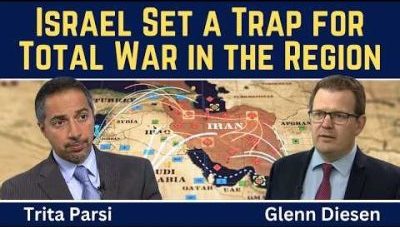
Trita Parsi: Israel Set a Trap for Total War in the Region
or go to
Aletho News Archives – Video-Images
From the Archive
Zionism’s Violent Legacy
By Donald Neff | Washington Report On Middle East Affairs | January 1996
On January 4, 1948, Jewish terrorists drove a truck loaded with explosives into the center of the all Arab city of Jaffa and detonated it, killing 26 and wounding around 100 Palestinian men, women and children.[1] The attack was the work of the Irgun Zvai Leumi – the “National Military Organization,” also known by the Hebrew letters Etzel – the largest Jewish terrorist group in Palestine. The Irgun was headed by Revisionist Zionist Menachem Begin and had been killing and maiming Arabs, Britons and even Jews for the previous ten years in its efforts to establish a Jewish state.
This terror campaign meant that at the core of Revisionist Zionism there existed a philosophical embrace of violence. … continue
Blog Roll
 Aletho News
- Trita Parsi: Israel Set a Trap for Total War in the Region
- Trump’s Iran war is on an Israeli leash
- Saudi oil boss issues global supply warning
- Riyadh Says Its Oil System Is Intact. The Numbers Say Otherwise.
- Trump and Netanyahu Want to “Finish the Job” on Iran
- US ‘one-sided dictation’ not Iran’s beliefs makes rational talks impossible: Baghaei
- Iran’s Next Strike May Not Explode. It Could Shut You Down /Col Doug Macgregor
- Iran: US political targets legitimate if assassinations return
- Iraq shuts key border crossing with Iran under US pressure: Report
- Undersea Internet cables could be targeted in retaliation for attacks on Iran: IRGC deputy chief
- If Americans Knew
- The Israel Lobby’s Changing Fortunes
- AIPAC has become such a political liability that it’s shifting to a more “nimble” approach to buying politicians
- At least 160 Israeli settler attacks in 2 weeks
- Will Gaza’s Ancient Christian Community Disappear Forever?
- Israel’s vision of regional security rests on keeping Arab states weak
- Heidi Levine recounts how Palestinian youths helped save her in settler attack
- DAILY UPDATE: Latest essential news on Palestine, Israel, & region
- Trump’s Intensifying Sabotage of the ICC, for Israel’s Sake
- Israeli military detain US and UK volunteers in West Bank including Democratic NY politician Brad Lander
- Americans at National Conservatism Conference held in Israel this year criticize Israel
- No Tricks Zone
- E-Cars Reduce CO2 Emissions By Only 41% Compared To Internal Combustion Engine Vehicles
- Predictions Made By Renowned Climate Professor Over Past Decades Have Been Proven To Be Poor
- New Study Suggests Large Regions Of The Pacific Ocean Have Been Cooling For The Last 80 Years
- Germany’s Green Energy Debacle: High Energy Costs Force Kahla Porzellan to Close After 182 Years!
- New Study: 50 Years Of The Most Aggressive ‘Net Zero’ Policies Can Only Affect The Global Climate By 0.03°C
- US September “Heat” Was No Record…Many Records Set Decades Ago
- Latest European Green Energy Debacle; Portugal’s Largest Flagship Solar Park Insolvent!
- Green Energy Debacle: German Expert Professor Fritz Vahrenholt Warns Of Severe Economic And Social Consequences
- Two More Paleo Reconstructions Affirm Meters-Higher Sea Levels Across Ireland, Brazil 7000-6000 Years Ago
- New Study: Earth And Venus Surface Warmth Largely Explained By Convection And Lapse Rate, Not CO2 Or Radiation

