38,983 Deaths and 3,530,362 Injuries Following COVID Shots in European Database as Mass Funeral for Children who Died After Pfizer Vaccine Held in Switzerland
By Brian Shilhavy | Health Impact News | February 4, 2022
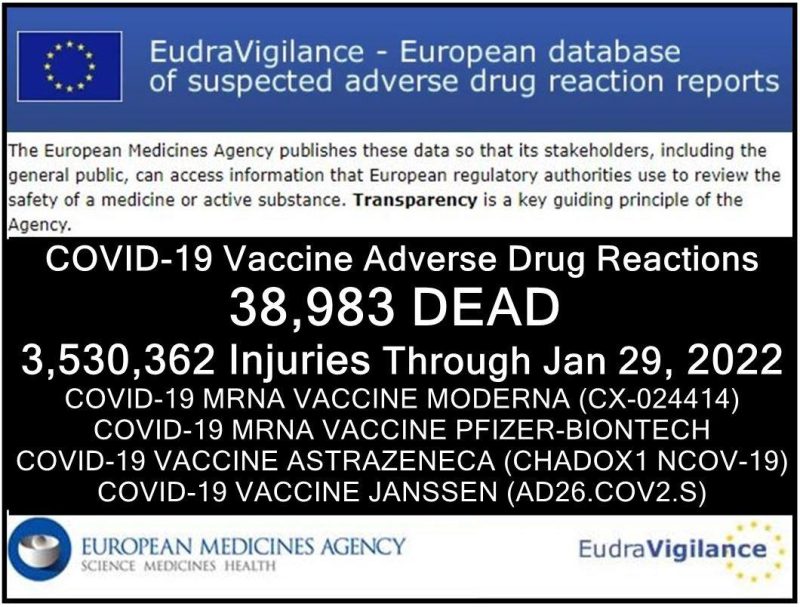
The European (EEA and non-EEA countries) database of suspected drug reaction reports is EudraVigilance, verified by the European Medicines Agency (EMA), and they are now reporting 38,983 fatalities, and 3,530,362 injuries following injections of four experimental COVID-19 shots:
- COVID-19 MRNA VACCINE MODERNA (CX-024414)
- COVID-19 MRNA VACCINE PFIZER-BIONTECH
- COVID-19 VACCINE ASTRAZENECA (CHADOX1 NCOV-19)
- COVID-19 VACCINE JANSSEN (AD26.COV2.S)
From the total of injuries recorded, almost half of them (1,672,872 ) are serious injuries.
“Seriousness provides information on the suspected undesirable effect; it can be classified as ‘serious’ if it corresponds to a medical occurrence that results in death, is life-threatening, requires inpatient hospitalisation, results in another medically important condition, or prolongation of existing hospitalisation, results in persistent or significant disability or incapacity, or is a congenital anomaly/birth defect.”
A Health Impact News subscriber in Europe ran the reports for each of the four COVID-19 shots we are including here. It is a lot of work to tabulate each reaction with injuries and fatalities, since there is no place on the EudraVigilance system we have found that tabulates all the results.
Since we have started publishing this, others from Europe have also calculated the numbers and confirmed the totals.*
Here is the summary data through January 29, 2022.
Total reactions for the mRNA vaccine Tozinameran (code BNT162b2,Comirnaty) from BioNTech/ Pfizer: 17,578 deaths and 1,704,757 injuries to 29/01/2022
- 48,240 Blood and lymphatic system disorders incl. 242 deaths
- 57,541 Cardiac disorders incl. 2,554 deaths
- 522 Congenital, familial and genetic disorders incl. 51 deaths
- 22,590 Ear and labyrinth disorders incl. 11 deaths
- 1,911 Endocrine disorders incl. 6 deaths
- 25,814 Eye disorders incl. 38 deaths
- 133,365 Gastrointestinal disorders incl. 681 deaths
- 422,360 General disorders and administration site conditions incl. 5,024 deaths
- 1,931 Hepatobiliary disorders incl. 90 deaths
- 18,455 Immune system disorders incl. 95 deaths
- 76,443 Infections and infestations incl. 1,878 deaths
- 33,972 Injury, poisoning and procedural complications incl. 331 deaths
- 42,585 Investigations incl. 502 deaths
- 11,344 Metabolism and nutrition disorders incl. 273 deaths
- 201,643 Musculoskeletal and connective tissue disorders incl. 212 deaths
- 1,629 Neoplasms benign, malignant and unspecified (incl cysts and polyps) incl. 153 deaths
- 278,744 Nervous system disorders incl. 1,859 deaths
- 2,513 Pregnancy, puerperium and perinatal conditions incl. 74 deaths
- 251 Product issues incl. 3 deaths
- 30,622 Psychiatric disorders incl. 207 deaths
- 6,150 Renal and urinary disorders incl. 266 deaths
- 68,129 Reproductive system and breast disorders incl. 6 deaths
- 72,531 Respiratory, thoracic and mediastinal disorders incl. 1,884 deaths
- 78,059 Skin and subcutaneous tissue disorders incl. 146 deaths
- 3,871 Social circumstances incl. 22 deaths
- 21,010 Surgical and medical procedures incl. 204 deaths
- 42,532 Vascular disorders incl. 766 deaths
Total reactions for the mRNA vaccine mRNA-1273 (CX-024414) from Moderna: 11,008 deaths and 543,543 injuries to 29/01/2022
- 12,365 Blood and lymphatic system disorders incl. 120 deaths
- 18,287 Cardiac disorders incl. 1,142 deaths
- 190 Congenital, familial and genetic disorders incl. 11 deaths
- 6,310 Ear and labyrinth disorders incl. 8 deaths
- 502 Endocrine disorders incl. 6 deaths
- 7,475 Eye disorders incl. 36 deaths
- 44,340 Gastrointestinal disorders incl. 413 deaths
- 145,153 General disorders and administration site conditions incl. 3,630 deaths
- 793 Hepatobiliary disorders incl. 54 deaths
- 5,370 Immune system disorders incl. 22 deaths
- 23,070 Infections and infestations incl. 1042 deaths
- 10,286 Injury, poisoning and procedural complications incl. 208 deaths
- 12,129 Investigations incl. 393 deaths
- 4,847 Metabolism and nutrition disorders incl. 263 deaths
- 66,358 Musculoskeletal and connective tissue disorders incl. 223 deaths
- 682 Neoplasms benign, malignant and unspecified (incl cysts and polyps) incl. 85 deaths
- 91,230 Nervous system disorders incl. 1,029 deaths
- 907 Pregnancy, puerperium and perinatal conditions incl. 10 deaths
- 98 Product issues incl. 4 deaths
- 9,441 Psychiatric disorders incl. 181 deaths
- 3,030 Renal and urinary disorders incl. 214 deaths
- 12,547 Reproductive system and breast disorders incl. 9 deaths
- 23,251 Respiratory, thoracic and mediastinal disorders incl. 1,162 deaths
- 27,540 Skin and subcutaneous tissue disorders incl. 96 deaths
- 2,239 Social circumstances incl. 45 deaths
- 3,028 Surgical and medical procedures incl. 203 deaths
- 12,075 Vascular disorders incl. 399 deaths
Total reactions for the vaccine AZD1222/VAXZEVRIA (CHADOX1 NCOV-19) from Oxford/ AstraZeneca: 7,977 deaths and 1,154,757 injuries to 29/01/2022
- 13,912 Blood and lymphatic system disorders incl. 278 deaths
- 20,984 Cardiac disorders incl. 830 deaths
- 235 Congenital familial and genetic disorders incl. 8 deaths
- 13,406 Ear and labyrinth disorders incl. 7 deaths
- 692 Endocrine disorders incl. 6 deaths
- 20,086 Eye disorders incl. 32 deaths
- 107,453 Gastrointestinal disorders incl. 434 deaths
- 304,993 General disorders and administration site conditions incl. 1,855 deaths
- 1,039 Hepatobiliary disorders incl. 69 deaths
- 5,409 Immune system disorders incl. 40 deaths
- 42,266 Infections and infestations incl. 620 deaths
- 13,630 Injury poisoning and procedural complications incl. 198 deaths
- 25,681 Investigations incl. 205 deaths
- 13,023 Metabolism and nutrition disorders incl. 126 deaths
- 168,174 Musculoskeletal and connective tissue disorders incl. 165 deaths
- 743 Neoplasms benign malignant and unspecified (incl cysts and polyps) incl. 40 deaths
- 234,117 Nervous system disorders incl. 1,178 deaths
- 635 Pregnancy puerperium and perinatal conditions incl. 20 deaths
- 199 Product issues incl. 1 death
- 21,051 Psychiatric disorders incl. 69 deaths
- 4,338 Renal and urinary disorders incl. 78 deaths
- 16,849 Reproductive system and breast disorders incl. 3 deaths
- 41,401 Respiratory thoracic and mediastinal disorders incl. 1,082 deaths
- 52,064 Skin and subcutaneous tissue disorders incl. 65 deaths
- 1,617 Social circumstances incl. 9 deaths
- 1,973 Surgical and medical procedures incl. 30 deaths
- 28,787 Vascular disorders incl. 529 deaths
Total reactions for the COVID-19 vaccine JANSSEN (AD26.COV2.S) from Johnson & Johnson: 2,420 deaths and 127,305 injuries to 29/01/2022
- 1,229 Blood and lymphatic system disorders incl. 51 deaths
- 2,552 Cardiac disorders incl. 204 deaths
- 40 Congenital, familial and genetic disorders incl. 1 death
- 1,319 Ear and labyrinth disorders incl. 3 deaths
- 105 Endocrine disorders incl. 1 death
- 1,656 Eye disorders incl. 10 deaths
- 9,588 Gastrointestinal disorders incl. 88 deaths
- 34,487 General disorders and administration site conditions incl. 685 deaths
- 153 Hepatobiliary disorders incl. 13 deaths
- 544 Immune system disorders incl. 10 deaths
- 8,521 Infections and infestations incl. 207 deaths
- 1,147 Injury, poisoning and procedural complications incl. 25 deaths
- 6,086 Investigations incl. 131 deaths
- 756 Metabolism and nutrition disorders incl. 60 deaths
- 17,116 Musculoskeletal and connective tissue disorders incl. 55 deaths
- 86 Neoplasms benign, malignant and unspecified (incl cysts and polyps) incl. 8 deaths
- 23,413 Nervous system disorders incl. 245 deaths
- 55 Pregnancy, puerperium and perinatal conditions incl. 1 death
- 30 Product issues
- 1,766 Psychiatric disorders incl. 22 deaths
- 535 Renal and urinary disorders incl. 31 deaths
- 2,941 Reproductive system and breast disorders incl. 6 deaths
- 4,468 Respiratory, thoracic and mediastinal disorders incl. 304 deaths
- 3,760 Skin and subcutaneous tissue disorders incl. 10 deaths
- 409 Social circumstances incl. 4 deaths
- 867 Surgical and medical procedures incl. 74 deaths
- 3,676 Vascular disorders incl. 171 deaths
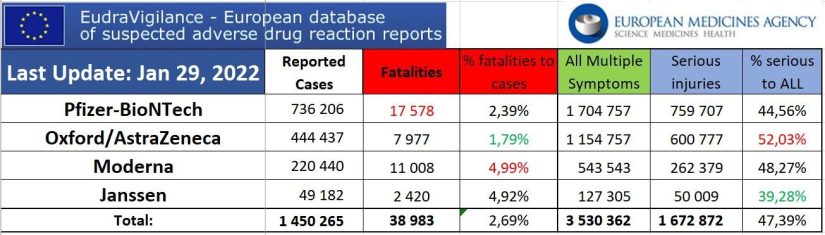
*These totals are estimates based on reports submitted to EudraVigilance. Totals may be much higher based on percentage of adverse reactions that are reported. Some of these reports may also be reported to the individual country’s adverse reaction databases, such as the U.S. VAERS database and the UK Yellow Card system. The fatalities are grouped by symptoms, and some fatalities may have resulted from multiple symptoms.
On January 29, 2021 a mass funeral protest for children who have died after receiving a Pfizer vaccine was held in Geneva, Switzerland.
Someone recorded the event and made a short video. This is on our Bitchute Channel, and also on our Telegram channel.
DATA REVEALS HIGHER COVID RATE IN THE VACCINATED
The Highwire with Del Bigtree | January 29, 2022
Scotland’s public health data has gone viral, revealing that the vaccinated are the primary drivers of the pandemic. Is this why Scotland is shifting on Covid restrictions?
The Ukraine crisis, sponsored by US hegemony and war profiteers
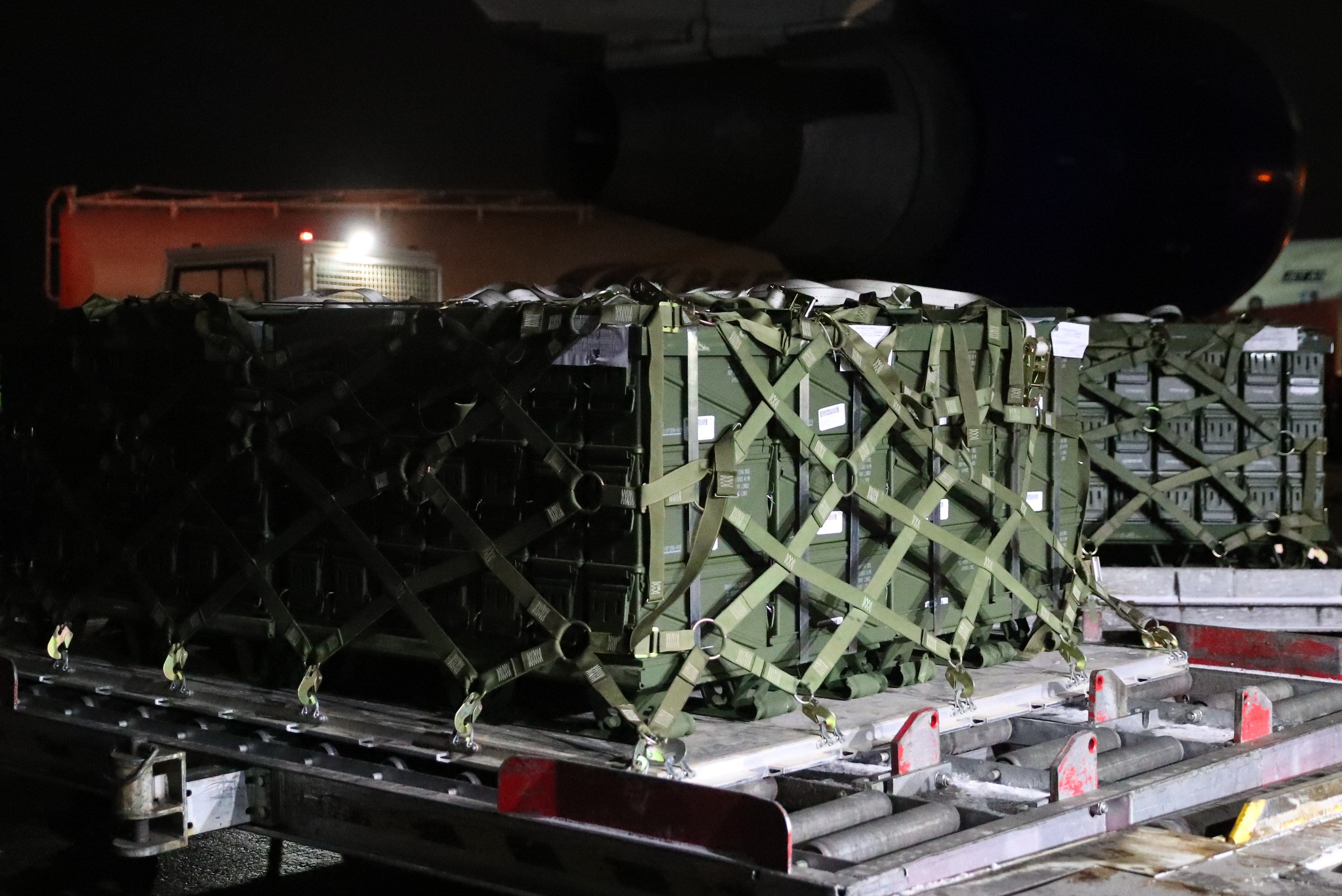
New US “lethal aid” for Ukraine, courtesy of US taxpayers and their weapons industry beneficiaries. (U.S. Embassy in Ukraine)
By Aaron Maté | January 26, 2022
The US-Russia standoff over Ukraine has sparked bellicose threats and fears of Europe’s biggest ground war in decades. There are ample reasons to question the prospects of a Russian invasion, and US allies including France, Germany’s now-ousted navy chief, and even Kiev itself appear to share the skepticism.
Another potential scenario is that Russia draws on the Cuban Missile Crisis and positions offensive weapons within the borders of Latin American allies. Whatever the outcome, the crisis has underscored the perils of a second Cold War between the world’s top nuclear powers.
If the path forward is unpredictable, what got us here is easy to trace. The row over Ukraine is the outgrowth of an aggressive US posture toward Russia since the collapse of the Soviet Union three decades ago, driven by hegemonic policymakers and war profiteers in Washington. Understanding that background is key to resolving the current impasse, if the Biden administration can bring itself to alter a dangerous course.
US principles vs. power constraints
Russia’s central demands – binding guarantees to halt the eastward expansion of NATO, particularly in Ukraine, and to prevent offensive weapons from being stationed near its borders – have been publicly dismissed by the U.S government as non-starters.
In rejecting Russian concerns, the Biden administration claims that it is upholding “governing principles of international peace and security.” These principles, Secretary of State Anthony Blinken says, “reject the right of one country to change the borders of another by force; to dictate to another the policies it pursues or the choices it makes, including with whom to associate; or to exert a sphere of influence that would subjugate sovereign neighbors to its will.”
The US government’s real-world commitment to these principles is non-existent. For decades, the US has provided critical diplomatic and military cover for Israel’s de-facto annexations, which have expanded its borders to three different strips of occupied territory (the West Bank, Gaza, and Syria’s Golan Heights). The US is by far the world leader in dictating policies to other countries, be it who their leaders should be; how little to pay minimum-wage workers; or how to share energy supplies.
The Biden administration continues to subjugate sovereign countries to its will, whether it’s “neighbors” like blockade-targeted Cuba; coup-targeted Venezuela; sanctions-targeted Nicaragua; or far-away countries like US military-occupied and sanctions-targeted Syria. Biden just recently embraced the longstanding Monroe Doctrine of a US sphere of influence by declaring Latin America to be the United States’ “front yard.”
When not making sanctimonious public pronouncements, US officials are quietly able to acknowledge the real principles that guide their actions. According to the Washington Post, one US official specializing in Russia “believes the Russians are still interested in a real dialogue.” Russia’s real aim, this official says, is “to see whether Washington is willing to discuss any sort of commitment that constrains U.S. power.”
The official added: “The Russians are waiting to see what we’re going to offer, and they’re going to take it back and decide is this serious. Is this something we [the Russians] can sell as a major victory for security, or is it just, from their point of view, another attempt to fob us off and not give us anything?”
If their public statements and actions are any guide, the Biden administration is so far opting for the latter.
Rather than focus on diplomacy, the United States’ reliable British client has been trotted out, Iraq WMD dossier-style (or Steele dossier-style, or Syria dirty war-style), to lodge the explosive allegation that Russia is plotting to install a new leader in Ukraine via a coup. While declaring that the obedient Brits were “Muscular” for shouldering the war-mongering allegation, the New York Times quietly acknowledged that they also “provided no evidence to back up” their claims.
After warning of a “false flag” operation by Russia in Ukraine, the US pulled off a stunt of its own by recalling its embassy personnel out of stated concern for their safety. Unlike the dutiful British, other US allies failed to get the memo, including the EU, which declined to follow suit and even took a pointed swipe at attempts to “dramatize” the situation.
When US officials and allied media voices permit themselves to drop “Wag the Dog” theatrics and entertain the possibility of constraining US power, the Ukraine crisis no longer appears so dangerously intractable.
In the New York Times, veteran national security correspondent David E. Sanger allows that it is “possible” that Putin’s “bottom line in this conflict is straightforward”: obtain a pledge to “stop Ukraine from joining NATO” as well as one that the US and NATO “will never place offensive weapons that threaten Russia’s security in Ukrainian territory.”
On these issues, “there is trading space,” Sanger concedes. Given that “Ukraine is so corrupt, and its grasp of democracy is so tenuous… no one expects it to be accepted for NATO membership in the next decade or two.” Accordingly, Russia could be offered “some kind of assurance that, for a decade, or maybe a quarter-century, NATO membership for Kyiv was off the table.”
In Sanger’s view, the real and “complex” issue is not Ukraine’s NATO status, but “how the United States and NATO operate” there – specifically, by flooding the country with weapons. Since 2014, Sanger writes, the US and NATO allies have provided “Ukraine with what the West calls defensive arms, including the capability to take out Russian tanks and aircraft”, a “flow that has sped up in recent weeks.” Russia – for reasons apparently foreign to Sanger – believes that these “weapons are more offensive than defensive” and “that Washington’s real goal is to put nuclear weapons in Ukraine.” An agreement to address these concerns, an unidentified US official concedes, would be “‘the easiest part of this,’ as long as Russia is willing to pull back its intermediate-range weapons as well.”
Unmentioned by Sanger is that Russia has repeatedly signaled such a willingness, including just last month: Russia’s proposed draft treaty with NATO — issued with the stated aim of resolving the Ukraine standoff — proposes that all sides “not deploy land-based intermediate- and short-range missiles” in any area that allows them “to reach the territory of the other Parties.” Also unmentioned is that such deployments were previously banned under the INF Treaty, the Cold War-era pact that the Trump administration abandoned in August 2019, to the resounding silence of Democratic lawmakers and allied media outlets more invested in pretending that Trump was a Russian puppet than in addressing his actual Russia policies.
In a bid to preserve some of the INF Treaty’s safeguards, Putin immediately offered a moratorium on the deployment of intermediate-range missiles in Europe – a proposal swiftly rejected by both Trump and NATO. (Trump’s response was again duly ignored by Russiagate-crazed media outlets and politicians, for the obvious narrative inconvenience.)
Much like its refusal so far to re-enter the Iran nuclear deal – another critical security pact torn up by Trump — the Biden administration has thus placed itself in a dangerous geopolitical standoff rather than embrace diplomacy around proposals that US officials either deem as reality anyway (Ukraine not joining NATO) or that they were once party to (the Trump-sabotaged INF treaty).
NATO expansion, from the Cold War to a Ukraine coup
If the Biden administration is now willing to accept “real dialogue” over an outcome that “constrains US power” on the Ukraine-Russia border, it will have to eschew guiding US principles since the end of the Cold War.
When he agreed to the reunification of Germany, Soviet leader Mikhail Gorbachev was “assured in 1990 that the [NATO] alliance would not expand,” Jack Matlock, Reagan and Bush I’s ambassador to the Soviet Union, recently noted. But upon entering office, Bill Clinton broke that pledge and began an expansion spree that has pushed NATO to Russia’s borders. In 2008 – against the reported advice of advisers including Fiona Hill – President George W. Bush backed a NATO declaration calling for Ukraine and Georgia’s eventual ascension.
The constant expansion of NATO has led to what the scholar Richard Sakwa calls a “fateful geographical paradox”: NATO, Sakwa says, now “exists to manage the risks created by its existence.”
Sakwa’s maxim undoubtedly applies to Ukraine, where the threat of Russia’s neighbor joining a hostile military alliance sparked a war in 2014 that continues today.
The standard narrative of the origins of the current Ukraine crisis, as the New York Times recently claimed, is that Ukrainians revolted in street protests that ousted “pro-Russian leader” Viktor Yanukovych, “prompting [Russian President Vladimir] Putin to order the annexation of the Crimean Peninsula and instigate a separatist war in eastern Ukraine.” In reality, the US backed a coup that overthrew Ukraine’s elected government and sabotaged opportunities to avoid further conflict.
The immediate background came in the fall of 2013, when the US and its allies pressured Yanukovych to sign a European Union association agreement that would have curtailed its ties to Russia. Contrary to how he is now portrayed, Yanukovych was not “pro-Russian”, to the point where he even “cajoled and bullied anyone who pushed for Ukraine to have closer ties to Russia,” Reuters reported at the time.
To sign the EU deal, Ukraine would have to accept the harsh austerity demands of the IMF, which had publicly criticized Ukraine’s “large pension and wage increases,” and “generous energy subsidies.” The agreement also contained a provision calling on Ukraine to adhere to the EU’s “military and security” policies, “which meant in effect, without mentioning the alliance, NATO,” as the late scholar Stephen F. Cohen argued.
The EU proposal, the New York Times observed in November 2013, was the centerpiece of its “most important foreign policy initiative”: an attempt to “draw in former Soviet republics and lock them on a trajectory of changes based on Western political and economic sensibilities.”
In the words of Carl Gershman, the then-head of the CIA-tied National Endowment for Democracy, “Ukraine is the biggest prize.” In Gershman’s fantasy, Ukraine’s entry into the Western orbit would redound to Russia as well. “Ukraine’s choice to join Europe will accelerate the demise of the ideology of Russian imperialism that Putin represents,” he wrote. “… Putin may find himself on the losing end not just in the near abroad but within Russia itself.”
Although it would have been a boon for DC neoconservatives, accepting the EU’s insistence on “increasing the retirement age and freezing pensions and wages” would have meant political suicide for Yanukovych. Putin capitalized by offering a more generous package of $15 billion in aid and gas subsidies, a deal that contained “no immediate quid pro quo for Russia,” the New York Times noted. To lure Yanukovych, Russia even dropped a proposal, opposed by Ukraine’s Maidan protesters, that Ukraine join a Russian-led customs union.
Putin’s Ukraine offer, the Times added, was one of “several foreign policy moves that have served to re-establish Russia as a counterweight to Western dominance of world affairs.” In the eyes of the Western domineers, the prospect of a Russian “counterweight” was an intolerable act. The US responded by ramping up support for the Maidan protests in Kiev and helping to sabotage an agreement with Yanukovych to hold new elections.
Any pretense that the US was acting as an honest broker was obliterated in early February 2014 when Russia released a recording of an intercepted a phone call between then-senior Obama official Victoria Nuland and the US Ambassador to Ukraine, Geoffrey Pyatt. The US diplomats not only selected who would be Ukraine’s next Prime Minister — Arseniy Yatsenyuk – but decided to exclude their EU allies from the process. “Yats is the guy,” Nuland declared, before adding: “Fuck the EU.”
A major tipping point in the conflict came two weeks later, on February 20th, when nearly 50 Madain protesters were massacred by snipers. The Ukrainian opposition immediately accused government forces, sparking a series of events that led to Yanukovych’s flight from the country two days later. Exhaustive research by the University of Ottawa’s Ivan Katchanovski argues that the massacre was in fact “perpetrated principally by members of the Maidan opposition, specifically its far-right elements.”
Faced with the possibility of losing Russia’s most important naval base at Sevastopol to a US-backed coup regime, Putin responded by seizing the Ukrainian territory of Crimea. Russia also provided military support to Ukrainians in the country’s Donbas region hostile to the new coup government, sparking an ongoing war between the opposing sides.
In Washington, the annexation of Crimea is widely seen as an expansionist act of aggression; even, according to Hillary Clinton, akin to “what Hitler did back in the 30s.” In Crimea, Russia had the support of the majority of the population, if polls are to be believed. The same for the Russian population, across the political spectrum. “For [Russian] politicians, not vocally supporting, let alone questioning, the annexation of Crimea is practically akin to political suicide – even for liberals,” a European Union think tank observed in 2014. Even “Anti-Putin nationalists… are enthusiastic backers of Putin’s territorial grab.” (For over 200 years Crimea had been a territory of Russia, until Nikita Khrushchev assigned it to Ukraine, then a part of the Soviet Union.)
A negotiated solution to the Donbas war has been in place since the signing of the Minsk II accords in 2015, as Anatol Lieven of the Quincy Institute for Responsible Statecraft has repeatedly stressed. The prospect of NATO expansion appears to be the pact’s main obstacle to implementation. Minsk II calls for granting autonomy to the Donbas region in return for its demilitarization. But Ukraine has “[refused] to guarantee permanent full autonomy for the Donbas”, Lieven writes, out of fear “that permanent autonomy for the Donbas would prevent Ukraine from joining NATO and the European Union, as the region could use its constitutional position within Ukraine to block membership.”
In Lieven’s view, this could change with one critical shift: “If the United States drops the hopeless goal of NATO membership for Ukraine, it will be in a position to pressure the Ukrainian government and parliament to agree to a ‘Minsk III’ by the credible threat of a withdrawal of US aid and political support.”
War in Ukraine, profit in Washington
As a result of the US drive for yet another NATO-aligned military outpost on Russia’s borders, Ukraine has been decimated. The war in the Donbas has left nearly 14,000 dead. Ukraine’s “conflict with Russia,” Denys Kiryukhin of the Wilson Center observes, is one of the major factors that “accounts for the mass outmigration of Ukrainians since 2014.” The Donbas war has encouraged a rise in far-right militancy inside Ukraine, including the notorious neo-Nazi Azov Battalion, which has directly cooperated with the US military.
The United States’ European allies are also feeling the impact of Washington’s entanglement with Russia over Ukraine. The current standoff is threatening Russia’s energy exports, which account for about one-third of the European Union’s gas and crude oil use.
“It’s going to be an incredibly hard sell in any European country, to say that you have a 10 times higher energy bill and we feel as though our supply is not plentiful enough, because of Ukraine,” Kristine Berzina of the German Marshall Fund’s Alliance for Securing Democracy, a US and NATO-funded think tank, told Axios.
The picture is much rosier for those living through the war from Washington.
“You’ve got a lot of people who see profit in this conflict… and that’s the arms industry,” retired Army colonel Douglas Macgregor, a senior Pentagon advisor under Trump, told me in a recent interview. “And the defense industrial complex sees this as an opportunity to spend a great deal of money on a whole range of armaments that they otherwise might not be able to sell.”
The arms industry has made no secret of its enthusiasm for the opportunities of NATO expansionism and the post-Maidan Ukraine market.
US arms manufacturers “stand to gain billions of dollars in sales of weapons, communication systems and other military equipment if the Senate approves NATO expansion,” the New York Times reported in March 1998. Accordingly, these arms manufacturers have made “enormous investments in lobbyists and campaign contributions to promote their cause in Washington.” At the time, the “chief vehicle” for their cause was a group called the U.S. Committee to Expand NATO. The group’s president, Bruce L. Jackson, carried out double duty: by day, the Times observed the previous year, “he is director of strategic planning for Lockheed Martin Corporation, the world’s biggest weapons maker.”
As Andrew Cockburn of Harper’s noted in 2015, Jackson’s committee was firmly bipartisan, ranging “ideologically from Paul Wolfowitz and Richard Perle… to Greg Craig, director of Bill Clinton’s impeachment defense and later Barack Obama’s White House counsel.” (Craig later became embroiled in a Ukraine corruption scandal, though he was acquitted on all charges.) Explaining his committee’s staying power in Washington, Jackson told Cockburn: “‘Fuck Russia’ is a proud and long tradition in U.S. foreign policy. It doesn’t go away overnight.”
Nor do the profits that result. Reporting in July 2017 that military stocks had reached “all-time highs,” CNBC noted that “NATO concerns about Russia are seen as a positive for the defense industry.”
So is the ongoing war in Ukraine, where the US has shipped $2.7 billion in weapons since 2014, along with 200,000 pounds of fresh “lethal aid” in recent weeks and more promised via new spending bills.
US government officials across the spectrum routinely laud these weapons shipments as “critically needed, congressionally approved military aid” to a “very fragile country fighting Russian aggression” (Progressive Caucus chair Pramila Jayapal, speaking on Democracy Now! in 2019).
Putting aside the guiding imperial and profit-driven motives, the main impact of pouring US military hardware into the Donbas conflict is to prolong it. Writing in Foreign Policy, two analysts with the Pentagon-tied think tank Rand Corporation, Samuel Charap and Scott Boston, argue that “The West’s Weapons Won’t Make Any Difference to Ukraine.” The “military balance between Russia and Ukraine is so lopsided in Moscow’s favor,” they write, that more new weapons from Washington “would be largely irrelevant in determining the outcome of a conflict.”
The authors also dispel another widely accepted bipartisan myth, that the US has been helping Ukraine resist “Russian aggression.” In reality, Russian-backed militants in the east “are mainly armed with small arms and light weapons, along with some artillery and Soviet-era armor.” Although Russsia has armed and trained its Donbas allies, “Ukraine has mainly not been fighting Russia’s armed forces” there. Instead, “the vast majority of rebel forces consist of locals—not soldiers of the regular Russian military.” The Russian military has “never used more than a tiny fraction of its capabilities against the Ukrainians,” with major military components, such as Russia’s air force, “[not] involved in the fighting at all.”
The authors also remind their US audience of another overlooked reality: the costs of a full-blown war in Ukraine “will be disproportionately borne by Ukrainians.” Should an insurgency develop, as the Biden administration is mulling, the conflict will reach a stage where “thousands—or, more likely, tens of thousands—of Ukrainians will have died.”
Those promoting such an outcome have made clear that they value NATO expansion and the attendant arms industry windfall over the lives of Ukrainians, Russians, and any others placed in the crossfire. The Biden administration can avoid ending many more lives if it can interrupt hegemony and war profiteering for a different set of principles.
Featured Video

HE SAVED LIVES. NOW HE FACES PRISON.
or go to
Aletho News Archives – Video-Images
From the Archives
NATO Sanctions and the Coming Global Diesel Fuel Disaster
By F. William Engdahl – New Eastern Outlook – 11.04.2022
Amid the ongoing global inflation crisis, NATO heads of state and mainstream media repeat a mantra that high energy prices are a direct result of Putin’s actions in Ukraine since end of February. The reality is that it is the western sanctions that are responsible. Those sanctions including cutting SWIFT interbank access for key Russian banks and some of the most severe sanctions ever imposed, are hardly having an impact on the military actions in Ukraine. What many overlook is the fact that they are increasingly impacting the economies of the West, especially the EU and USA. A closer look at the state of the global supply of diesel fuel is alarming. But Western sanctions planners at the US Treasury and the EU know fully well what they are doing. And it bodes ill for the world economy.
While most of us rarely think about diesel fuel as anything other than a pollutant, in fact it is essential to the entire world economy in a way few energy sources are. The director general of Fuels Europe, part of the European Petroleum Refiners Association, stated recently, “… there is a clear link between diesel and GDP, because almost everything that goes into and out of a factory goes using diesel.” … continue
Blog Roll
 Aletho News
- Trita Parsi: Middle East Unraveling — Are We on the Path to World War?
- Iran FM meets with US envoy on UN meeting’s sidelines at American side’s insistence: Report
- Qatar PM calls for Gulf security framework with Iran, says war must be ‘wake-up call’
- China condemns US extortion of Iranian airlines, rejects Washington’s ‘illegal’ sanctions threats
- Italy to move military personnel from Taif base after missile strike
- Finland’s Stubb tells European leaders to calm down
- Defeating Russia on battlefield impossible – Fico
- Finland’s Gender Clinic Reversal
- Massachusetts Wants Mental Health Visits, Why Does Government Use ‘Health’ to Enter Our Homes & Families?
- US lawmaker admits American people footing bill for Trump’s failed aggression against Iran
- If Americans Knew
- Sanctions are collective punishment: immoral and self-defeating
- Phosphorus Munitions Fired by Israel Burn Groves, Orchards in Southern Lebanon
- Israel Carries Out New Ceasefire Violations Across Gaza
- AI – Emphasis on the ‘I’: Israel Is Funding AI Chatbot Propaganda
- Israel Blocking Hundreds of Wheelchairs for Injured Children From Entering Gaza
- Israel Is Expanding and Upgrading Compounds for Palestinian Militias in Gaza
- The Palestinian-American Residents of This West Bank Town Are Wondering: Where Is Trump?
- Gaza desperately needs tents, wheelchairs, fuel… and everything else (Israel blocks it all) – Daily Update
- Israeli Attacks in Gaza Kill at Least Seven Palestinians Over Three Days, including Woman and Child
- Trump’s militarization of Washington DC as he pursues Israel’s war against Iran
- No Tricks Zone
- New Study: Earth And Venus Surface Warmth Largely Explained By Convection And Lapse Rate, Not CO2 Or Radiation
- 2025 Nature Paper Claiming Worsening Global Drought Gets RETRACTED …Heavily Flawed
- New Study: ‘Global Drought Shows No Detectable Recent Acceleration Under Climate Warming’
- Economic Masterminds: German Socialists Suggest Taxing Productivity Gains Stemming From Using AI
- The South China Sea Has Not Been Cooperating With The Climate Change Narrative
- Energy Crisis: Germany Enters Heating Season With Historically Low Gas Reserve Fill Levels
- New Study: The Antarctic Ice Sheet Gained Mass From 2020-2024 Due To Staggering Snow And Ice Accumulation
- Study: Ocean Heating Rates From Thousands Of Years Ago ‘Dwarf’ Modern Ocean Heating Rates
- Climate Extremists Target, Attack Large-Scale Power Grid Infrastructure In Germany!
- New Study: Antarctic Ice Melt Has Contributed Less Than 1 Centimeter To Sea Level Rise In The Last 30 Years

