Turkiye, Pakistan, Saudi Arabia Sign Memorandum on Collective Defense – Statement
Sputnik – 07.08.2026
Turkiye, Pakistan and Saudi Arabia signed a memorandum on collective defense on Friday, according to a joint statement from the countries seen by Sputnik.
According to the Turkiye newspaper, the joint defense agreement provides for cooperation in the field of intelligence sharing and regional security coordination. Turkiye’s accession to the system of strategic defense cooperation between Saudi Arabia and Pakistan, an agreement on which was signed in 2025, may become an important stage in changing the balance of power in the Middle East.
“Saudi Crown Prince Mohammed bin Salman, Pakistani Prime Minister Mohammad Shahbaz Sharif and Turkish President Recep Tayyip Erdogan signed an agreement in Mecca on collective defense, showing the countries’ shared commitment to further enhance collective security,” the joint statement said.
The purpose of the agreement is to strengthen collective deterrence of any act of aggression, the statement read.
According to the document, an attack on any of the three countries would be considered as an attack on all of them. It also implies strengthening all aspects of defense cooperation between the three countries, the statement said.
US conjoins the wars in Eurasia, West Asia
By M. K. BHADRAKUMAR | Indian Punchline | July 29, 2026
On Friday, even as the US President Donald Trump was announcing the end of the latest round of the conflict with Iran, the Pentagon unobtrusively extended the war theatre to the Caspian Sea in a hugely consequential geopolitical thrust. The incident hardly figured in the western news cycle.
But CGTN, perhaps sensing that the US could be stealthily spreading its war to the Caspian region, reported on July 25, “US missiles struck a Revolutionary Guards Navy headquarters in the Ziba Kenar area of the Caspian Sea province of Gilan, according to a security official in Gilan quoted by Iranian media. Provincial authorities said US projectiles had also struck the port city of Bandar Anzali, according to the Iranian Labor News Agency.”
Gilan province has a Caspian coastline that borders Azerbaijan in the west, with which Iran has had a troubled relationship in the recent years following the Transcaucasian region’s geopolitical gravitation towards the western orbit. Unsurprisingly, Russia’s ties with Azerbaijan and Armenia also have suffered a severe erosion following the ascendance of US (and NATO) influence in Transcaucasia.
Trump is the new sheriff in town in Baku and Yerevan with Turkey’s president Recep Erdogan playing the role of undersheriff. To add to the complexity, Azerbaijan is a close ally of Turkey, and Turkey’s ties with Moscow are somewhat under the weather in the most recent years following the covert takeover in Syria by al-Qaeda affiliates backed by Ankara.
On the other hand, Turkey has never been a reliable friend for Iran, either, historically. During the war with Iran last year, Turkey opened its air space to the US aircraft to attack Iran from Azerbaijan, which also happens to be one of Israel’s key operational bases against Iran.
Taking advantage of the Ukraine conflict, western intelligence and NATO have made big inroads into the Caucasus and Caspian regions bordering Russia’s Muslim republics and are challenging Iran’s security when it already faces an existential threat from the US-Israeli alliance.
The western media played down the US air strike on Bandar Anzali last week, which is Iran’s biggest port on the Caspian coast and is a vital transportation hub linked to Iran’s national railway grid. The Caspian Sea makes a strategically vital supply route between Russia and Iran. Bandar Anzali is for Tehran what Odessa Port is for Kyiv where it receives western arms supplies. Indeed, Iran and Russia have a close military relationship.
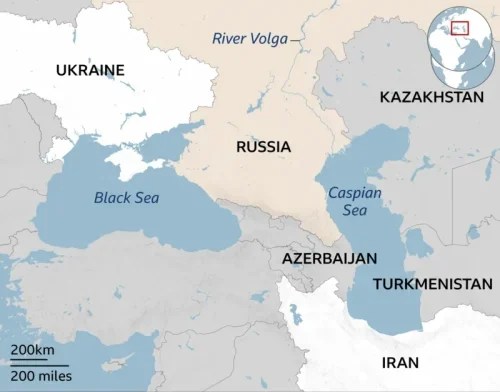
Therefore, Ukraine’s attack on an Iranian commercial vessel in the Caspian Sea in Russia’s territorial waters on Saturday, the first such attack since the start of the Russia-Ukraine war, is anything but a stray incident. Kyiv claimed responsibility for striking an Iranian vessel, signalling that one of Eurasia’s most stable security zones is now vulnerable to the direct spillover of the Ukraine conflict.
The Kremlin took note and spokesman Dmitry Peskov remarked at his daily briefing on Tuesday that the “geography of the Kiev regime’s terrorist activities is expanding.” Citing the incident, he added cryptically that all this “again highlights the need for a successful and complete special military operation.”
The attack on the Iranian ship was carried out from a distance of approximately 1,200 kilometres. Moscow has repeatedly alleged that such precise targeting over very long distances is way beyond Ukraine’s military capability and is only possible with the West’s direct participation. Foreign Minister Sergey Lavrov touched on it again on July 24: “A significant portion of the support provided to Vladimir Zelensky (from the West) comes from the United States. This is not only because the Americans sell weapons to the EU, which then transfers them to Ukraine, but also because the United States provides intelligence and reconnaissance, Starlink remains operational, and advanced technologies that require specialist expertise on the battlefield do not find their way there by accident. That is the way things are.”
Interestingly, the New York Times report on the Ukrainian attack appeared under the headline Ukraine’s Strike on an Iranian ship Could Bring Two Wars Closer. The Wall Street Journal headline runs as follows: Two Wars Converge in the Caspian Sea as Ukraine Hits Iranian Supply Line to Russia. Al Jazeera gave a further twist saying Ukraine’s Zelenskyy set to meet Trump as Iran and Ukraine wars converge. A BBC report acknowledged that “The incident marked the first direct link between the wars in Iran and Ukraine.” It added, however, “But some experts question the wisdom of Kyiv’s decision to pick a fight with Iran.”
The impact of the Iran conflict initially seemed negative for Ukraine. It threatened to divert Trump’s already wavering attention. However, there has been not only no let-up in US support for Ukraine but in certain ways, the US involvement has only intensified by escalating the covert operations in Russian territory. Admittedly, these tactical advantages may not add up eventually, as Moscow is also stepping up attacks all across the frontline in Ukraine with a view to end the war soon.
The reported likely reassignment of General Sergey Surovikin, who at one time was commander of Moscow’s war effort in Ukraine, would signal a massive offensive going forward. The highly decorated general had previously served in Chechnya and Syria during conflicts that had overtones of proxy wars similar to Ukraine.
The Ukrainian attack on the Iranian ship could well be a calibrated move by Washington. Ukraine acted simultaneously with the US bombing of Gilan province, suggesting a degree of coordination. The Iranian ambassador to Russia disclosed that the ship was hardly 5 miles from the mouth of River Volga when the attack took place.
If the Moscow-led regional concord on the Caspian’s collective security is weakened, extra-regional military and security rivalries could vitiate the region impacting Russia and Iran’s core interests. Tehran views the Caspian Sea incident not as an isolated tactical event but as evidence of a broader shift in its surrounding security environment.
Last August, US-Azerbaijan-Armenia tripartite agreement was signed in the White House that will create a major transit corridor in Transcaucasia to be named the Trump Route for International Peace and Prosperity. Plainly put, the US and NATO are seriously contesting Russia’s pre-eminence in the Caspian / Central Asian regions.
Evidently, the Caspian Sea is no longer the conflict-free zone it was once believed to be. A new arena of geopolitical competition, fundamentally reshaping the security landscape of Eurasia and potentially marking the emergence of a new geographic theatre of conflict, has surfaced last weekend.
Prevent the Great War
By Israel Shamir • Unz Review • July 24, 2026
A couple of weeks ago, in Ankara, the capital of Turkey, there was a NATO conference that sought yet more rearmament and militarization, steps that must inevitably lead to a new Great War. As an answer to this NATO conference, 200 ministers, members of parliament, ambassadors, politicians, activists, journalists, retired generals, academics, diplomats, military personnel and experts from many countries gathered in Ankara last weekend to prevent NATO’s new Great War. Among them were a few of our fellows, Unz Review writers, notably Larry Johnson and Scott Ritter.
The Alliance to Prevent the Great War concluded that the threats that could lead to a Great War originate from the United States, the EU and Israel. The US and Israeli attacks on Iran, NATO’s build-up of military power in Ukraine and the deployment of proxy forces against Russia, Israel’s genocide in Gaza and the attacks on Lebanon — these are regional wars that carry the risk of triggering a Great War.
NATO, as an instrument of US hegemony, poses a threat to world peace. The countries targeted by NATO, foremost among them Russia, do not pose a threat to Europe. The militarisation of Europe should be stopped. The course towards confrontation between NATO and Russia must be reversed. The escalation of the conflict poses a direct threat of nuclear war. Western leaders must not cross Russia’s ‘red lines’, provoke or ‘test’ the strength of the Russian people and their president. Conference participants stated that arms supply to Ukraine must cease. Further arms supply to Kiev will sooner or later lead to an expansion of military operations in Europe.
In short, the Alliance to Prevent the Great War calls for the strategic union of four states: Russia, China, Iran and Turkey, against the US, EU, and Israel. Never before has Israel been considered such an enemy – not by Russia, neither by Turkey. Putin in his first visits to Israel tried to befriend the Jewish state, saying that there are more than a million ex-Soviet citizens in Israel, speaking Russian and maintaining family ties with Russians in Russia. However, recently Israel has become a stage for anti-Russian emigres with a strong sympathy for an independent Ukrainian state. These are mainly Soviet Jews who were born in the Ukraine, or their ancestors were from the Ukraine, and it turned them towards the Ukrainian statelet of Mr Zelensky.
Many Soviet Jews were extremely pro-American. A Russian writer Viktor Pelevin wrote once that a modern cultural Jew—whether living in Moscow or New York—often faces a subconscious dilemma, unable to definitively answer whether they are primarily a patriot of Israel or a patriot of the United States. The support of Ukraine by Israel spoiled its relations with Russia, though Israel tried to hide its pro-Ukrainian stance. A Russian-Israeli journalist Artem Kirpichonok wrote (tongue in cheek) of Israel’s contributions to the Ukraine war:
1. Israeli anti-tank weapons have been transferred to Ukraine via NATO countries. With their help, a column of Russian troops near Kharkiv has already been destroyed.
2. ‘Volunteers’ – veterans of Israeli special forces – have been deployed to Ukraine. As MP Gerashchenko stated: ‘The best of the best. They, too, want to take part in the struggle of light against darkness. Shabbat Shalom!’
3. Doctors and hospitals have been deployed to assist the Ukrainian army and the civilian population.
4. 76 per cent of Israelis support Ukraine (i.e. everyone except the Arab minority)
5. The renowned Israeli thinker Yuval Noah Hariri noted in a television interview that Putin believes Ukrainians are Russians, and that only a handful of Jews who have taken over Ukraine are preventing them from pelting Russian tanks with flowers. Thus, Putin is a psychopath and an anti-Semite.
9. Religious circles emphasise the fact that Putin launched a war against the Jew Zelensky on the eve of Purim and will therefore inevitably suffer the same fate as Haman and Stalin.
Turkey was once rather friendly to Israel, but Israel’s attack on the Mavi Marmara boat that carried Turkish volunteers to Gaza spoiled it. Israel’s genocide of Gaza turned the people of Turkey against Israel, while Israeli objections to the US sale of jets to Turkey added to the enmity. And finally, Israeli officials claiming that “Turkey is the next Iran” firmly shut this door forever. Thus has Israel been doing its part to get Russia, China, Iran and Turkey together into a strategic union. Still Turkey remains a member of NATO, and President Trump calls President Erdogan “his best friend”.
Russian relations with Iran are very good, and could be described as “strategic”. The Alliance to Prevent the Great War stated: “One of the factors that undoubtedly prevented the United States and Israel from using nuclear weapons in their attacks against Iran was the nuclear umbrella provided by Iran’s partnership with Russia and China. Had a strategic alliance between Turkey, Russia, China and Iran already been established, this would have made an American-Israeli attack on Iran impossible from the outset.”
What should be done with NATO? The Alliance to Prevent the Great War ruled:
It is not the reorganisation of NATO, but its abolition, that would serve global security. European countries would thereby also be freed from the new and onerous burden imposed by the United States on NATO members.
Among interesting speakers there was Prof Dr Ulrike Guérot of Germany. A renowned political scientist, Prof Guérot presented a radical vision for the future of Europe. Arguing that NATO has completed its historical mission, Prof Guérot stated that Europe must break free from American hegemony, transition to a neutral stance, and build its future with Eurasia, particularly with Turkey. Giving extensive space to the war in the Ukraine in her speech, Prof Guérot claimed that this conflict is a proxy war that has been prepared for a long time. Criticizing NATO’s eastward expansion policies, the political scientist argued that NATO has ceased to be a security alliance and has become an element of tension, stating: “We did not tear down the Berlin Wall; we merely moved it a thousand kilometres to the East, to Kiev. We are building a rigid NATO line and dividing the European continent.”
Prof Guérot proposed a concrete model of cooperation to reduce Europe’s dependence on the United States. She argued that a strong tripartite cooperation mechanism established between Paris, Moscow, and Istanbul could build a lasting order of peace and independence on the continent.
Responding sharply to Israel’s policies toward Gaza, Prof Guérot described the silent collaboration and ongoing arms support of the European Union as a “deep shame.” Probably Israel VS Palestine is the deepest bifurcation point between the US and the rest of mankind. While the world supports Palestine, President Trump stands for Israel, and he does not care about genocide. I think it will be his undoing.
Our Scott Ritter said: “To be honest, what happened in Ankara (the NATO conference) was an affront to Turkey’s sovereignty. We must never forget that the countries gathered in Ankara are not Turkey’s friends. Not a single one of them. Neither the United States, nor France, nor Germany, nor the United Kingdom, nor other NATO members, nor Greece.”
What took place there was nothing more than a grand political spectacle. It was a large-scale political charade staged to drag Turkey into NATO’s adventure in Ukraine and to exploit Turkey’s strategic position – painstakingly built up by President Erdogan over the last decade – in Europe’s interests and to Turkey’s detriment.
People need to understand this: everything NATO does – frankly, everything the United States does – runs counter to Turkey’s interests. Because Turkey has never been a priority. Neither for the United States nor for NATO.
NATO has used Turkey for its own interests from the very first day of its accession to the alliance. Turkey was drawn into the alliance to ensure the security of NATO’s southern flank. But that task effectively came to an end with the collapse of the Soviet Union. Now they are trying to drag Turkey into an even greater quagmire: Ukraine. They want Turkey to become an active participant in a war that has dragged on for far too long, has resulted in far too many casualties, and seems unlikely to end as NATO intends – namely, with a strategic defeat for Russia.
So why did President Erdogan allow NATO’s conference to be hosted in Ankara?
I think the answer lies in the Turkish economy. I think President Erdogan was hoping to create an atmosphere of goodwill by hosting Western countries in Ankara, which could have yielded positive results for Turkey. However, I believe he will be disappointed in this regard.
On the contrary, I believe that in the coming period Turkey will continue to develop relations with Russia, China and, increasingly, Iran. This is because Turkey will realise that working together with these countries, which oppose American global hegemony and NATO’s subservient role within that hegemony, is the right path for its own future.
Larry C. Johnson said: “The Ukraine war is not simply a war between Ukraine and Russia. The West is waging a ‘NATO proxy war’, using Ukraine against Russia.”
European leaders are facing a crisis of confidence in their own countries. Examples of this include Germany’s deindustrialisation, the Volkswagen crisis and the economic downturn.
NATO’s stockpiles are depleted; factories cannot cope with the workload.
The war in Ukraine is currently ‘the most dangerous flashpoint in the world’. NATO’s preparations for direct war are increasing the risk of nuclear escalation, and Russia has reached the point where it could deploy tactical nuclear weapons.
Germany was also represented by Admiral Kay-Achim Schönbach, the man who commanded the German Navy and retired to avoid fighting Russians. He said:
My name is Kay-Achim Schönbach. I am a retired Vice-Admiral of the German Navy, and until 2022 I served as Commander-in-Chief of the German Navy.
As a citizen of a European country and as a German, I can only express my deepest concern on this matter. Not since the dark and dangerous days of the Cuban Missile Crisis have we been so close to an escalation that could lead to a major war in Europe. And I do not believe I am the only one to have reached this conclusion.
The war in Donbas, in particular, has shown us that ignoring the historical context and failing to undertake a more in-depth and, above all, impartial examination of the causes of the conflict has been one of the fundamental factors that made this armed conflict possible.
The wars in Eastern Europe could have been avoided. We know this. We all know this.
Drawing on my own experience, I can say with confidence today that diplomacy based on mutual respect and conducted on an equal footing provided all the necessary means to prevent this smouldering conflict from escalating into a full-scale war. And I do not think I am the only one who shares this view. However, we must all acknowledge that the influential players in the international system had ample opportunities to resolve this conflict. Perhaps there was no complete agreement on every detail, but they managed to prevent the conflict from spiralling out of control.
The Admiral explained this behaviour of his superiors by “moralising and misguided idealism”, in my view this is too optimistic an explanation.
The Greek journalist Dimitris Konstantakopoulos chaired one of the sessions. Konstantinopoulos stated that Europe’s sanctions against Russia are not sustainable. Issuing a warning, the Greek expert assessed the situation as follows: “Both in Ukraine and in Western Asia, we are heading towards a very dangerous situation which, if it escalates, could even lead to nuclear war. That is precisely why we must de-escalate tensions, and I fear that very few political forces in Europe realise this. This makes the situation extremely dangerous.”
The Greek expert noted that the sanctions imposed by Europe have not worked. Konstantinopoulos said: “The sanctions have proved ineffective. However, if you wish to achieve the United States’ long-term strategic objective, they have proved effective: namely, to separate Europe from Russia (and the former Soviet Union in the past) and make Europe entirely dependent on the United States. If that was the aim of the sanctions, then they have achieved it. Incidentally, I believe that the entire operation in Ukraine — by which I mean the 2014 coup, because the Ukrainian issue did not begin with Russia’s intervention in 2022 but many years earlier — all this Western aggression in the territories of the former USSR was planned. It was a pre-emptive policy aimed at preventing a potential alliance between Europe and Russia, or, as the former French Prime Minister de Villepin put it, between Europe, Russia and China.”
It takes more than a conference to stop the coming Great War. Still, the Alliance to Prevent the Great War was a very useful discussion of the possible ways to do it. And surely much better than NATO’s own conference of trial balloons for their future war crimes.
No route around Hormuz: Why West Asia’s pipeline alternatives fall short
The rush to bypass Hormuz leads back to the same problem: Every alternative route remains hostage to war, rival chokepoints, or political disputes.
By Hussein Askary | The Cradle | July 23, 2026
“The only alternative to the Strait of Hormuz is the Strait of Hormuz.”
This blunt assessment, offered by an Iraqi expert in a recent interview, captures the central weakness in the rush to revive old pipeline schemes and promote new ones across West Asia. Since Iran effectively closed the Strait of Hormuz after Israel and the US launched their second war against it in February 2026, the region has been flooded with proposals for alternative oil-export routes.
Washington has encouraged these plans, while several governments have presented dormant or unfinished pipelines as strategic solutions. Yet the closer one looks at geography, markets, costs, capacity, and security, the clearer it becomes that most of these projects cannot substitute for Hormuz.
Even if oil bypasses the strait, it still faces the rival chokepoint of Bab al-Mandab, where the Ansarallah-aligned armed forces have declared a maritime blockade against Saudi Arabia and attacked Saudi tankers.
These expensive detours will remain exposed unless security in the Persian Gulf itself improves. Until the war on Iran ends and an inclusive regional security architecture is established, Iranian and Yemeni missiles and drones can reach the pipelines and loading terminals built to evade them.
Asia still runs through Hormuz
The first reason is straightforward. The Strait of Hormuz is the natural outlet of the Gulf energy system. In 2024, oil flows through the strait averaged about 20 million barrels per day (bpd), roughly one-fifth of global petroleum liquids consumption. The International Energy Agency (IEA) describes it as one of the world’s most important oil transit chokepoints.
Most of this oil is not heading west. About 80 percent of the oil moving through Hormuz is destined for Asia, with China, India, Japan, South Korea, and other Asian economies as the principal buyers. The pattern is even clearer for liquefied natural gas (LNG).
The US Energy Information Administration estimated that 83 percent of LNG moving through Hormuz in 2024 went from Persian Gulf exporters to Asian markets, especially China, India, and South Korea.
This market reality matters because many proposed alternatives send oil away from its main customers. Pipelines to the Mediterranean, the Red Sea, or the Levant may appear useful on a map, but they often move Gulf crude farther from Asia rather than closer to it.
Commercially, building multibillion-dollar infrastructure to move oil westward, only to redirect it by sea toward Asian markets, is inefficient. If Hormuz is open, the direct route remains cheaper and faster. If it is closed by war, the underlying problem is not a lack of pipelines but the collapse of regional security.
Old routes, unresolved disputes
The older pipeline options illustrate the point. The Kirkuk–Baniyas pipeline once carried Iraqi oil across Syria to the Mediterranean. Built in the early 1950s, it had genuine strategic value in its time but has been largely inactive since it was damaged during the 2003 US-led invasion of Iraq. Washington is now backing efforts to revive the route, with US companies expected to play a role. Yet the project still requires extensive reconstruction and years of work before it can provide meaningful export capacity.
Estimates for a full restoration and expansion to around 700,000 bpd run as high as $8 billion. It cannot answer an immediate crisis in Hormuz, and if regional peace is restored before completion, the commercial case for reviving it weakens sharply.
The Iraq–Turkiye pipeline faces a different but equally serious problem: politics. The route through the Kurdistan region to Turkiye’s Mediterranean port of Ceyhan was repeatedly interrupted by disputes among Baghdad, the Kurdistan Regional Government (KRG), Ankara, and international oil companies.
A 2023 arbitration ruling against Turkiye over unauthorized Kurdish exports led to a two-and-a-half-year shutdown. Flows resumed in September 2025, and exports have continued, but the route still depends on fragile agreements over contracts, payments, federal authority, and revenue sharing.
Its limited throughput and political vulnerability prevent it from becoming a structural replacement for a maritime passage that normally carries a vast share of the world’s seaborne oil.
The Iraqi pipeline in Saudi Arabia, known as IPSA, is another example of strategic nostalgia. Built in the 1980s during the Iran–Iraq war, it was designed to move Iraqi crude from the Basra region to the Red Sea.
It stopped operating after Iraq’s 1990 invasion of Kuwait, and Saudi Arabia expropriated it in 2001. Reopening the line would therefore require a Saudi–Iraqi political settlement over ownership and control, as well as a major technical assessment after decades of disuse. In other words, IPSA is not an available alternative; it is a diplomatic and engineering problem dressed up as a solution.
The proposed Basra–Aqaba pipeline is even more controversial. Its advertised purpose is to move Iraqi oil from southern Iraq to Jordan’s Red Sea port of Aqaba, bypassing Hormuz. Yet it has faced intense objections inside Iraq because of its projected cost, uncertain financing, and questionable strategic value.
Since much of Iraq’s crude is sold to Asian customers, sending it westward to Aqaba would add distance and complexity rather than solve the basic market problem. The pipeline would also move Iraqi exports closer to another zone of instability, including the Israeli military sphere and the wider Red Sea security environment.
A bypass route that merely exchanges one security risk for another is no solution. Iraq’s severe fiscal pressures also leave Baghdad poorly placed to finance such an expensive project, while international investors are unlikely to embrace it without strong political and security guarantees.
Bypasses within missile range
The existing Saudi and Emirati bypasses are more credible but still limited. Saudi Arabia’s East–West Pipeline, or Petroline, moves crude from the eastern oil region to Yanbu on the Red Sea. The UAE’s Abu Dhabi Crude Oil Pipeline carries oil from Habshan to Fujairah on the Gulf of Oman.
These systems reduce exposure to Hormuz for Saudi Arabia and the UAE and have become important national energy-security assets. But they cannot replace the strait for the region as a whole. They offer little to Kuwait, Qatar, Bahrain, Iran, or most Iraqi exports, and they do not solve the LNG problem, especially Qatar’s dependence on Hormuz.
The IEA estimates that only 3.5 to 5.5 million bpd of spare pipeline capacity is available to bypass the strait. Neither Yanbu nor Fujairah are immune from attack; regional conflict has already shown the vulnerability of ports, tankers, and energy infrastructure.
The crisis pipelines cannot solve
This is why the alternative pipeline debate is misleading. It treats the closure of Hormuz as a logistical puzzle when it is primarily a political and security crisis. If the Persian Gulf remains militarized and unstable, no pipeline network can fully protect exports.
Pipelines cross vulnerable territory, depend on political agreements, and terminate at ports that can also be threatened. If Gulf security improves, however, Hormuz will almost certainly reopen because this serves the interests of producers and Asian consumers alike.
Once that happens, the commercial rationale for many alternative pipelines will fade. Why spend tens of billions of dollars duplicating a natural route with unmatched capacity and direct access to the main buyers?
The more honest conclusion is that alternative pipelines may offer limited resilience for individual states, but they are no strategic replacement for Hormuz. They are costly, slow, politically fragile, geographically inefficient, and in some cases obsolete before construction begins.
The answer to the crisis is a security arrangement that keeps the Persian Gulf open, prevents attacks on shipping, and restores normal trade through the strait.
Under such an arrangement, oil and LNG would continue to flow mainly to Asia by the most direct and economical route. Hormuz will remain indispensable, while the grand pipeline alternatives amount to expensive insurance policies against a crisis that only diplomacy and regional peace can resolve.
Pakistan, Kuwait hold early talks on defense-for-energy partnership
The Cradle | July 17, 2026
Pakistan and Kuwait have entered early-stage negotiations to expand defense cooperation, with Islamabad seeking deeper energy ties and greater investment from the Gulf monarchy in return, Reuters reported on 17 July.
“Kuwait’s wish list includes everything,” said a Pakistani security official familiar with the negotiations. “But let me be clear about one thing: We are not and we cannot consider a deployment of combat troops at this stage.”
One source confirmed the talks have covered defense procurement, but noted it was “not clear this will amount to a defense pact per se.”
In exchange for any deal, Islamabad wants expanded cooperation on energy security as it builds up its strategic oil and fuel reserves as part of a wider initiative led by Pakistan’s Energy Ministry.
Over the past year, Pakistan and the Gulf monarchies have moved toward new regional defense arrangements.
The realignment was accelerated by the US’s war on Iran, which saw Gulf countries absorb the brunt of the retaliatory impact, and called into question the reliability of the US as a defense partner.
Meanwhile, Islamabad commands one of the region’s largest armies and manufactures its own fighter jets, credentials that have positioned it as a potential supplement, or even alternative, to US protection.
For Kuwait, Pakistan represents a dependable partner, according to a source in the region familiar with Kuwaiti security planning.
“They are already in with the Saudis, they have a long history of defense development, they are Muslim Sunni, they have a good relationship with the Americans, so it’s not as sensitive as some other options,” the source said.
Turkiye, Pakistan, and Saudi Arabia have been preparing a draft agreement for a three-way mutual defense pact, distinct from the existing accord between Islamabad and Riyadh.
Bahrain is pursuing a similar arrangement, one source said, while Jordan has signaled interest in a weapons and training deal.
Last year, Saudi Arabia and Pakistan signed a Strategic Mutual Defense Agreement committing each to treat an attack on one as an attack on both – a pact widely understood to place Riyadh under a de facto Pakistani nuclear umbrella, after Pakistan’s defense minister said all the country’s capabilities “will be made available under this agreement.”
US Strategy and the shift to NATO 3.0
A shorter declaration masks deeper tensions, as Washington pushes to reshape NATO’s role from Europe to West Asia and Asia-Pacific.
By Mehmet Ali Guller | The Cradle | July 11, 2026
The six-point final declaration of the NATO Ankara Summit is among the shortest in recent years, similar to last year’s five-point declaration from The Hague. In contrast, the 2021 Brussels Summit declaration contained 79 points, Madrid in 2022 had 22, Vilnius in 2023 included 90, and Washington in 2024 featured 38.
The sharp reduction reflects ongoing tensions between the US and Europe. The declaration is brief because areas of agreement remain limited. The debate over NATO as a “paper tiger” has not been resolved, only set aside.
In the declaration, this issue is temporarily addressed through the slogan “a stronger Europe in a stronger NATO.”
Ankara Declaration targets Russia and Iran
The first article of the six-point Ankara declaration reaffirms commitment to Article 5 of the Washington Treaty, while the final article offers thanks to the host country.
The remaining four articles center on Russia, outline a $70 billion support package for Ukraine, expand defense spending, reference $50 billion in arms deals, and briefly touch on Iran.
The Donroe Doctrine and NATO 3.0
Washington is seeking to adapt NATO to what it frames as a new strategic phase, described here as NATO 3.0. The so-called Donroe Doctrine centers on consolidating dominance in the Western Hemisphere, shifting more responsibility onto allies in Europe and elsewhere, and encircling China in the Asia-Pacific through partnerships.
In practice, this takes three forms:
- Europe assumes primary responsibility for its own security, including taking the lead in supporting Ukraine against Russia.
- A new order is established in West Asia under Israeli hegemony, requiring normalization between NATO member Turkiye and Israel, as well as between Israel and Syria and the Gulf states, while weakening Iran as the principal obstacle.
- NATO deepens cooperation with its Asia-Pacific partners—the IP4 countries: Japan, South Korea, Australia, and New Zealand—integrating them into its arms supply chain and gradually extending NATO’s reach into Asia.
The political economy of NATO 3.0
Washington views militarization as the lever for the transformation of NATO 3.0. It has two key objectives: raising NATO members’ defense spending to 5 percent of GDP and building a new arms production chain. The first step was initiated in The Hague last year, and the second advanced in Ankara.
Pushing defense spending to 5 percent would generate a vast financial pool within a few years. Including NATO partners such as Japan would further expand the scale, creating a market that draws broad interest. The US aims to distribute this pool in a way that sustains the NATO 3.0 framework.
Alongside this sits the effort to construct a new arms supply chain. The approach is to retain control over core components while distributing subcomponent production across allies, linking them to one another and ultimately to Washington.
The $50 billion arms deals referenced in the declaration mark an initial step. The $10 billion NATO–South Korea agreement, which grants Seoul access to NATO’s joint defense procurement market, fits within this model.
A new military-industrial economy
For the Erdogan government, securing a share of expanding defense spending has become a priority. Ankara sees this as an opening for its defense sector, particularly through the state firm ASELSAN and the private company BAYKAR.
The Defense Industry Forum, long held as a side event at NATO summits, was included in the official program in Ankara for the first time, reflecting that shift.
Countries seeking a share of this expanding market and Washington’s effort to allocate that share in line with its strategy have converged.
The idea of a NATO Defense Bank is also on the agenda. Nine countries laid its groundwork during the Ankara summit. If realized, it would tie a military-industrial model more closely to financial capital.
Turkiye 3.0: NATO’s central frontline state
For Turkiye, NATO 3.0 also signals a new phase.
NATO 1.0 covers the period from the alliance’s founding to the collapse of the Soviet Union in 1991. In that time, Turkiye was integrated into US strategy, diluting its founding emphasis on independence and anti-imperialism, eroding aspects of its secular character through the Green Belt project, and absorbing its human capital within anti-communist programs.
NATO 2.0 spans the period from 1991 to 2026. In these years, NATO expanded toward Russia, dismantled Yugoslavia, and intervened across West Asia. Turkiye’s role was again shaped within US strategy, this time through “moderate Islamism.”
NATO 3.0 is defined by Europe taking on security responsibility against Russia, the pursuit of a West Asian order under Israeli dominance, and a strategic shift toward the Asia-Pacific.
Within this framework, Turkiye is positioned as a security enforcer for Europe, encouraged to normalize relations with Tel Aviv to secure a place in the regional order, and drawn into efforts aimed at countering Iran.
In effect, Turkiye is being placed at the center of NATO’s frontline. The naval command under construction in the Bosphorus is directed toward Russia, while the new NATO Corps headquarters in Adana is oriented toward West Asia and Iran.
Washington’s ‘Asian NATO’ objective
NATO Secretary General Mark Rutte effectively represents US leadership within the alliance. His statements reflect Washington’s position rather than Europe’s.
His remarks before and during the summit pointed to a longer-term objective. Rutte argued that Russia was working closely with North Korea, China and Iran, adding that NATO “cannot be naive” and had to remain united.
At its core, NATO 3.0 reflects an effort to use the alliance first against Beijing’s partners—Russia and Iran—and, over time, against China itself. The push to reorient NATO toward Asia follows from this.
For the past four years, leaders of the IP4 countries have been invited to NATO summits. In Ankara, discussions with these states focused on expanding cooperation in defense industries and advanced technologies.
Washington is pressing these partners toward closer military alignment, at times resembling a sub-alliance—an “Asian NATO.” Proposals to open a NATO liaison office in Tokyo—though contested, notably by France—form part of this effort.
Washington, however, has continued to push for a broader NATO role in Asia. As Rutte put it, “The security of the Euro-Atlantic and the Indo-Pacific are closely interconnected,” reinforcing efforts to extend the alliance’s focus beyond its original geographic remit.
Expectations from NATO 3.0
Following the Ankara Summit, NATO 3.0 is expected to serve different priorities:
- For the US: aligning NATO with its Asia-Pacific strategy.
- For Europe: maintaining US involvement in European security even as direct support shifts.
- For Turkiye: expanding a military-industrial growth model.
For countries across the Global South, NATO is widely viewed as an outdated military alliance whose role has run its course.
Türkiye sells S-400 systems to undisclosed Gulf state
Al Mayadeen | July 10, 2026
Türkiye has sold its S-400 air defense systems to an unnamed Gulf country, with the announcement expected to be made on Friday.
Turkish newspaper, Hürriyet journalist Abdulkadir Selvi reported that an informed source told him Ankara finalized the sale of its S-400 systems after a deal was approved overnight on Friday.
He added that the speculated buyers are either the UAE or Qatar, noting that the information will remain unknown until an official statement is made.
Selvi noted that the US assets in the UAE being targeted by retaliatory Iranian strikes during the war on Iran were a cause for wanting an increased air defense presence. He added that the attacks “crippled the UAE’s tourism-based system,” adding that it “has been trying to acquire alternative defense systems” after the Iranian retaliation.
He also brought up the Israeli attack on Qatar last year as a significant reason why Doha may want new air defense systems, as Qatar’s Patriot missile system did not activate during the attack on the Hamas officials in the capital city due to “Israel” being coded as a friendly country.
“Qatar learned from this shock attack that it was unprotected against Israel,” Selvi said.
The Hürriyet journalist reported that regardless of which Gulf state the S-400 goes to, Türkiye seeks to gain freedom from US sanctions from the sale.
Ankara is currently a target of the American sanctions package, Countering America’s Adversaries Through Sanctions Act (CAATSA), which mandates penalties for entities that participate in “significant transactions” with the Russian defense or intelligence sectors.
The sale of the Russian-made S-400 systems could give Türkiye the break it needs to relieve itself of these sanctions that have barred it from the F-35 fighter jet program.
It is worth noting that US President Donald Trump signaled at returning Türkiye to the F-35 fighter jet program after a years-long ban, which caused tears in the relationship between Ankara and Washington.
Explainer: Which foreign delegations attended the funeral of martyred Leader of the Islamic Revolution?
Press TV – July 4, 2026
The funeral ceremony for the martyred Leader of the Islamic Revolution, Ayatollah Seyyed Ali Khamenei, brought together one of the largest gatherings of foreign dignitaries in Iran in recent decades, with representatives from across Asia, Africa, Europe, the Americas, and major international organizations attending the event in Tehran.
The delegations included presidents, prime ministers, parliamentary speakers, foreign ministers, senior government officials, political leaders, and representatives of religious organizations and resistance movements, underscoring the broad international participation in the ceremony.
Asia
Asia accounted for the largest share of official delegations.
From West Asia, Iraq sent one of the largest delegations, including Kurdistan Region President Nechirvan Barzani, Parliament Speaker Mahmoud al-Mashhadani, senior officials, and representatives of the Popular Mobilization Forces (PMF).
Saudi Arabia was represented by Deputy Foreign Minister Waleed Al-Khuraiji, while Oman sent the chairman of its State Council and Qatar was represented by Parliament Speaker Hassan bin Abdullah Al Ghanim.
Shia community representatives also attended from Bahrain and several other Persian Gulf countries.
Lebanon dispatched Defense Minister Michel Menassa alongside senior delegations from Hezbollah and the Amal Movement.
Yemen was represented by Vice President Mahmoud al-Junaid and an Ansarullah delegation.
Palestinian groups also attended, including senior Hamas leaders and Islamic Jihad Secretary-General Ziyad al-Nakhalah.
From the wider Asian region, Pakistan sent one of the highest-level foreign delegations, headed by Prime Minister Shehbaz Sharif and Army Chief Field Marshal Syed Asim Munir. The delegation also included the Senate speaker, senior government officials, and religious leaders.
Afghanistan was represented by delegations from the Taliban administration and the Afghan resistance.
India sent a special government envoy at the deputy foreign minister level.
China was represented by He Wei, Vice Chairman of the Standing Committee of the National People’s Congress.
Tajik President Emomali Rahmon attended the ceremony in person, while Armenia was represented by Prime Minister Nikol Pashinyan. Georgia sent President Mikheil Kavelashvili along with a Muslim delegation.
Türkiye dispatched Vice President Cevdet Yılmaz, together with political and party representatives.
Turkmenistan was represented by Gurbanguly Berdimuhamedow, Chairman of the People’s Council and National Leader.
Among other participants were Azerbaijan’s parliament speaker, Kazakhstan’s foreign minister; the parliamentary speakers of Kyrgyzstan, Uzbekistan, Bangladesh, and Sri Lanka; Thailand’s deputy prime minister; Malaysia’s agriculture minister; Myanmar’s special envoy; and official delegations from South Korea and North Korea.
Africa
Several African governments were represented by ministerial- or cabinet-level delegations.
Egypt sent its Senate speaker.
South Africa, Burkina Faso, the Democratic Republic of the Congo, Namibia, Tanzania, and Tunisia all sent official representatives.
Nigeria and Senegal also dispatched delegations to participate in the funeral ceremonies.
Europe and the Americas
Russia sent Dmitry Medvedev, Deputy Chairman of the Russian Security Council, as President Vladimir Putin’s special representative.
Belarus was represented by its parliament speaker, while Serbia sent its communications minister. Bulgaria also dispatched parliamentary and political representatives.
Germany was represented by members of the country’s Shia community.
From Latin America, Cuba sent its higher education minister as a special representative, while Nicaragua was represented by Foreign Minister Valdrack Jaentschke.
International organizations
The ceremony also drew senior representatives of several international organizations.
The Shanghai Cooperation Organization (SCO) was represented by Secretary-General Nurlan Yermekbayev, while the Organization of Islamic Cooperation (OIC) sent Deputy Secretary-General Tariq Ali Bakheet.
The D-8 Organization for Economic Cooperation and the Economic Cooperation Organization (ECO) were represented by their respective secretaries-general.
Israel furious at Trump over Turkey, Syria to invade Lebanon – w/ Col. Macgregor
Mario Nawfal | June 26, 2026
Israel Brings The War Rhetoric Towards Türkiye
After Being Defeated In Iran, Israel Targets Türkiye.
By Justin K.P. – The Dissident – June 22, 2026
The idea of Israel going to war with Türkiye- a NATO member- potentially triggering World War III seems insane.
And yet Israel is using their war rhetoric towards Türkiye.
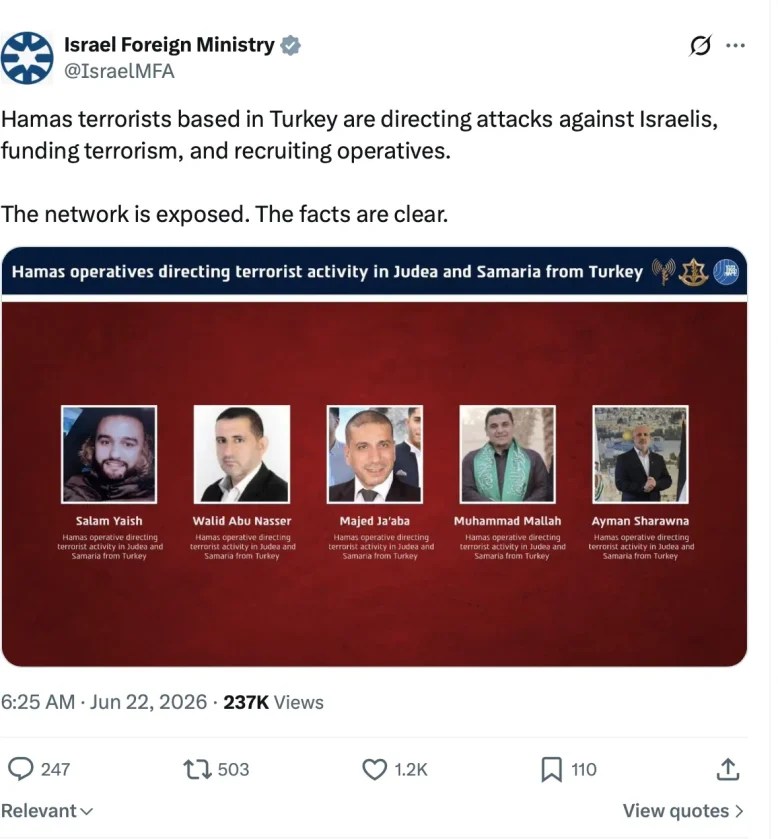
The Israeli Foreign Ministry put out a post seemingly laying the groundwork for an Israeli war, claiming that “Hamas terrorists based in Turkey are directing attacks against Israelis, funding terrorism, and recruiting operatives. The network is exposed. The facts are clear.”
This is far from the first time Israel has used war rhetoric towards Türkiye.
Israel’s Minister of Diaspora Affairs Amichai Chikli recently said that Israel “will be at war with Syria sooner or later” in part because he called Syria “a Turkish protectorate”.
He also fabricated a new “radical Sunni axis of evil” which supposedly includes Pakistan, Turkey and Qatar.
Middle East Eye reported:
“What we are witnessing before our eyes is the rise of a new axis,” Chikli told 103FM radio on Wednesday, referring to Turkey, Qatar and Pakistan. He described this so-called alliance as “a radical Sunni axis of evil, more dangerous than anything we have seen before”.
While Chikli mentioned both Qatar and Pakistan in his interviews, he mainly focused on Turkey, branding Turkish President Recep Tayyip Erdogan’s vision “an extremely dangerous combination for us”.
Other members of the ruling Israeli Likud party have similarly been declaring Türkiye “an enemy state”.
Middle East Eye noted, “Last week, Israeli lawmaker Ariel Kellner, also of Likud, called Turkey an ‘enemy state’, while Culture and Sports Minister Miki Zohar said last month that Israel’“must begin to treat Turkey as an enemy state,’ suggesting that Turkey would suffer heavy blows in a possible conflict with Israel.”
It added that “In February, former prime minister Naftali Bennett indicated that he sees Turkey as an enemy, with the opposition figure stating: ‘Turkey is the new Iran.’”
Perhaps the most concerning development is the fact that the Foundation for The Defence of Democracies (FDD), an Israeli lobby cutout that played a large role in the U.S. war on Iran, has begun publishing articles using similar rhetoric towards Türkiye.
FDD put out an article titled , “Turkey the new Iran? Ankara’s growing challenge to Western interests”.
The article attempted to label Türkiye as the “new Iran”, writing:
As Iran and its proxies take a beating from American and Israeli forces, observers are questioning whether Turkey is waiting in the wings to emerge as the region’s next “bogeyman.” The answer is likely yes, albeit in its own form.
Turkey is not Iran, but depicting Turkey as a nuisance or simply “complicated” only emboldens a maturing adversarial regime with an established track record of undermining its Western allies.
The article attempted to ratchet up hostilities between Türkiye and the United States, writing, “The real question is whether Turkey is actively undermining US, NATO, and regional security interests. There is little doubt that Ankara is doing just that, and doing so more brazenly with the passage of time.”
It also lamented that Türkiye is too supportive of the Palestinian resistance, writing “Hamas, as an Iranian proxy, has served Ankara’s interests in undermining Israel’s security interests, something which Turkey would like to see intact after the end of the current war.”
FDD has similarly put out articles pushing for the U.S. to put sanctions on Türkiye, saying that “Washington should pursue Global Magnitsky sanctions against targets in Turkey” and that “the United States should utilize Global Magnitsky authorities to target Turkish individuals responsible for human rights violations”.
It also called for the U.S. to designate “government officials” in Türkiye as “terrorist organizations” and wrote that “The United States should protect the international financial sector by recommending added scrutiny and screening to transactions involving Turkish financial institutions” and that “Washington should coordinate with the G7 to return Turkey to the Financial Action Task Force (FATF) ‘grey list’ until further improvements are seen in combating terrorism financing.”
The Carnegie Endowment for Peace documented that “FDD was the brainchild of a New York Times journalist-turned-Republican operative, Clifford May,” adding that “it arose out of an organization committed to burnishing Israel’s reputation in the United States. On April 24, 2001, three major pro-Israel donors incorporated an organization called EMET (Hebrew for ‘truth’). In an application to the Internal Revenue Service for tax-exempt status, May explained that the group ‘was to provide education to enhance Israel’s image in North America and the public’s understanding of issues affecting Israeli-Arab relations.’ But in the wake of the Sept. 11 attacks, May broadened the group’s mission and changed its name to the Foundation for Defense of Democracies. As he explained in a supplement to the IRS, the group’s board of directors decided to focus on ‘develop[ing] educational materials on the eradication of terrorism everywhere in the world.’”
It added that, “FDD’s chief funders have been drawn almost entirely from American Jews who have a long history of funding pro-Israel organizations. They include Bernard Marcus, the co-founder of Home Depot, whiskey heirs Samuel and Edgar Bronfman, gambling mogul Sheldon Adelson, heiress Lynn Schusterman, Wall Street speculators Michael Steinhardt and Paul Singer, and Leonard Abramson, founder of U.S. Healthcare.”
Sima Vaknin-Gil, a former Israeli military intelligence officer, in the Al Jazeera documentary The Lobby, admitted that “We have FDD” and that “the foundation is ‘working on’ projects for Israel, including ‘data gathering, information analysis, working on activist organizations, money trail. This is something that only a country, with its resources, can do the best”.
FDD played a huge role in shaping American policy towards Iran at the behest of Israel.
Now, as Israel calls Türkiye an “enemy state”- the FDD has begun pushing Washington to place sanctions on the country and designate government officials as terrorists, laying the groundwork for a new Israeli war.
Syria, Lebanon, and the limits of power
By Bassam Abu Abdallah | The Cradle | June 19, 2026
Remarks by US President Donald Trump in an interview with NBC News earlier this month, in which he said he would like to see “a more precise surgical attack on Hezbollah” and suggested that Syria’s Ahmad al-Sharaa (formerly known as Abu Mohammad al-Julani) could play a role in reaching an agreement over the conflict in Lebanon, have revived a familiar question across the region.
Trump later escalated his rhetoric, saying that if Israel “can’t do the job without killing everyone else, Syria should do the job.” Describing the war on Lebanon as a secondary front, he suggested that Syria, in coordination with the US, could take on Hezbollah if Israeli Prime Minister Benjamin Netanyahu could not be reined in.
Whenever the region enters a period of major change, the same issue resurfaces. Can Syria once again play a direct security or military role in Lebanon, as it did in 1976?
The comparison is tempting on the surface. It invites parallels between the current leadership in Damascus and the late president Hafez al-Assad, who sent Syrian forces into Lebanon during the civil war. Yet even a brief look at the surrounding conditions suggests that the resemblance is largely superficial.
Trump himself did not clarify what form of assistance he had in mind. The possibilities range from border control and curbing smuggling routes to a broader attempt to pressure Hezbollah.
An old question returns
Similar ideas have surfaced before. In a July 2025 interview with The National, US envoy Tom Barrack warned that Lebanon faced an “existential threat” if it failed to address Hezbollah’s weapons, adding that “if Lebanon doesn’t move, it’s going to be Bilad Al Sham [Greater Syria] again.”
In March, Reuters reported that Washington had encouraged Syria to consider sending forces into eastern Lebanon to help disarm Hezbollah, a claim later denied by Barrack. The episode nevertheless fueled speculation about a possible Syrian role in Lebanon.
The responses from Sharaa’s government, however, have remained cautious and indirect. Sharaa has expressed support for Lebanese President Joseph Aoun’s efforts to consolidate arms under state authority, while recent exchanges with Lebanese Prime Minister Nawaf Salam have emphasized coordination between military and security institutions in both countries.
Syria’s self-appointed president and former Al-Qaeda chief Ahmad al-Sharaa dismissed reports that Syrian forces could enter Lebanon as “rumors.”
At the same time, periodic announcements from Syrian authorities about dismantling alleged Hezbollah-linked cells have been interpreted by some observers as signals aimed at Washington, suggesting readiness to engage if political backing is secured. Whether this reflects a concrete agreement or simply an attempt to keep options open remains unclear.
What is clear is that the renewed discussion comes at a moment when broader regional balances are in flux, particularly after the collapse of the previous Syrian order. The question is not whether Syria once intervened in Lebanon, but whether the conditions that made that intervention possible still exist.
1976 and the architecture of intervention
By the time Syrian forces entered Lebanon in 1976, the civil war had pushed the state to the brink. Importantly, the intervention took shape within a web of regional bargains and international understandings, rather than a unilateral move by Damascus.
The move was carried out at the request of the Lebanese president at the time, Suleiman Frangieh, and was supported by influential Lebanese actors who feared a decisive shift in the internal balance of power. It also aligned with broader concerns shared by regional and international players who were wary of Lebanon descending into total disorder.
Accounts in both western and Arab sources point to quiet understandings between the US, Saudi Arabia, and France that gave Syria space to act as a stabilizing force. The objective was about containing a crisis that risked spilling beyond Lebanon and unsettling the wider region.
The intervention was later formalized through the Arab Deterrent Forces (ADF), which provided a measure of regional legitimacy under the umbrella of the Arab League. This layer of political cover mattered as much as the military dimension.
Equally important was the nature of the Syrian state itself at the time. Syria in 1976 was a cohesive political entity with functioning institutions and a professional army that ranked among the largest in the region. Assad’s leadership carried both domestic and international recognition, reinforced by the aftermath of the 1973 war.
From Assad’s perspective, Lebanon was not a distant arena but an extension of its own security environment. The prospect of a hostile force dominating Lebanon was treated as a direct threat to Syrian national security.
Even so, the intervention was not without tension. The Soviet Union, Syria’s principal ally, expressed reservations, reflecting its own alignment with other forces inside Lebanon. Assad nevertheless proceeded, guided by his assessment of Syria’s strategic interests.
The ability to make such a decision rested on a combination of factors: a stable state, a centralized leadership, a disciplined army, regional acceptance, and working relationships with key Arab actors. Together, these elements created a framework that made intervention both possible and, for a time, sustainable.
A different Syria
None of these conditions applies in the same way today. The current leadership in Damascus operates from a transitional position, still seeking to consolidate authority within a country deeply affected by years of conflict.
There is no broad national consensus over the future political order, and the institutional framework remains incomplete. Legislative bodies and representative structures that might anchor political legitimacy are either absent or still in formation. External backing, whether from the US, Turkiye, Qatar, or others, does not substitute for internal acceptance.
Experience suggests that states cannot rely on external recognition alone to secure stability. Durable governance depends on a social contract that reflects a degree of consensus among citizens. In Syria’s case, that process is ongoing and far from settled.
The challenges facing the current authority are primarily internal. Rebuilding state institutions, addressing economic collapse, and managing the social consequences of prolonged conflict all demand sustained attention. Large segments of the population continue to face economic hardship, while public services and infrastructure remain under strain.
The divisions forged during the war have not receded. Political, social, and sectarian fault lines still cut across the country. In this context, the priority remains consolidation at home, not projection abroad.
A leadership still working to establish its authority is unlikely to commit to a regional role that would require resources, cohesion, and legitimacy it has yet to secure.
The question of the military
The structure and character of the military institution further complicate the picture. The Syrian army that entered Lebanon in 1976 was a regular force with a defined command structure and a coherent doctrine.
Today’s military formations are the product of a long, fragmented war. At their core are factions that once operated as distinct armed groups – among them elements that emerged from or overlapped with networks such as the Nusra Front and other Salafi extremist currents, alongside local militias and foreign fighters folded in over time. Efforts to weld these strands into a single national army remain partial and uneven.
Questions also persist regarding leadership structures, external affiliations, and the presence of foreign fighters within certain units. These factors have drawn scrutiny from international actors and have been reflected in sanctions targeting individuals linked to these formations.
Reports of violations during operations along Syria’s coast and in Suwayda have kept questions of accountability and discipline alive. That record complicates attempts to present these formations as a cohesive national army capable of assuming a wider regional role.
Without a unified command structure and broad public confidence, the military lacks the foundation required for sustained operations beyond Syria’s borders.
Lebanon without an invitation
The Lebanese context has also changed in fundamental ways. In 1976, Syria’s intervention was facilitated by internal Lebanese dynamics, including a formal request from the presidency and support from key political forces.
Today, there is no comparable call for Syrian involvement. Across the political spectrum, Lebanese actors tend to view the period of Syrian tutelage as a chapter they do not wish to revisit, regardless of their differing positions on Hezbollah or regional alignments.
The absence of a domestic Lebanese consensus is matched by a lack of regional endorsement. No major Arab state is advocating for a renewed Syrian military role in Lebanon, and the political environment offers little space for such a move.
Regional risks and the Turkish factor
Another variable that did not exist in 1976 is the extent of Turkish involvement in Syria. Ankara’s presence adds a layer of complexity to any potential Syrian move beyond its borders.
Any Syrian move into Lebanon would run straight into Turkish red lines, Iranian interests, and Hezbollah’s own calculations. What begins as a limited step risks quickly widening, pulling in actors who are already embedded across the same theater.
The prospect of Syrian forces entering Lebanon could also deepen sectarian tensions, extending beyond Lebanon into Syria and Iraq. In an already volatile environment, such a development would be difficult to contain.
If the equation shifts
The equation has already begun to shift. Washington and Tehran have signed an interim memorandum that freezes the conflict and opens the door to wider negotiations. Whether that process produces a lasting settlement or merely a temporary pause remains unclear, but the assumptions that governed the region before the agreement are already being tested.
Such a shift would likely alter priorities across multiple arenas, including Syria, Lebanon, and Iraq. The emphasis could move from confrontation to managing balances of influence, reducing the relevance of some of the initiatives that emerged during periods of heightened tension.
In that context, the role of actors such as Hezbollah would be recalibrated within a different strategic environment, one where stability takes precedence over escalation.
Limits of power
Comparisons between 1976 and the present miss how far the ground has shifted. That intervention rested on a particular convergence of internal strength, regional acceptance, and international cover.
Syria today sits in a different position. Questions of legitimacy, institutional reconstruction, economic recovery, and social cohesion remain unresolved. The regional environment has also changed, with little appetite for a renewed Syrian role in Lebanon.
The question of intervention is not about intent alone. It turns on power, resources, and the condition of the state itself.
From that perspective, the more pressing question is not whether Damascus can re-enter Lebanon, but whether it has fully reconstituted itself at home.
As the familiar political saying goes, those who have yet to put their own house in order are unlikely to reorganize the neighborhood around them.
The debate, in the end, returns to a simple constraint: power is bounded by geography.
Featured Video

When Israel Is Mighty
or go to
Aletho News Archives – Video-Images
From the Archives
US murdering 1 million Iraqis is democracy, Iran giving yogurt to Iraq is “domination”
By Ali Salaam | American Herald Tribune | July 31, 2017
The New York Times, owned by the Zionist Jewish supremacist Ochs-Sulzberger family, has no problem with Iraqi suffering as long as Iran is not the one behind it.
The Iraq War was a genocide of the Iraqi people by Zionist supremacists in the Bush administration. Over 1 million innocent people were killed based on a lie. American soldiers died in an Israeli war and now an average of 22 soldiers commit suicide every day because their consciences cannot cope with the fact they committed crimes in an illegal war that served no purpose other than to benefit Israel, not America.
Benjamin Netanyahu, Prime Minister of the Zionist regime, once said “We are benefiting from one thing, and that is the attack on the Twin Towers and Pentagon, and the American struggle in Iraq.”
Paul Wolfowitz had his sights on Iraq since his time in the first Bush administration. Former Israeli official and Bush administration official Richard Perle had his eyes on Iraq since at least his authorship of the Clean Break white paper. The Zionist regime had their eyes on Iraq since the 1980s when strategist Oded Yinon wrote his white paper in support of dividing the Arab-Muslim world along ethnic and sectarian lines. The global Zionist lobby has had their eyes on Iraq since Theodor Herzl stated that Eretz Israel’s true borders go from the Nile River in Egypt to the Euphrates River in Iraq. … continue
Blog Roll
 Aletho News
- Huckabee aide goes to ‘unusual lengths’ to portray ‘Israel’ positively
- Trump Announces Diesel Supply Deal With Putin Following Phone Call
- MEP blasts ‘Euro-Gestapo’ for lecturing Russia on democracy
- Syria May Send Troops to Saudi Arabia Amid War with Ansar Allah
- UK whines about losing billions to ‘Putin tax’
- Baghaei to Rubio: Distorted narratives cannot erase US record of broken commitments
- Houthis Don’t Have to Conquer Saudi Arabia to Make It Pay
- MOE: Nearly 22,000 Students and Education Workers Killed
- Guterres in Islamabad: Genocide, cowardice, and the cage of Imran Khan
- Johnson, Marandi say Yemen holds upper hand over Saudi Arabia
- If Americans Knew
- Gaza ceasefire exists in name only, say more than 100 organizations
- Nearly 2 Million in Gaza Need Urgent Shelter Assistance as Winter Looms: IOM Chief Warns
- Suppressing Palestinian resistance: US charity under fire for AI monitoring of Gaza classrooms
- Thousands Are Held in Israeli Torture Camps. This Is What Happens Inside
- Israel puts Gaza’s sick, injured, newborn in peril – Daily Update
- Report claimed Mark Levin used by Israeli government to influence Trump
- Over 2,000 Gazans have died awaiting medical evacuation amid Israel’s continued siege
- How a U.S. Diplomat Suppressed and Altered Reports Critical of Israel
- 5 Palestinians Die from Israeli Strikes in Gaza as Relentless Attacks Continue
- Report: Ceasefire Slows Killing but Leaves Devastation Intact
- No Tricks Zone
- New Study: 50 Years Of The Most Aggressive ‘Net Zero’ Policies Can Only Affect The Global Climate By 0.03°C
- US September “Heat” Was No Record…Many Records Set Decades Ago
- Latest European Green Energy Debacle; Portugal’s Largest Flagship Solar Park Insolvent!
- Green Energy Debacle: German Expert Professor Fritz Vahrenholt Warns Of Severe Economic And Social Consequences
- Two More Paleo Reconstructions Affirm Meters-Higher Sea Levels Across Ireland, Brazil 7000-6000 Years Ago
- New Study: Earth And Venus Surface Warmth Largely Explained By Convection And Lapse Rate, Not CO2 Or Radiation
- 2025 Nature Paper Claiming Worsening Global Drought Gets RETRACTED …Heavily Flawed
- New Study: ‘Global Drought Shows No Detectable Recent Acceleration Under Climate Warming’
- Economic Masterminds: German Socialists Suggest Taxing Productivity Gains Stemming From Using AI
- The South China Sea Has Not Been Cooperating With The Climate Change Narrative

